


 the
detector signal as a function of time. The magnitude of the peaks
are calibrated
to the concentration of that component by measuring the peaks
obtained from "standard solutions" of known concentration. In
chromatography it is common to measure the area under the
detector peaks rather than the height of the peaks, because
peak area is less sensitive to the influence of peak broadening
(dispersion) mechanisms that cause the molecules of a specific
substance to be be diluted and spread out rather than being
concentrated on one "plug" of material as it travels down the
column. These dispersion effects, which arise from many sources,
cause chromatographic peaks to become shorter, broader, and in some
cases more unsymmetrical, but they have little effect on the
total area under the peak, as long as the total number of
molecules remains the same. If the detector response is linear with
respect to the concentration of the material, the peak area remains
proportional to the total quantity of substance passing into the
detector, even though the peak height is smaller. A
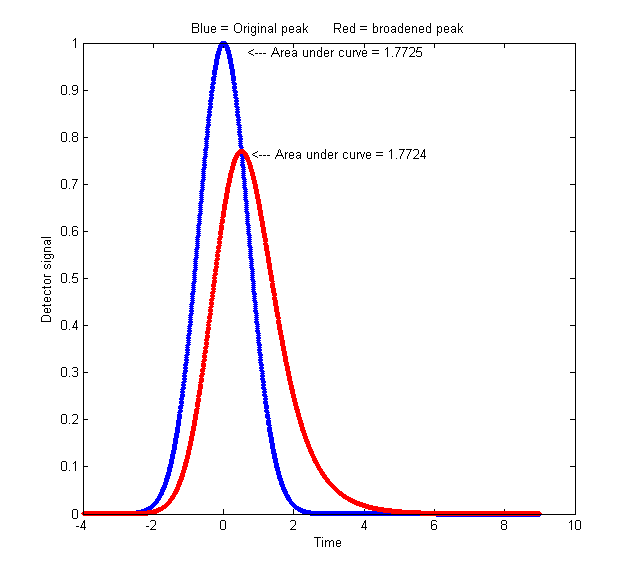
graphical example is shown on the left (Matlab/Octave
code), which plots detector signal vs time, where the blue curve represents the original
signal and the red curve shows
the effect of broadening by dispersion effects. The peak height is
lower and the width is greater, but the area under the
curve is almost exactly the same. If the extent of broadening
changes between the time that the standards are run and the
time that the unknown samples are run, then peak area
measurements will be more accurate and reliable than peak
height measurements. (Peak height will be proportional to the
quantity of material only if the peak width and shape are constant).
Another example with greater broadening: (script and graphic).
the
detector signal as a function of time. The magnitude of the peaks
are calibrated
to the concentration of that component by measuring the peaks
obtained from "standard solutions" of known concentration. In
chromatography it is common to measure the area under the
detector peaks rather than the height of the peaks, because
peak area is less sensitive to the influence of peak broadening
(dispersion) mechanisms that cause the molecules of a specific
substance to be be diluted and spread out rather than being
concentrated on one "plug" of material as it travels down the
column. These dispersion effects, which arise from many sources,
cause chromatographic peaks to become shorter, broader, and in some
cases more unsymmetrical, but they have little effect on the
total area under the peak, as long as the total number of
molecules remains the same. If the detector response is linear with
respect to the concentration of the material, the peak area remains
proportional to the total quantity of substance passing into the
detector, even though the peak height is smaller. A
graphical example is shown on the left (Matlab/Octave
code), which plots detector signal vs time, where the blue curve represents the original
signal and the red curve shows
the effect of broadening by dispersion effects. The peak height is
lower and the width is greater, but the area under the
curve is almost exactly the same. If the extent of broadening
changes between the time that the standards are run and the
time that the unknown samples are run, then peak area
measurements will be more accurate and reliable than peak
height measurements. (Peak height will be proportional to the
quantity of material only if the peak width and shape are constant).
Another example with greater broadening: (script and graphic).(a) plot the signal on a paper chart, cut out the peak with scissors, then weigh the cut out piece on a micro-balance compared to a square section of known area;But now that computing power is built into or connected to every measuring instrument, more accurate and convenient digital methods can be employed. However it is measured, the units of peak area are the product of the x and y units. Thus, in a chromatogram where the x is time in minutes and y is volts, the area is in volts-minute. In absorption spectrum where the x is nm (nanometers) and y is absorbance, the area has the units of absorbance-nm. Because of this, the numerical magnitude of peak area will always be different from that of the peak height. If you are performing a quantitative analysis of unknown samples by means of a calibration curve, you must use the same method of measurement for both the standards and the samples, even if the measurements are inaccurate, as long as the error is the same for all standards and samples (which is why an approximate method like triangle construction works better than expected for quantitative analysis).
(b) count the grid squares under a curve recorded on gridded graph paper,
(c) use a mechanical ball-and-disk integrator,
(d) use geometry to compute the area under a triangle constructed with its sides tangent to the sides of the peak, or
(e) compute the cumulative sum of the signal magnitude and measure the heights of the resulting steps (see figure below).
 The
classical way to handle the overlapping peak problem is to draw
two vertical lines from the left and right bounds of the peak down
to the x-axis and then to measure the total area bounded by the
signal curve, the x-axis (y=0 line), and the two vertical lines,
shown the the shaded area in the figure on the left, below. This
is often called the perpendicular drop method; it's an
easy task for a computer, although tedious to do by hand. The left
and right bounds of the peak are usually taken as the valleys
(minima) between the peaks or as the point half-way between the
peak center and the centers of the peaks to the left and right.
The basic assumption is that the area missed by cutting off the
feet of one peak is made up for by including the feet of the
adjacent peak. This is accurate only of the peaks are symmetrical,
not too overlapped, and equal in height and in width. In addition,
the baseline must be zero; any extraneous background signal must
be subtracted before measurement. Using this method it is possible
to estimate the area of the second peak in the example below to an
accuracy of about 0.3%, but the last two peaks give errors greater
than 4%. As a rough rule, the valley between the peaks must be
quite low, perhaps a quarter or a fifth of the adjacent peak
height, for this method to be acceptable. Even so, this method is
widely used because there is no simple alternative. If
there is no valley between the peaks you need to measure, it's
possible to apply peak
sharpening techniques to narrow the peaks and deepen the
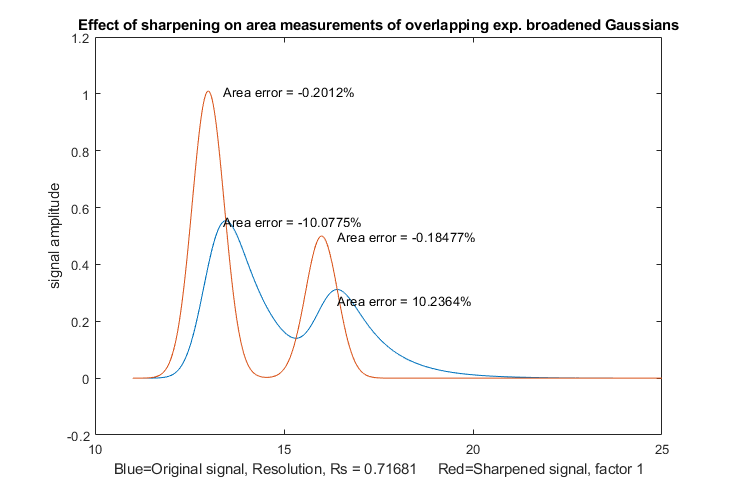
valley before the perpendicular drop measurement; see PeakSharpeningAreaMeasurementDemo.xlsm
(screen image).
Moreover, asymmetrical peaks that are the result of exponential
broadening can be narrowed and symmetricalized
by the weighted addition of its first derivative, making the
perpendicular drop area measurements much more
accurate. In both cases, it may be necessary to set the
strength of sharpening higher than previously recommended, if it
that is the only way to form a valley between peaks whose areas
you want to measure.
The
classical way to handle the overlapping peak problem is to draw
two vertical lines from the left and right bounds of the peak down
to the x-axis and then to measure the total area bounded by the
signal curve, the x-axis (y=0 line), and the two vertical lines,
shown the the shaded area in the figure on the left, below. This
is often called the perpendicular drop method; it's an
easy task for a computer, although tedious to do by hand. The left
and right bounds of the peak are usually taken as the valleys
(minima) between the peaks or as the point half-way between the
peak center and the centers of the peaks to the left and right.
The basic assumption is that the area missed by cutting off the
feet of one peak is made up for by including the feet of the
adjacent peak. This is accurate only of the peaks are symmetrical,
not too overlapped, and equal in height and in width. In addition,
the baseline must be zero; any extraneous background signal must
be subtracted before measurement. Using this method it is possible
to estimate the area of the second peak in the example below to an
accuracy of about 0.3%, but the last two peaks give errors greater
than 4%. As a rough rule, the valley between the peaks must be
quite low, perhaps a quarter or a fifth of the adjacent peak
height, for this method to be acceptable. Even so, this method is
widely used because there is no simple alternative. If
there is no valley between the peaks you need to measure, it's
possible to apply peak
sharpening techniques to narrow the peaks and deepen the
valley before the perpendicular drop measurement; see PeakSharpeningAreaMeasurementDemo.xlsm
(screen image).
Moreover, asymmetrical peaks that are the result of exponential
broadening can be narrowed and symmetricalized
by the weighted addition of its first derivative, making the
perpendicular drop area measurements much more
accurate. In both cases, it may be necessary to set the
strength of sharpening higher than previously recommended, if it
that is the only way to form a valley between peaks whose areas
you want to measure.
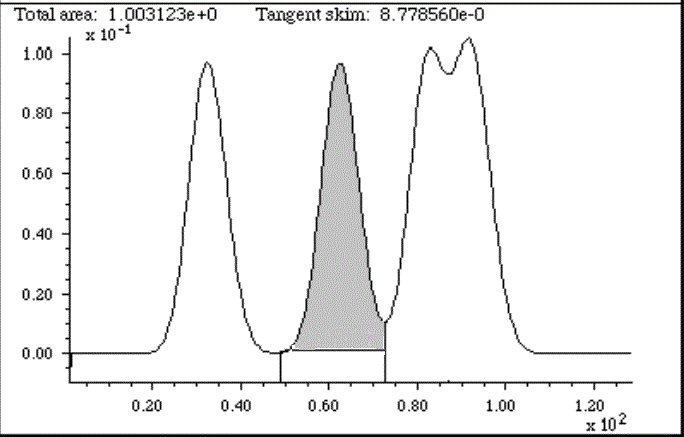
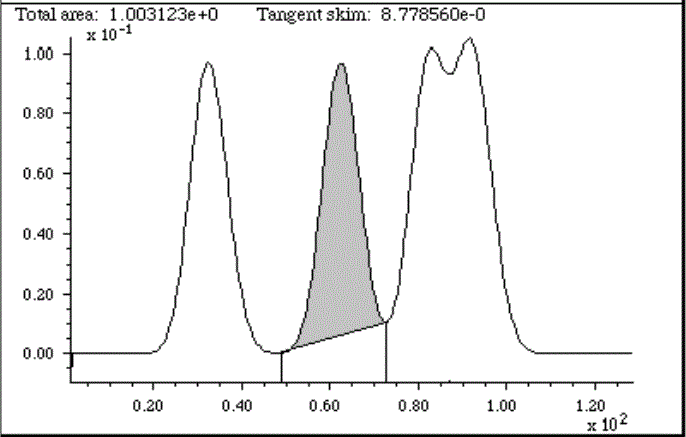
Peak
area measurement for overlapping peaks, using
the perpendicular drop method (left, shaded area)
and
tangent skim method (right, shaded area).
In the case where a single peak is superimposed on a straight or
broadly curved baseline, you might use the tangent skim method,
which measures the area between the curve and a linear baseline
drawn across the bottom of the peak (e.g. the shaded area
in the figure on the right, above). In general, the hardest part
of the problem and the greatest source of uncertainty is
determining the shape of the baseline under the peaks and
determining when each peaks begins and ends. Once those are
determined, you subtract the baseline from each point between the
start and end points, add them up, and multiply by the x-axis
interval. Incidentally, smoothing a noisy signal does not change
the areas under the peaks, but it may make the peak start and stop
points easier to determine. The downside of smoothing is that
increases peak width and the overlap between adjacent peaks.
Numerical methods of peak sharpening, for example derivative sharpening and
Fourier deconvolution, can help
with the problem of peak overlap, and both of these techniques
have the useful property that they do not change the total area
under the peaks.
If the shape of peaks is known, the most general way to
measure the areas of overlapping peaks is to use some type of
least-squares curve fitting, as is discussed in the three
following sections (A, B, C).
If the peak positions, widths, and amplitudes are unknown,
and only the fundamental peak shapes are known, then the iterative least-squares method can
be employed. In many cases, even the background can be accounted
for by curve fitting.
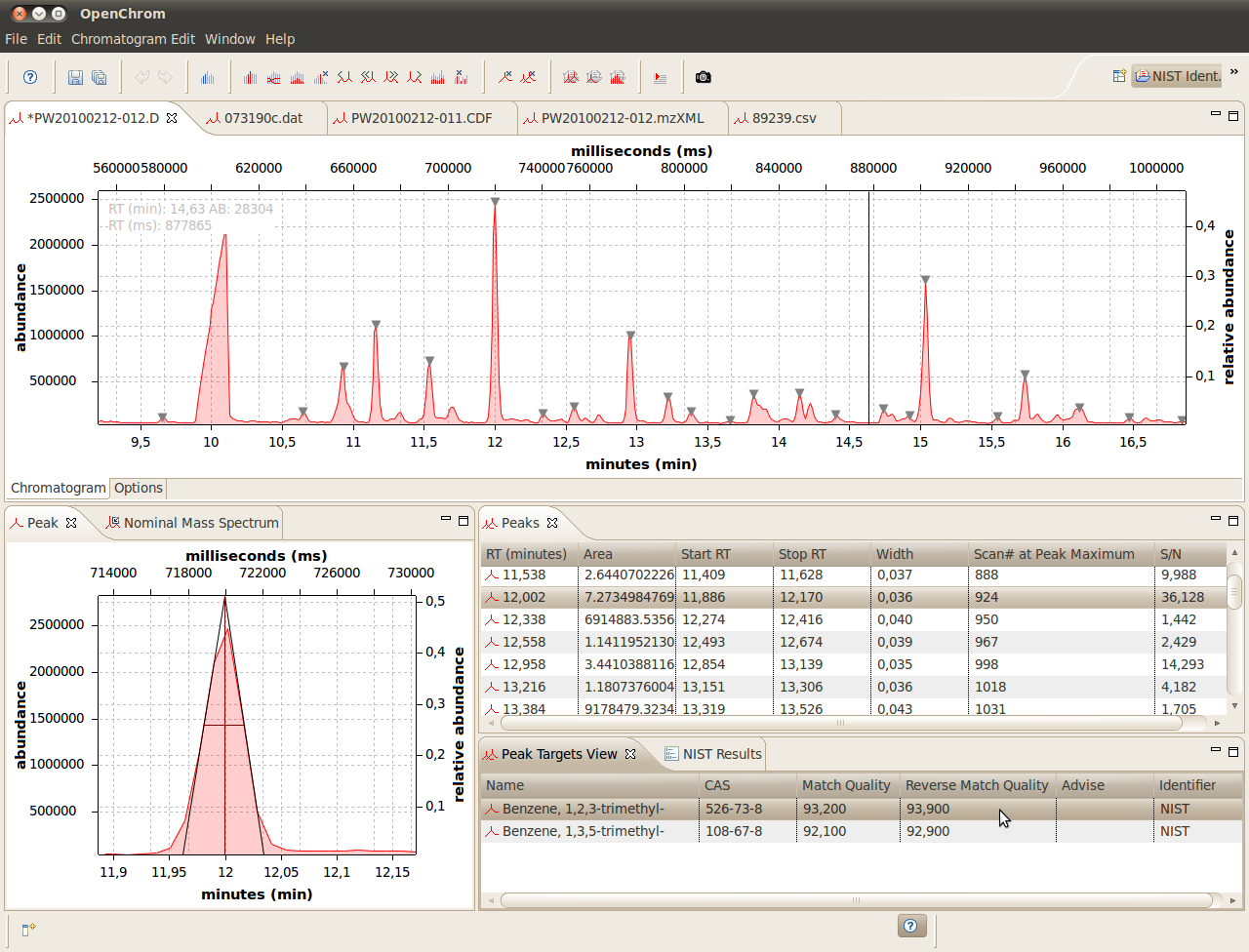 For
gas chromatography and mass spectrometry specifically, Philip
Wenig's OpenChrom is an open source
data system that can import binary and textual chromatographic
data files directly. It includes methods to detect baselines and
to measure peak areas in a chromatogram. Extensive documentation
is available. It is available for Windows, Linux, Solaris and
Mac OS X. A screen shot is shown on the left (click to
enlarge). The program and its documentation is regularly updated
by the author.
For
gas chromatography and mass spectrometry specifically, Philip
Wenig's OpenChrom is an open source
data system that can import binary and textual chromatographic
data files directly. It includes methods to detect baselines and
to measure peak areas in a chromatogram. Extensive documentation
is available. It is available for Windows, Linux, Solaris and
Mac OS X. A screen shot is shown on the left (click to
enlarge). The program and its documentation is regularly updated
by the author.
Another freely-available open-source program for mass
spectroscopy is "Skyline"
from MacCoss Lab Software,
which is specifically aimed at reaction monitoring. Tutorials and
videos are available.
 The symmetrization of exponentially broadened peaks by the
weighted addition of the first derivative is performed by the
template PeakSymmetrizationTemplate.xlsm
(graphic); PeakSymmetrizationExample.xlsm
is an example application with sample data already typed in. The
procedure here is first to adjust k1 to get the most symmetrical
peak shapes (judged by equal but opposite slopes on the leading and
trailing edges), then enter the start time, valley time, and end
time from the graph for the pair of peaks you want to measure into
cells B4, B5, and B6, and finally (optionally) adjust the second
derivative sharpening factor k2. The perpendicular drop areas of
those two peaks are reported in the table in columns F and G. These
spreadsheets have Active-X clickable buttons to adjust the first
derivative weighting factor (k1) in cell J4 and the second
derivative sharpening factor k2 (cell J5). There is also a demo
version that allows you to determine the accuracy of perpendicular
drop peak areas under different conditions by internally generating
overlapping peaks of known peak areas, with specified asymmetry
(B6), relative peak height (B3), width (B4), and noise (B5): PeakSymmetrizationDemo.xlsm
(graphic).
For peaks that have a more complex broadening behavior, the template
PeakDoubleSymmetrizationExample.xlsm
allows symmetrization of double exponential broadening (graphic).
The symmetrization of exponentially broadened peaks by the
weighted addition of the first derivative is performed by the
template PeakSymmetrizationTemplate.xlsm
(graphic); PeakSymmetrizationExample.xlsm
is an example application with sample data already typed in. The
procedure here is first to adjust k1 to get the most symmetrical
peak shapes (judged by equal but opposite slopes on the leading and
trailing edges), then enter the start time, valley time, and end
time from the graph for the pair of peaks you want to measure into
cells B4, B5, and B6, and finally (optionally) adjust the second
derivative sharpening factor k2. The perpendicular drop areas of
those two peaks are reported in the table in columns F and G. These
spreadsheets have Active-X clickable buttons to adjust the first
derivative weighting factor (k1) in cell J4 and the second
derivative sharpening factor k2 (cell J5). There is also a demo
version that allows you to determine the accuracy of perpendicular
drop peak areas under different conditions by internally generating
overlapping peaks of known peak areas, with specified asymmetry
(B6), relative peak height (B3), width (B4), and noise (B5): PeakSymmetrizationDemo.xlsm
(graphic).
For peaks that have a more complex broadening behavior, the template
PeakDoubleSymmetrizationExample.xlsm
allows symmetrization of double exponential broadening (graphic).These lines accurately compute the area
under the curve of x,y (in this case an isolated Gaussian,
whose area is theoretically known to be the square
root of pi, sqrt(pi), which is 1.7725. If the interval between x
values, dx, is constant, then the area is
simply yi=sum(y).*dx. Alternatively,
the signal can be integrated using yi=cumsum(y).*dx, then the
area of the peak will be equal to the height of the
resulting step, max(yi)-min(yi)=1.7725.
 The area of a peak is proportional
to the product of its height and its width, but the
proportionality constant depends on the peak shape. A pure
Gaussian peak with a peak height h
and full-width
at half-maximum w has
a
total area of 1.064467*h*w.
A Gaussian-Lorentzian blend with p percent Gaussian
character has an area of ((100- p)/100)*((pi/2).*w*h) + (p /100)*(1.064467*w*h). A pure Lorentzian
peak has a total area of (pi/2)*h*w. The
graphic LorentzianVsGaussian.png
compares Gaussian and Lorentzian
peaks of the same height and width. The Lorentzian has
more area in the outer wings, so if you measure the area of an
unknown peak using trapz, you have to measure over a very wide
range on both sides of the peak. To get an area within 1%, you
need to expand that to 64 times the FWHM! (See LorentzianAreaProblem.m,
graphic). Many real signals in
practice have too many peaks that are too close together to
allow the theoretical areas to be measured directly by
integration. If you really need an accurate area and the
available measurement span is insufficient, it may be more
accurate to calculate the area analytically using the above
analytical expressions.
The area of a peak is proportional
to the product of its height and its width, but the
proportionality constant depends on the peak shape. A pure
Gaussian peak with a peak height h
and full-width
at half-maximum w has
a
total area of 1.064467*h*w.
A Gaussian-Lorentzian blend with p percent Gaussian
character has an area of ((100- p)/100)*((pi/2).*w*h) + (p /100)*(1.064467*w*h). A pure Lorentzian
peak has a total area of (pi/2)*h*w. The
graphic LorentzianVsGaussian.png
compares Gaussian and Lorentzian
peaks of the same height and width. The Lorentzian has
more area in the outer wings, so if you measure the area of an
unknown peak using trapz, you have to measure over a very wide
range on both sides of the peak. To get an area within 1%, you
need to expand that to 64 times the FWHM! (See LorentzianAreaProblem.m,
graphic). Many real signals in
practice have too many peaks that are too close together to
allow the theoretical areas to be measured directly by
integration. If you really need an accurate area and the
available measurement span is insufficient, it may be more
accurate to calculate the area analytically using the above
analytical expressions. (a) their shapes might not be known;These must be taken into account to measure accurate areas in experimental signals. Various Matlab/Octave functions have been developed to deal with these complications.
(b) they may be superimposed on a baseline; and
(c) they may be overlapped with other peaks.
Overlapping peaks. The following Matlab/Octave code uses the perpendicular drop (PD) method to measure the areas of two overlapping symmetrical peaks in the data vectors x,y by the perpendicular drop method. Variables "m1" and "m2" are the estimated positions of the two peaks. The "val2ind" function returns the index number of the value in a vector that value matches the specified value.
The third
line finds the half-way point between the two peaks. The last
two lines use the trapz function to measure the areas before and
after the valley point.
index1=val2ind(x,m1);
index2=val2ind(x,m2);
valleyindex=val2ind(x,(m1+m2)/2),
PDMeasArea1=trapz(x(1:valleyindex),y(1:valleyindex));
PDMeasArea2=trapz(x(valleyindex:length(x)),y(valleyindex:length(x));
Alternatively,
you could replace "valleyindex" with valleyy=min(y(index1:index2));
valleyindex=val2ind(y,valleyy);
which uses the minimum
between the peaks rather than the half-way point. But the
half-way point method has the advantage that the SNR at a
signal maximum is usually better than at a minimum,
so it's likely that maxima are more precisely located that
minima. Moreover, the half-way
point method works even when the overlap is so great
that there is not a discernible minimum between the peaks. My
function PerpDropAreas.m
uses the half-way point method to measure the areas of any
number of overlapping peaks, given a list of their peak maxima
positions. These methods work best if the peak widths are not very
different.
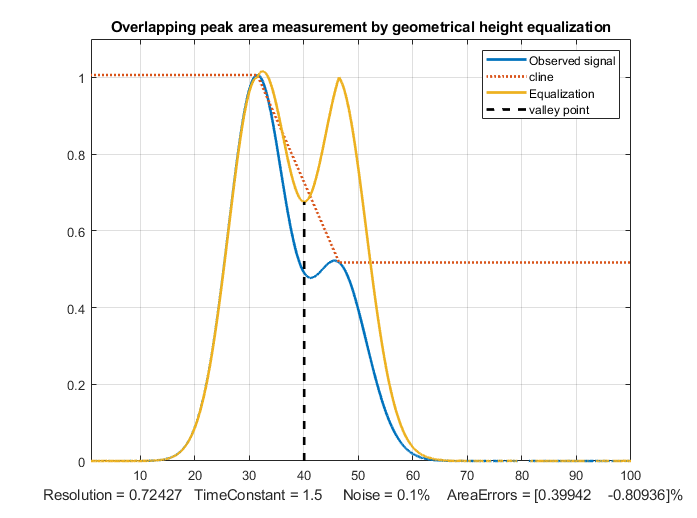 Although the perpendicular drop method remains
popular, there are other geometrical methods that can work
better in many cases. The "equalization" method, illustrated in
the figure on the left, uses another method of locating the
perpendicular drop point. A line of three straight-line segments
is
constructed that
touches the estimated maxima of the two peaks,
shown by the dotted red line called the
"cline" in the figure on the left. The quotient
of the original signal, in blue, divided by this line, results
in a temporarily normalized signal (the yellow line) that has
more nearly equal peak heights. The
effect of this treatment is to deepen the valley between
the peaks, so
that it remains distinct for lower values of
the second peak height. This
is used only for the purpose of determining its
minimum, shown as a vertical black line, and then is
discarded. Using that minimum as the
separation point between the peaks, the perpendicular
drop areas are then calculated on the
original observed signal (blue line).
Note that this new valley point is not quite the same as the
valley of the original signal, nor is it the half-way point
between the two peak positions. The process need not be done
by hand; it is easily automated, given only an initial
estimate for the two peak positions based on the observed
signal. The Matlab/Octave function EqualPerpDrop.m performs the
calculation; the script EqualPerpDropTest.m
demonstrates the use of the function applied to the
measurement of two simulated overlapping EMG (exponentially
modified Gaussian) peaks.
Although the perpendicular drop method remains
popular, there are other geometrical methods that can work
better in many cases. The "equalization" method, illustrated in
the figure on the left, uses another method of locating the
perpendicular drop point. A line of three straight-line segments
is
constructed that
touches the estimated maxima of the two peaks,
shown by the dotted red line called the
"cline" in the figure on the left. The quotient
of the original signal, in blue, divided by this line, results
in a temporarily normalized signal (the yellow line) that has
more nearly equal peak heights. The
effect of this treatment is to deepen the valley between
the peaks, so
that it remains distinct for lower values of
the second peak height. This
is used only for the purpose of determining its
minimum, shown as a vertical black line, and then is
discarded. Using that minimum as the
separation point between the peaks, the perpendicular
drop areas are then calculated on the
original observed signal (blue line).
Note that this new valley point is not quite the same as the
valley of the original signal, nor is it the half-way point
between the two peak positions. The process need not be done
by hand; it is easily automated, given only an initial
estimate for the two peak positions based on the observed
signal. The Matlab/Octave function EqualPerpDrop.m performs the
calculation; the script EqualPerpDropTest.m
demonstrates the use of the function applied to the
measurement of two simulated overlapping EMG (exponentially
modified Gaussian) peaks. The
"reflection/subtraction" method, shown on the right, is simpler.
As before, the original signal is shown in blue. An estimate of the
isolated first (larger) peak is constructed by reflecting its
left half and using it to replace the right half, resulting in
the red dotted line in the figure, assuming that the first peak
is symmetrical. Then that peak is simply subtracted from the
entire signal to reveal the isolated second peak (dotted yellow
line). The two areas are then separately calculated by the
"trapz" function. This process is also easily automated, given
only the peak position of the first peak. It works perfectly
only if the first peak is the larger of the two peak and is
symmetrical and if
the peak separation is sufficient so that the left-hand tail
of the smaller peak does not significantly increase the
height of the first peak.
The
"reflection/subtraction" method, shown on the right, is simpler.
As before, the original signal is shown in blue. An estimate of the
isolated first (larger) peak is constructed by reflecting its
left half and using it to replace the right half, resulting in
the red dotted line in the figure, assuming that the first peak
is symmetrical. Then that peak is simply subtracted from the
entire signal to reveal the isolated second peak (dotted yellow
line). The two areas are then separately calculated by the
"trapz" function. This process is also easily automated, given
only the peak position of the first peak. It works perfectly
only if the first peak is the larger of the two peak and is
symmetrical and if
the peak separation is sufficient so that the left-hand tail
of the smaller peak does not significantly increase the
height of the first peak. Peak 1 Peak 2 Perpendicular drop, valley point: -6.44% 12.89%
Perpendicular drop, half-way point: 3.91% -7.83%
Equalization method: 1.27% -2.54%
Subtraction method: -2.12% 4.25%
You can change the parameters in lines 5 through 10 to test with other peak separations and relative peak heights. The equalization method is often, but not always, the most accurate method. (Note: the script requires the downloadable functions val2ind.m, halfwidth.m, ExpBroaden.m, and plotit.m functions be in the path).
 A more through investigation
of these methods demonstrates the effect of changing the
peak resolution, shown on the left (script,
graphic)
and of changing the the height of the smaller peak, shown on
the right (script,
graphic).
These scripts include the effect of random noise in
the signal, because noise can influence the location of peak
maxima and the separation point between the peaks, whether
they are determined manually or by a computer algorithm (as
it is here);
the
random noise is set by the variable
"noise", which is the fractional
random white noise added to the
signal. Also,
these scripts include the effect of
asymmetry of the peak shapes, which
can cause errors in area measurement by all
these methods. After all, the very reason
for measuring peak area rather than peak
heights is to reduce
the effect of uncontrolled variations in
peak broadening.
The asymmetry is set by the variable "TimeConstant",
which is the time constant of the exponential
convolution applied to the signal that reduces the
height and stretches out the right-hand half. Both
of those are zero in the above figures for
simplicity and to show the best possible accuracy.
For example, with a resolution of 1.0, a tau of 2,
and noise set to 0.01 (1%),
the valley perpendicular drop and the equalization method
outperform the other methods (graphic).
A more through investigation
of these methods demonstrates the effect of changing the
peak resolution, shown on the left (script,
graphic)
and of changing the the height of the smaller peak, shown on
the right (script,
graphic).
These scripts include the effect of random noise in
the signal, because noise can influence the location of peak
maxima and the separation point between the peaks, whether
they are determined manually or by a computer algorithm (as
it is here);
the
random noise is set by the variable
"noise", which is the fractional
random white noise added to the
signal. Also,
these scripts include the effect of
asymmetry of the peak shapes, which
can cause errors in area measurement by all
these methods. After all, the very reason
for measuring peak area rather than peak
heights is to reduce
the effect of uncontrolled variations in
peak broadening.
The asymmetry is set by the variable "TimeConstant",
which is the time constant of the exponential
convolution applied to the signal that reduces the
height and stretches out the right-hand half. Both
of those are zero in the above figures for
simplicity and to show the best possible accuracy.
For example, with a resolution of 1.0, a tau of 2,
and noise set to 0.01 (1%),
the valley perpendicular drop and the equalization method
outperform the other methods (graphic). 
 ignal,
using the derivative zero-crossing method described previously,
and measures their areas using the perpendicular drop and
tangent skim methods. It shares the first 6 input arguments with
findpeaksSG.
The syntax is M=measurepeaks(x,y, SlopeThreshold,
AmpThreshold, SmoothWidth, FitWidth, plots). It returns a
table containing the peak
number, peak
ignal,
using the derivative zero-crossing method described previously,
and measures their areas using the perpendicular drop and
tangent skim methods. It shares the first 6 input arguments with
findpeaksSG.
The syntax is M=measurepeaks(x,y, SlopeThreshold,
AmpThreshold, SmoothWidth, FitWidth, plots). It returns a
table containing the peak
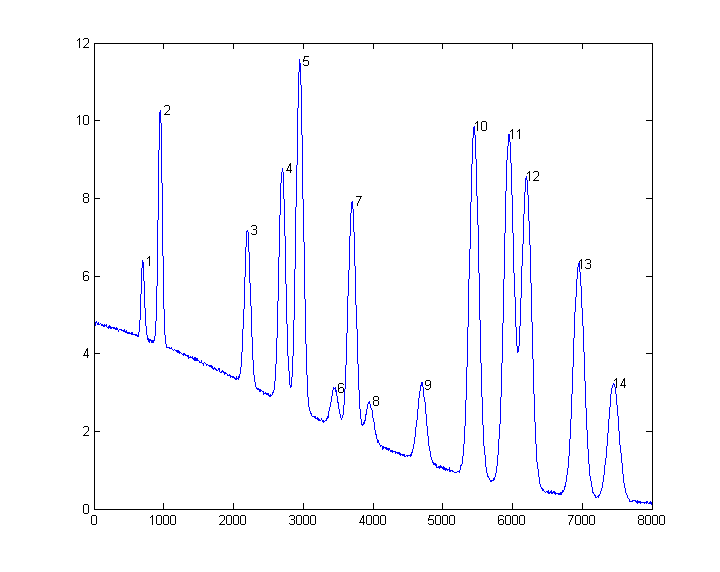
number, peak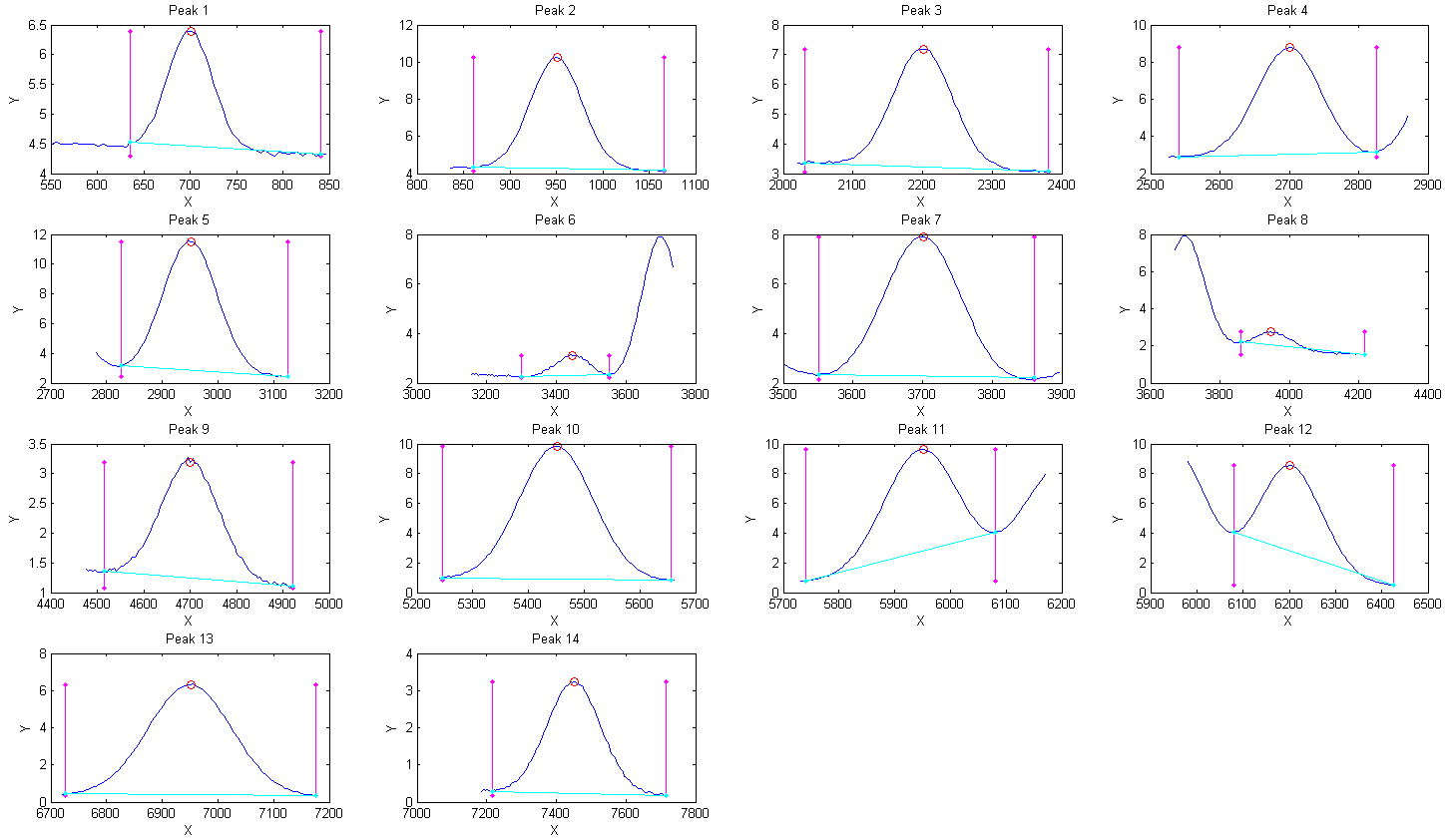 position, absolute peak
height, peak-valley difference,
perpendicular drop area, and the tangent skim area of
each peak it detects. If
the last input argument ('plots') is set to 1, it plots the signal
with numbered peaks (shown
on the left)
and also plots the individual peaks (in
blue) with the maximum (red circles), valley points (magenta),
and tangent lines (cyan) marked as shown
on the right. Type "help measurepeaks" and try the
seven examples there, or run HeightAndArea.m
to test the accuracy of peak
height and area measurement with signals that have
multiple peaks with noise, background, and some peak overlap.
Generally, the values for
absolute
peak height and perpendicular
drop area are best for peaks that have no background, even
if they are slightly overlapped, whereas the values for peak-valley
difference and for tangential
skim area are better for isolated peaks on a straight or
slightly curved background. Note: this function uses smoothing (specified by the
SmoothWidth input argument) only for peak detection;
it performs measurements on the raw unsmoothed y
data. If the raw data are noisy, it may be beneficial to
smooth the y data yourself before calling measurepeaks.m,
using any smooth function of your choice.
SharpenedOverlapDemo.m is a
script that automatically determines the optimum degree of
even-derivative sharpening that minimizes
position, absolute peak
height, peak-valley difference,
perpendicular drop area, and the tangent skim area of
each peak it detects. If
the last input argument ('plots') is set to 1, it plots the signal
with numbered peaks (shown
on the left)
and also plots the individual peaks (in
blue) with the maximum (red circles), valley points (magenta),
and tangent lines (cyan) marked as shown
on the right. Type "help measurepeaks" and try the
seven examples there, or run HeightAndArea.m
to test the accuracy of peak
height and area measurement with signals that have
multiple peaks with noise, background, and some peak overlap.
Generally, the values for
absolute
peak height and perpendicular
drop area are best for peaks that have no background, even
if they are slightly overlapped, whereas the values for peak-valley
difference and for tangential
skim area are better for isolated peaks on a straight or
slightly curved background. Note: this function uses smoothing (specified by the
SmoothWidth input argument) only for peak detection;
it performs measurements on the raw unsmoothed y
data. If the raw data are noisy, it may be beneficial to
smooth the y data yourself before calling measurepeaks.m,
using any smooth function of your choice.
SharpenedOverlapDemo.m is a
script that automatically determines the optimum degree of
even-derivative sharpening that minimizes 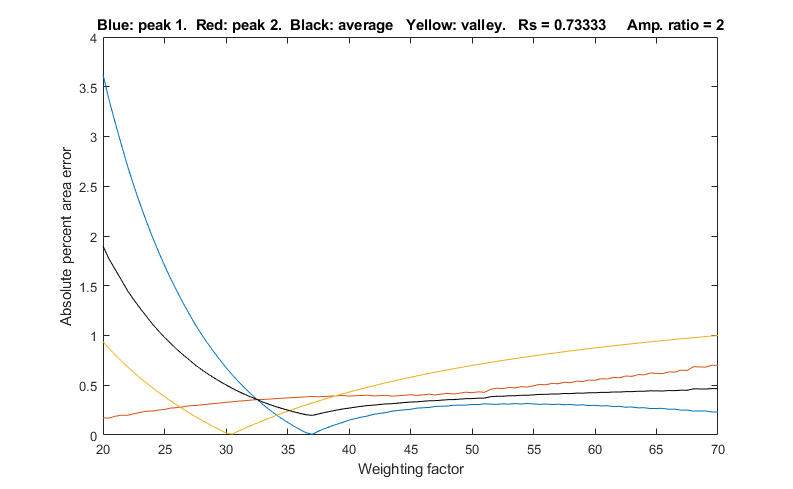 the errors of
measuring peak areas of two
overlapping Gaussians by the perpendicular drop
method using the autopeaks.m function.
It does this by applying different degrees of sharpening and
plotting the area errors (percent difference between the true and
measured errors) vs the sharpening factor, as shown on the right.
It also shows the height of the valley between the peaks (yellow
line). This demonstrates that (1) the optimum sharpening factor
depends upon the width and separation of the two peaks and on
their height ratio, (2) that the degree of sharpening is not
overly critical, often exhibiting a broad optimum region, (3) that
the optimum for the two peaks is not necessarily exactly the same,
and (4) that the optimum for area measurement usually does not
occur at the point where the valley is zero. (To run this script
you must have gaussian.m, derivxy.m, autopeaks.m,
val2ind.m, and halfwidth.m
in the path. Download these from https://terpconnect.umd.edu/~toh/spectrum/).
the errors of
measuring peak areas of two
overlapping Gaussians by the perpendicular drop
method using the autopeaks.m function.
It does this by applying different degrees of sharpening and
plotting the area errors (percent difference between the true and
measured errors) vs the sharpening factor, as shown on the right.
It also shows the height of the valley between the peaks (yellow
line). This demonstrates that (1) the optimum sharpening factor
depends upon the width and separation of the two peaks and on
their height ratio, (2) that the degree of sharpening is not
overly critical, often exhibiting a broad optimum region, (3) that
the optimum for the two peaks is not necessarily exactly the same,
and (4) that the optimum for area measurement usually does not
occur at the point where the valley is zero. (To run this script
you must have gaussian.m, derivxy.m, autopeaks.m,
val2ind.m, and halfwidth.m
in the path. Download these from https://terpconnect.umd.edu/~toh/spectrum/).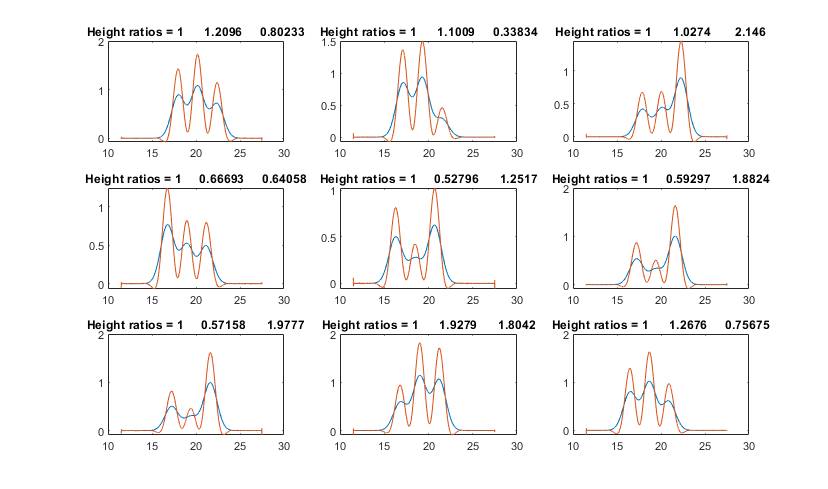 . A straight line is fit to the
calibration curve and the R2 is calculated, in order to demonstrate
(1) the linearity of the response, and (2) in independence of the
overlapping adjacent peaks. You can easily change:
. A straight line is fit to the
calibration curve and the R2 is calculated, in order to demonstrate
(1) the linearity of the response, and (2) in independence of the
overlapping adjacent peaks. You can easily change: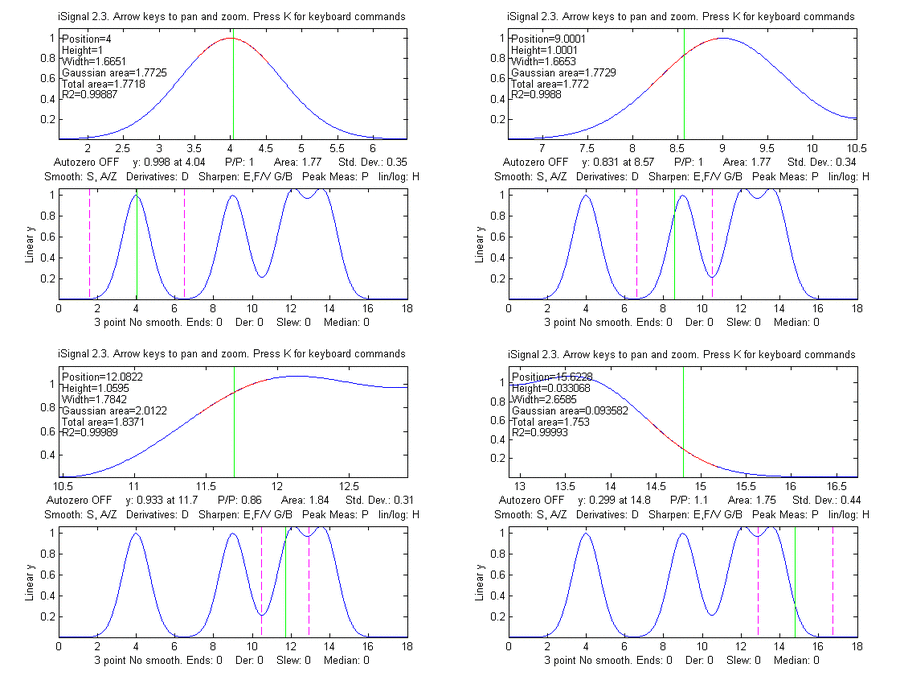 values. (But this method does perform better than findpeaksG.m when
the peaks are noticeably asymmetric; see triangulationdemo for some examples). In contrast, measurepeaks.m makes no assumptions
about the shape of the peak.; it simply looks for the minima on
both sides of each peak to use as the dividing point between
peaks.
values. (But this method does perform better than findpeaksG.m when
the peaks are noticeably asymmetric; see triangulationdemo for some examples). In contrast, measurepeaks.m makes no assumptions
about the shape of the peak.; it simply looks for the minima on
both sides of each peak to use as the dividing point between
peaks.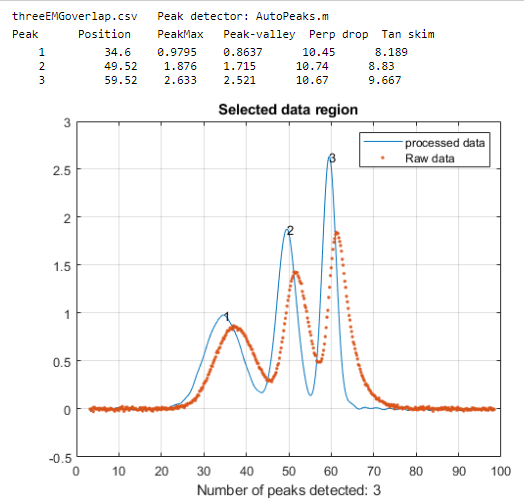 Peak area measurements by multiple
methods is a part of the Live Script Peak detection tool PeakDetection.mlx
described here
and illustrated on the left. This interactive tool allows optional
first-derivative
symmetrization of skewed peaks, as well as symmetrical
sharpening by Fourier
self-deconvolution, to enhance the resolution of overlapping
peaks and improve the accuracy of peak are measurement.
Peak area measurements by multiple
methods is a part of the Live Script Peak detection tool PeakDetection.mlx
described here
and illustrated on the left. This interactive tool allows optional
first-derivative
symmetrization of skewed peaks, as well as symmetrical
sharpening by Fourier
self-deconvolution, to enhance the resolution of overlapping
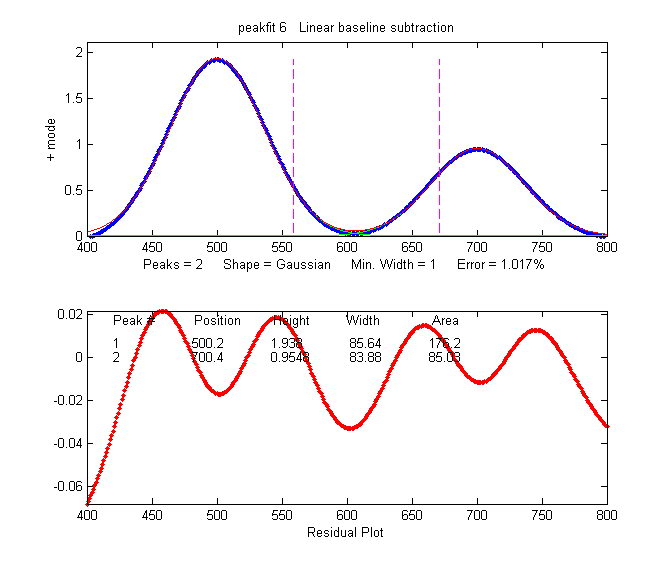
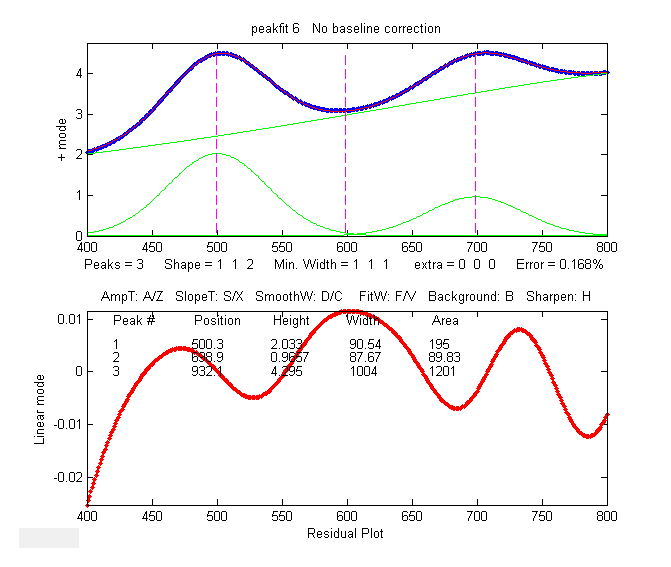
peaks and improve the accuracy of peak are measurement. 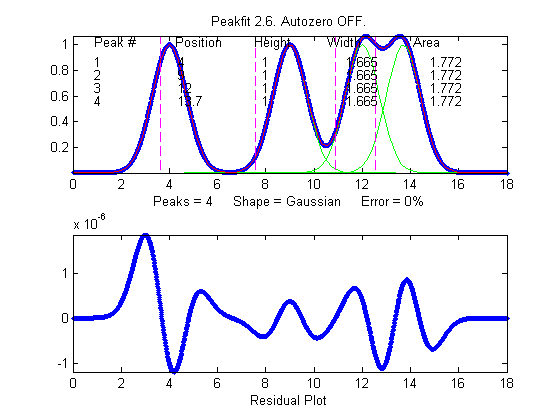 Correction
for background/baseline. The
presence of a baseline or background signal, on which the peaks are
superimposed, will greatly influence the measured peak area if not
corrected or compensated. iSignal,
iPeak, measurepeaks, and peakfit all have
several different baseline correction modes, for flat, linear, and
quadratic baselines, and iSignal
and iPeak have a
multipoint piece-wise linear baseline subtraction function allows
the manually estimated background to be subtracted from the entire
signal. See iSignal.html#background_subtraction,
ipeakdemo1 on PeakFindingandMeasurement.htm#demos,
and CurveFittingC.html#Background_correction
for examples of these background correction functions. If the
baseline is actually caused by the edges of a strong overlapping
adjacent peak, then it's possible to include that peak in the
curve-fitting operation, as see in Example 22 on InteractivePeakFitter.htm.
Correction
for background/baseline. The
presence of a baseline or background signal, on which the peaks are
superimposed, will greatly influence the measured peak area if not
corrected or compensated. iSignal,
iPeak, measurepeaks, and peakfit all have
several different baseline correction modes, for flat, linear, and
quadratic baselines, and iSignal
and iPeak have a
multipoint piece-wise linear baseline subtraction function allows
the manually estimated background to be subtracted from the entire
signal. See iSignal.html#background_subtraction,
ipeakdemo1 on PeakFindingandMeasurement.htm#demos,
and CurveFittingC.html#Background_correction
for examples of these background correction functions. If the
baseline is actually caused by the edges of a strong overlapping
adjacent peak, then it's possible to include that peak in the
curve-fitting operation, as see in Example 22 on InteractivePeakFitter.htm. 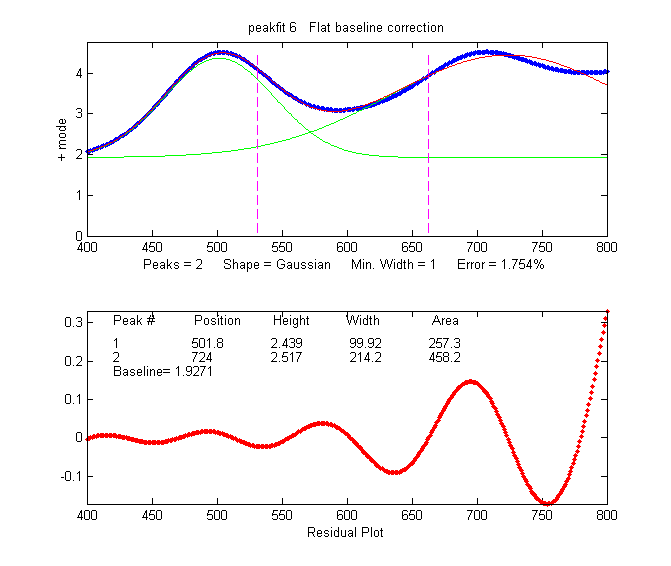
 Asymmetrical
peaks and peak broadening: perpendicular drop vs curve fitting.
Asymmetrical
peaks and peak broadening: perpendicular drop vs curve fitting.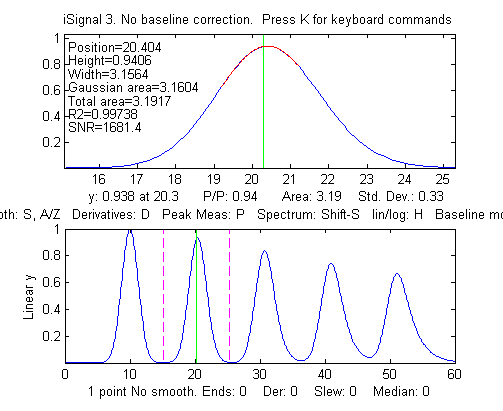
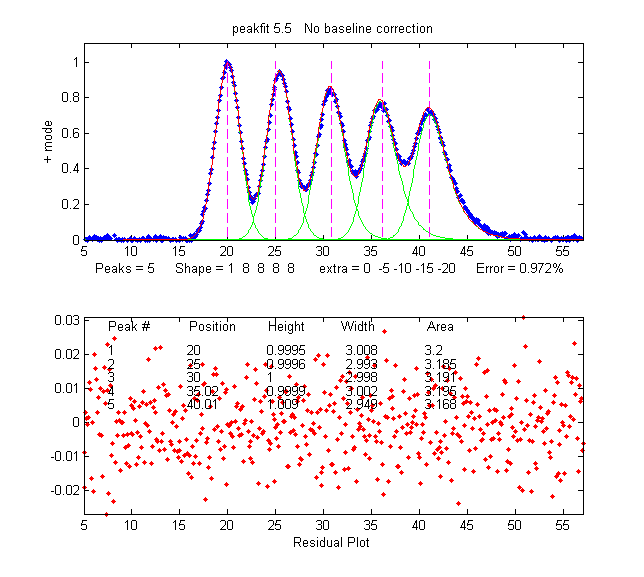
Peak Position PeakMax Peak-val. Perp drop Tan skimUsing iSignal and the manual peak-by-peak perpendicular drop method yields areas of 3.193, 3.194, 3.187, 3.178, and 3.231, a mean of 3.1966 (pretty close to the theoretical value of 3.1938) and standard deviation of only 0.02 (0.63%). Alternatively, integrating the signal, cumsum(y).*dx), where dx is the difference between adjacent x-axis values (0.1 in this case), and then measuring the heights of the resulting steps, gives similar results: 3.19, 3.19, 3.18, 3.17, 3.23. By either method, the peak heights are very different but the areas are closer together, yet not exactly equal.
1 10 1 .99047 3.1871 3.1123
2 20.4 .94018 .92897 3.1839 3.0905
3 30.709 .83756 .81805 3.1597 2.9794
4 40.93 .74379 .70762 3.1188 2.7634
5 51.095 .66748 .61043 3.0835 2.5151
 First-derivative symmetrization.
Although curve fitting is generally the most powerful method for
dealing with the combined effects of overlapping asymmetrical peaks
superimposed on an irrelevant background, the simpler technique of first derivative
sharpening can be useful as a method to reduce or eliminate
the effects of exponential broadening, resulting in a simpler shape
that is easier to fit. This is a simple techniques that calculates
the weighted sum of the original signal and its first derivative.
You just vary different first derivative weighting factor and choose
the one that makes the baseline after the peaks as low as possible
without going negative. As is the case with curve fitting, it's most
convenient is there is also isolated peak with the same exponential
broadening, because that peak can be used to determine more easily
the best value of the first derivative weighting factor.
First-derivative symmetrization.
Although curve fitting is generally the most powerful method for
dealing with the combined effects of overlapping asymmetrical peaks
superimposed on an irrelevant background, the simpler technique of first derivative
sharpening can be useful as a method to reduce or eliminate
the effects of exponential broadening, resulting in a simpler shape
that is easier to fit. This is a simple techniques that calculates
the weighted sum of the original signal and its first derivative.
You just vary different first derivative weighting factor and choose
the one that makes the baseline after the peaks as low as possible
without going negative. As is the case with curve fitting, it's most
convenient is there is also isolated peak with the same exponential
broadening, because that peak can be used to determine more easily
the best value of the first derivative weighting factor.


