|
Program Note
After years of being held together by duct tape and bailing wire it has come to the point where I can't get the Radio Userland weblog engine to update Atomized jr at all anymore, not even with persuasion. It doesn't start up right, doesn't shut down right, doesn't "publish" anything while its running. Radio Userland software ceased business years ago and there's no one left now to ask questions of -- which helped me keep it running previously. Barring a miracle I think it may be time to put it out to pasture.
While I mull over my options, WordPress (I'm thinking), Typepad etc., I would direct visitors to my related back-up weblog, really a hand coded weblog-like thing, I call: where future updates and posts will appear. Hey, there's one there already! Another in a day or so. Then my annual Christmas pixel pict. a day or so after that.
Thanks much
Paul
Friday 20 December 2013

|
Monday, September 30, 2013
|
|
| |
Boston Globe Forward
As a corollary to the previous piece on The Washington Post I wanted to write a short post on the paper I grew up with -- the Boston Globe. I wanted to write something about the first headline I can remember reading. It was first time I can recall reading the front page at all (although I might have the year before when the Red Sox won the Pennant). Regardless it was first time I did not auto default first to the comics which I knew could be found by laying the paper face down on the floor and opening up the very last page.
This is headline I remember; from the Fall of 1968 only days before the election that year.
Morning news November 1 1968 
At the time it brought me up sharp. I stopped and thought about the world I was living in, somewhat bewildered. I was an inattentive youth, for sure, this made that clear. I suppose I didn't believe it was my job at the time to care or worry about adults. Their world was a labyrinth, an impenetrable mystery. The quality of the resolution I made at the time was simply to mark it, and pay more attention from then on until things like this could be comprehended. Or at least classified. I knew vaguely of a Vietnam difficulty but this was a war and I was confused. War was a specific thing, it meant World War Two, a thing or things past. Now there were others, going on now. In places I knew nothing about.
It is a common and dangerous belief that the moment one is living through is uncommonly dire and troubled. That in these times there are barricades to be manned and fronts to be marched to, calling for extraordinary measures and sacrifices. Mostly it is merely the unfortunate ordinary churn of the ambitious. In any regard from that day forward I read the front page of the Globe every day, and later any paper in whose city I found myself.
8:15:25 AM  ;; ;;
|
|
|
|
|
Friday, August 16, 2013
|
|
| |
Washinton Post Modern
The Washington Post is being bought by an internet billionaire This Week in Review Why Bezos is buying the Washington Post, and what's next for it Nieman Journalism Lab. The billionaire in particular is Jeffery Bezos of Amazon, Bezos the disruptor, here buying into the old media. Almost like buying a small bookstore in a sleepy seacoast town -- and putting an Amazon.com logo over the lintel.
Amazon was a first generation internet company. Explicitly it moved across the land as brick and paper displacer. First bookstores then books themselves as e-readers came into their own. The internet, a network of screens, was a new distribution medium. One combining many of the best features of telephony television, and libraries and few of the worst. There was a great deal of low hanging fruit in those days, a great deal of money, fortunes to be made by those fortunate enough to be in the right place at the right time. I admit I placed Jeff Bezos along with Steve Case and many others too numerous to list into that category.
It's also not really possible to to assess the personality of Bezos as a measure of his new stewardship of the Washington Post. His other side projects The Odd Philosophy Behind Jeff Bezos's Weird Investments - Robinson Meyer - The Atlantic the space missions and fantastic clocks show the fascinations of youth and wealth that has outstripped adult imagination.
I was also struck by the sheer volume of advice that came with the commentary, on the sale. More advice I imagine than billionaires are used to getting Jeff Bezos Should Run the Washington Post Like Amazon New Republic, Five things Jeff Bezos should do to reinvent the sinking ship that is the Washington Post - Tech News and Analysis mark a small portion of it, even former staff jumped in Mr. Bezos Goes to Washington (DC) | Politics & Prose Bookstore. That first article is by former FCC head Julius Genachowski. Briefly after this story broke some were saying this would increase the likelihood that Bloomberg will buy NY Times, or that the Koch brothers the LA Times. This remains to be seen.
Internet is many things. A sliding of the world into a new interactive communication medium. All of them making money in different ways. All too disparate to be regarded as a single comprehensible thing. An online bookstore is not online newspaper. Its not that simple. However well-run your information management and catalog system, your point-of-sale money and exchange system. It is not simply a content-management-system with a feeding system of reporters/editors shoveling words into the boilers all day long. Newspapers are the publishing industry in miniature. Yoked mostly to the special purpose of the new if not the novel. Any newspaper placed online will begin to adopt the behavior of an online aggregator. The pressure of ongoing events leads to collection and commentary even as resources engage with the occurrence.
Reminiscing the Paleolithic
The Washington Post was (and is) a "big" deal with genuine history Washington Post-Wikipedia A newspaper started in 1877 headed by privately then grudgingly publicly by a single family, the Grahams, in both matriarchal and patriarchal modes for eighty years. A major story broken that shook and shaped the entire nation; the Watergate scandal. A legendary editor, Ben Bradlee, who was as "big" as editors in the business ever were. Further as if that weren't enough going back into the dawn of the last century, they had their own theme song/march (I guess that's what they called walk-on-music back then) written by none less than John Paul Sousa.
Along the way the Post checked its rival, the Washington Star, into the boards and came away with its best columnists and in a show of magnanimity doubled its comics page to accommodate the majority of the Stars comics. This brought about the age of monopoly, as DC like most large US cities dropped to one daily and evening editions evaporated. There was the Washington Times, operating somewhere outside the economy, and it did have its impact, but the Post steadily assumed the mantle of paper of record of the Government of the United States Why the Sale of the Washington Post Seems So Significant - James Fallows - The Atlantic.
So why did Graham family give up now?. How did paper lose so much value worth only $ 250 million at the end, only $80 million for the Boston Globe the paper I grew up? Compare this for the prices obtained by Instagram and other internet services. You might conclude that valuation is not entirely rational or linear.
Before going into those questions its worth taking a brief look at what got sold to the Begums, and what didn't. Essentially only the single concern -- the Washington Post newspaper was sold. All other elements of the Washington Post company: real estate such as the headquarters building , the online magazine Slate, Kaplan reviews, and significantly Washington Post Labs all remain with the publicly traded company run by the Grahams. These presumably are all normal business that will continue to respond adequately to market conditions. It is the the paper that is going private and stepping outside shareholder scrutiny and demand.
Strength through failure is overrated
The failings of the Washington Post (and other big city papers) is both obvious in its generalities and puzzling in its particulars. It is like finding yourself outrun by a glacier. Daily newspapers find themselves joined at their morning swim by modern media types and paced by the velocity of news. Newspapers have faced decades of semi competition from first radio, then television, and television's multiverse changeling; cable -- which freed television from the need to be broadly compelling. Finally (the) internet: near the entire corpus of human information digitally distributed among the set of joined file spaces. The internet is hardly a single static thing having taken many forms already, a communication growing through clients thick and thin out of the marriage of computation and telephony. There is no more focus to it than there is to the world Online news hasn't killed newspapers.
From my day job, as a clerk matching existing MARC bibliographic records to existing books, par of which involves cataloging books from the broadcast archives at the University of Maryland (a collection of radio and television era material) Mass Media & Culture, UMD Libraries. I know that radio and television had to prove their advertising model and the mix of information and entertainment that carried it into households, prove it in a more rigorous way than newspapers were expected to, particularly at the time. They didn't just have to figure it out once either -- as each technical cascade of innovation erupted and layered the landscape with another strata of ash everything adjusted again. Television changed radio. fm changed am, as the telephone changed telegraph.
Another factor that has disadvantaged traditional print newspapers is the emergence of the the 24 hr and sub-24 hour news cycle. Inevitable as it seems it always struck me as caused by capacity as much as called by some necessity. Most don't need constant news the subjects of news need nothing from them, but radio and television are always on the air and cable news made every minute a news minute.
It was a differentiation point; a selling point and through the mechanistic tyranny of the clock and the competition of hours news escaped beyond morning and evening editions to become as necessary as oxygen to modern life. All politics and business. Mass disasters and other calamities, a subset of news, of course don't wait for day parts to occur and serve to demonstrate the part of journalism's mandate that information (profession and infrastructure) is safety and a public good. It's worth pointing out that sports news has played its part in real-time reporting as well.
The sense of being overwhelmed by the news is a by product of the merging of news and analysis. Getting more of the why and what in the news is a good concept, but masks the difference between information and understanding. Commentary inside the twenty-four hour news cycle rarely adds to the latter.
The main factor that affected the newspaper business is the collapse of the advertising model Collapse of Print Advertising in 1 Graph - The Atlantic 2012 Derek Thompson. An often mention adjunct to this is their failure to guard the classifieds . Paper's late secret: classifieds were a tremendous cash cow. Classifieds would have had to move online in whole or part before Craig's list or E bay to have kept that game. Likely even the expectations Craig's List itself had at time would not have generated sufficient foresight of disruption to see this. A more obvious error perhaps is that newspapers never tried to connect their classifieds strongly to their brand, before they encountered competition.
The moment of truth for advertising revenue flow was the revolt of advertisers on the web. Already online advertisers were attracting a different national local split that the print versions. National brands -- cars -- internet travel services. Tiny vague non-local ads didn't measure well with consumers and fueled a spill-over skepticism leading to an inability to appeal to advertisers that benefit most from big time-sensitive ads. Newspapers are simply a very different from a web page. They are permanent physical objects. You probably don't, generally, read the ads at the same time you read the news, but you remember they're there. There is an attention offset, you've scanned them as you go, and will go back to them if you need them. The inability of online advertising to produce a believable return on investment with ongoing and subsequent doubts of the daily print newspaper reach represents lead to a fall of a house of cards for the newspaper business.
Looking back on it many see a subsidy effect by department store philanthropists. Paper's 2nd little secret: local businesses had been underwriting journalism.beyond nominal value for decades. As long as the cash flowed these beliefs by local business owners desiring recognition, in prestige, in community and other intangibles, made a certain sense.
Maybe what journalism wanted, what it always wanted was a Sugardaddy. A Daddy Warbucks with deep pockets. Perhaps journalism requires patrons like any other art or cultural catalyst. A sponsorship, if you'd prefer; the sort of public largess enjoyed by sport team owners. At any rate a comfortable equilibrium between interested parties, a consistent revenue stream from news consumers, and a mutual beneficial arrangement that all can see and value. Journalism will never be able to paywall itself off to freedom.
Transition and pivots
The Washington Post is undergoing a number of transitions simultaneously: ownership, decreased resources, digitalization of operations, transitioning away from paper. This last the most far reaching. Newspapers like the Post were always a bundle of services under a single banner, or brand. They were paper embedded in that medium like the ink that carried the message. The future isn't paper though. It seemed to me like they've know that for a decade. The paper slowly shrank, then withdrew then withdrew altogether. I refer to this as the Washington Post's Berliner era. Strictly speaking the Berliner format is 12.4 by 18.5 inches. If the Post never got that small, it certainly left the open plains of the American broadsheet behind. Graphically it was tight and balanced, but the comics became a microform.
My own experience, over the last decade is that the Post became much harder to buy. It disappeared from the familiar blue kiosk boxes, they lay empty or disappeared themselves. It became scarcer at stores around the University of Maryland. At the Student Union store there were lengthening hiatuses around various semester breaks. Eventually a few years ago now the Washington Post (Along with the Baltimore Sun, USA Today and NYT) just stopped coming.
Before the Post put up it's recent paywall I lived a double life between their paper and digital products. Paper on Sundays (from a 7-Eleven -- subscriptions didn't work out in my neighborhood). Paper at lunch on weekdays, when I had time. I was increasingly dependent on RSS feeds, but losing a sense of the paper as a whole in the process. When their first App came out I gave up weekday paper, I stopped imploring the convenience store at the U. Maryland to continue ordering the one solitary copy they seemed to buy. I read the paper on an iPod touch.
When their second App came out this Spring it was a greatly improved beast. It had comics; that's largely what I mean by that. More broadly ii had worked out a presentation of stories, features, photos and columns that did not leave half their identity on the doorstep. I accepted this as an acceptable form (I had an iPad by this time), and bought a digital subscription. although as a financial matter that meant giving up the civilizing ritual of the Sunday Paper.
Its unlikely I took that path alone or that the Post developed those Apps just to grab another percentage of readers. So another transition the Post is executing is the transition to mobil. In as many ways as this continues the transition from paper this represents the death of desktop, of strategies that depended on a browser and the open web.
The last transition the Post is trying to accomplish is the transition to mobile. This is as much the death of the desktop, of all the Post's website paywall and trapper-keeper strategies, as the death of paper. It is the birth of mobile.
What value the services sold by a enterprise like the Post? The public resists directly valuing it at full cost. Advertisements give information to people as consumers which reliably measures, up to a point, as traffic and sales for retailers. Smaller lesser mobile ads are also smarter targeted and potentially more able. Crafted, ideally, to be seamless with, even augment, the formal news content provided. The key of course is collection and sale of information about individuals through active tracking and data mining. Services existing on the web alone already sense this Why does Twitter buying MoPub matter? It's all about persistent identity and mobile ads Tech News and Analysis. To the corporations they belong to news divisions are simply fungible content.
The future is ubiquitous atomized news on platforms. People it is presumed want to know particular things, in reference to particular places, at particular times of day. The mobile web enables this. Engagement is achieved with this targeted news, but there is a considerable downside. This comes from siloing: confirmation bias, and a similar term the filter bubble developed by Eli Pariser. Both are related by a narrowing of received information: confirmation bias describes an internal human tendency to seek out and only retain information that reinforces what they already believe and what supports their current choice sets. The filter bubble is an external process where the institutions that deliver information to us through algorithms and simulacrums of ourselves only sort only pleasing conformations our way.
The ultimate value of news is not to the atomized individual, but to the community, to ad hoc groups to the society as a whole. The shared discussions and decisions they make. An ongoing dialog among ordinary people with each other in a virtual public sphere. Not as a decided fact from on high being learnt simultaneously. Not under the ageis guidence or control of government. As the governing, not governed.
11:59:57 AM ;;
|
|
|
|
|
Tuesday, July 16, 2013
|
|
| |
A Matter of Metaphor
A couple of weeks ago I watched an early summer rain-storm fall on a small arm of a large pond in Delaware. This was Red Mill pond in Milton, which has occupied its present spot for a hundred years or more, though its eponymous mill is long gone. In a strange phenomenon of nature I couldn't recall seeing before, the fresh rain water flowed in thin broad channels or streams over the murkier pond water. The light reflected off these differing patches of water in a way that threw them into contrast. The pond normally maintains a strong green glow through the mid-year months near that of a summer lawn. There is no mistaking its photosynthetic vibrancy. Initially the two waters were not mixing the one flowing over the other, but eventually and untrammeled by the unceasing pelt of the rain on the ponds surface they began to merge. The rain water pooling on the surface darkening it and slowly sinking down and dissolving in.
The effect was similar to oil and water at first blush but the medium was of like, not opposed substances. The pond water was older and dustier than the rain water. Full of existing mineral and organic entities imposing their own form and impermeable barriers. More a matrix, a substrate of phytoplankton, than the solitary word water conveys. The rain water falling on it was cleaner purer, and far far simpler.
Same pond portion, on another colder dryer day /pb 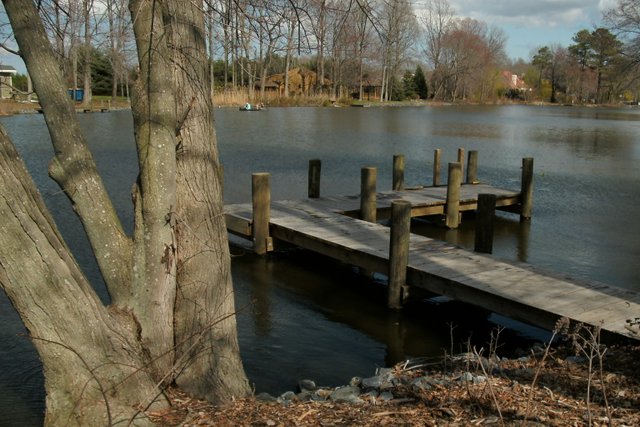
Some, at a moment like this, might start arranging in their minds lines for a poem -- to carry the metaphor over. The rhythm in my head tends to prose over poetry. It slows to rehearse the argument, construct an inventory of terms. There are those that consider poetry to be the highest best expression of an idea. I accept that in general poetry is the strongest form of language. By that I imagine I am saying it is the most particularized compact deployment of language. The right word in the right place. Poetry carries too, I suppose, an extra appeal to emotion, in its heart-beat cadence. To sense and sensitivity. A primacy as well to image symbol and arrangement.
I might not have spent that much time even considering the muster of poetic expression if I did not keep in the back of my thoughts the fact that I know someone who has gone on to make a living at line and meter. Stripes cover you in rain. / We are grew and grew, / a particular mood tooth / Kind of day: beans on toast / and become / the professor of transformation. This is the poet Hoa Nguyen (I refer to her that way to distinguish her from my friend the poetical Tran Nguyen who; however, has never read G.M Hopkins yet carries a life-ring from the Deutchesland wherever she goes). I knew Hoa as an undergraduate when words were not yet her vocation. The quoted lines are from Rain Poem contained in her collection As long as trees last (Book, 2012) , p.8) I thought of Hoa recently while reading this article from the Atlantic Literature Is Dead (According to Straight, White Guys, At Least) - Joel Breuklander - The Atlantic:. "Mannered...soft", the charge is laid against modern poetry. So Obvious feathers on a heart pen (p.12). It's hardly dead.
I prefer prose when I write because it more closely resembles the run of thoughts in my head; the slow array of language. Although, to be sure it ain't prose exactly. I like the mounted argument with its seeming loose pile of concrete verbiage. A ramp to the highest wall. The thinner edge worked under the most ponderous opinion. Prose is such a simple machine.
Prose allows you to unlimber not only metaphors similes and the like, but also the space to deploy analogies and compound-complex allegories. The only thing holding me back here is the lack of enough discipline and education to rigorously apply these devices. My metaphors remain mixed, my sheets bent to my lines if tied down at all. The canvas becomes a torn curtain of loose ends. The way is lost, things go adrift.
Here, reflecting on this unsuspected aspect of a summer rain I incline to natural metaphor. Another facet of the world assuming a form of similar impression. Youth, perhaps. Youth merging into the adult world. With its own ideals, ways of being. Reticent resistant, but gradually accepting of established roles and responsibilities. What is the metaphor saying then? Youth dissipates; loses itself in adulthood? That rain/youth is a temporary or initial state, is it the pond that is permanent? Which is the more natural, without rain, what for the jealous pond? The rain water is, we could imagine, part of a fuller cycle involving evaporation and the sun, identifying the rainwater as an emergent clarity returning.
Nature has process -- cycles that run on thermodynamics and entropy alone. At first we may be tempted to regard this as an ideation outside of nature. That is nature identified strictly with the organic, the realm of the living striving and winding round, crowded and recursive. Nature is a mix of the organic and inorganic. They imitate each other in process and in form, (crystals grow, stars are born) a branching, area-filling fractal extensiveness is common to both. The laws of physics apply and rule the possibilities of both and the common elements of matter make up both the organic and in organic realms.
Nothing in nature occurs with absolute necessity. What we call nature is our observation and description of it. The statistical account of it we deploy is still a better model the one of command and edict. Nature is what we see, the laws of nature what happens. Often what we are talking about when we talk of nature is proscribing behavior, of natural phenomenon, but more that of people.
At the end of this I'm just content for avoiding bringing around yet another metaphor of youth as incandescent, burning (and burning out). The young have no reason to believe that the regularity of nature that orders things and imposes paths through the forest good and bad does not not apply to them. At the same time false dichotomies and rushed streams of some naturally ordained life should not impede desire and infinite possibility.
11:59:40 PM ;;
|
|
|
|
|
Saturday, April 20, 2013
|
|
| |
National Security State
Security State USA
A couple of months ago I started to write a post about the pervasive degree of surveillance in our lives and the increasing amount of comment given to it Surveillance state - Wikipedia. At the time I observed this was mostly on the periphery of the main conversations of our culture. Indirect and delicate when spoken of centrally. My main rhetorical thrust was to to say that Security State USA is here, or at the least we are well down that road. That all seems so quaint now.
The attacks on 11 September 2001 did not "change everything", but there are things they did change, perhaps permanently. One of the things that changed were the bundle of civil liberties clustered around privacy that we were willing to give up for reassurance of safety 1. Particularly if it could be arranged to happen in the background, and mainly to others and in secret laws so we would not have to look at it. This was in response to unprecedented threat of the World Trade Center and Pentagon attacks of 11 September 2001 by commercial aircraft cruelly repurposed as massive flying bombs. This was real, the only other attack of this magnitude brought us into World War Two. The assertion of the moment was that without a massive security apparatus laying across the land this would be a regular occurrence. We live in times of such technological distribution and population density that mass casualty events lie within the grasp of nearly any ad hoc organization. The rise of permanent non state actors removes the diplomatic tool of requiring even hostile states to look after and police the actions of their own.
I have been making notes for this post for a while now, half a year or more on back burner. I had put together a rudimentary outline generally makes something the next post. Then the Boston marathon bombings occurred and part of the set of ideas I wanted to discuss suddenly became the focus of the news and mainstream conversation. This affected my thinking. As well, being from Eastern Massachusetts growing up only 3 miles from where the marathons start (one town over, Holliston) and having taken in the Patriots day package tour (a Red Sox game and Marathon finish line) on occasion with my father growing up. I took its random violent cruelty towards my familiar things hard. I drew a line at recasting this post again for the Snowdon/Glennwald revelations; though, I have thrown in a few links from the last month. As I look over the draft of this post and the articles I was reading in March April and May, it stands out, starkly even, that it was more confirmation than revelation.
Almost as soon as the echoes of the Boston blasts receded forces were at work converting fear into extended control: more surveillance more checks (as long as it didn't restrict guns in any way) more restrictions on movement and on immigration. All towards an ever more extensive counter intelligence program. The markers of this program are clear pervasive and warrant-less surveillance. By our municipal police, the FBI and the NSA. Personal privacy, the autonomy of personal movement is suspect and dangerous. The public not the government must be transparent to be safe.
There is a view of this that is the natural degeneration of careless republics. A fall into a police state (the public transfixed, locked down). A view outlined in Michel Foucault's 1975 work Discipline and Punish [Foucault, Michel Discipline & Punish: The Birth of the Prison (NY: Vintage Books 1995)] For those controlling society this is a utopia of the perfectly governed city. This was the ideal; the elevation of control in the bi-modality of order and production against chaotic liberty.
But there was also a political dream of the plague, which was exactly its reverse: not the collective festival, ''but strict divisions; not laws transgressed, but the penetration of regulation into even the smallest details of everyday life through the mediation of the complete hierarchy that assured them capillary functioning of power; not masks that were put on and taken off, but the assignment to each individual of his 'true' name, his 'true' place, his 'true' body, his 'true' disease. (Foucault 197-98)
For all the Foucault quotes, I relied on this websites' online presentation of the third section of Foucault's book listed above Michel Foucault Panopticism PART THREE: DISCIPLINE 3. Panopticism Foucault, Michel Discipline & Punish: The Birth of the Prison (NY: Vintage Books 1995) pp. 195-228.
Equally the comparison might be made to a Counter Intelligence State They overlap and differ only in the flavor of their fear. The hall marks of this type of state are the agitation and alienating paranoia we so readily exhibit. The markers of a police/surveillance state [ National Security State - SourceWatch ]-- (paraphrased and abbreviated from this source) are that the military is the highest authority. It establishes that it answers for the security of the state and through gradual unstated veto for the entirety of the state. Political democracy and democratic elections are viewed with suspicion. "The military and related sectors wield substantial political and economic power. They do so in the context of an ideology which stresses that 'freedom" and "development" are possible only when capital is concentrated in the hands of elites." The National Security State is obsessed with enemies. Defending against external and/or internal enemies becomes a leading preoccupation of the state[not equal]Ķ a major source of national identity and purpose. These enemies of the state are cunning and ruthless. Therefore, any means used to destroy or control these enemies is justified. The National Security State restricts public debate and limits popular participation through secrecy or intimidation.
It is a test of the depth and morality of a given culture, the choices that are made in adversity. To stick by the principles of due process, individual rights and privacy. Or to sacrifice all to the feeling of security and material comfort. The questions we need to be asking are does all this make us safer? Does any of it makes us better? Are we collecting too much information to accomplish any legitimate and practical concern? As the amount of data doubles and doubles again the challenge of separating actionable data points from the mass of collected integers and vectors disappears to a vanishing point. There is though a hidden efficiency of the Surveillance State: the internalized discipline of the observed. A psychological effect producing the lowered cost to elites of a self subjugating proletariat. Surveillance's purpose; the point of a program of constant surveillance, at end, is internal not external.
He who is subjected to a field of visibility, and who knows it, assumes responsibility for the constraints of power; he makes them play spontaneously upon himself; he inscribes in himself the power relation in which he simultaneously plays both roles; he becomes the principle of his own subjection. By this very fact, the external power may throw off its physical weight; it tends to the non-corporal; and, the more it approaches this limit, the more constant, profound and permanent are its effects: it is a perpetual victory that avoids any physical confrontation and which is always decided in advance. (Foucault, 203)
Mass Observation
The techniques of mass observation can be developed towards external or foreign populations with little or no difference in process, and little or no question or oversight in that process. The National Security Agency (NSA) seems to find it necessary to its works to absorb every bit of data and metadata.passing through a US circuit. The National Reconnaissance Operations Center (NROC) confines itself, in the main, to standard satellite reconnaissance of military or national security nature. These run the gamut of orders-of-battle, industrial and agricultural capabilities and flushing out facilities of special nature such as missile and nuclear weapon fabricators. But beyond these are tactical systems like Gorgan Stare Gorgon Stare - Wikipedia whose subject is not national but very much the individual and their actions. Systems that similarly consolidate and centralize observation and analysis of existing surveillance cameras exist in the hands of certain municipal police forces.
All these means of collection fall into the category of technological dragnet. Their aim every signal every phone call, every email, every unruled activity; observed. Their logic is to capture all. Effectiveness is defined by data being there obtained, to unwrap when needed. Focused intelligence of the sort agencies were traditionally supposed to deliberately and purposefully gather and analyze is a dubious enterprise, unproductive historical romanticism. Modernity demands ubiquitous behavioral surveillance; suspicion equals guilt activity is evidence.
I would like to take a small detour here since I am in the rhetorical neighborhood of the global war on terror (GWOT) and address a few general issues regarding Drones Torture and Incarceration. The processes of counterterrorism insomuch as they demand a militarized response are a choice between drones, special forces, and against occupying land armies. The first has enormous appeal to policy makers for its low cost and low danger to American combatants, perhaps foremost it's relative invisibility to the American public. If not to the publics where it is used. Beyond the drama of incident and heat caused by friction with international law, drone anti terrorism may be the least destructive means of engaging terrorism, militarily. Still drone warfare is a product of the inability to discern genuine national interest, a creature of a temporary unilateral capability which sets the standard, and a bias towards action over diplomacy.
Normalizing engagement with organizations using terror as a war leads to conflict with laws regarding incarceration and repatriation. The regions combatants do not fight as a uniformed army or even as citizens of a state. There is often no standing government they recognize or that recognizes them. They may be captured, but there is no single formal political entity to negotiate the conflict with or remand the combatants to. The government of their geographic point of origin may reject custody on a number of grounds: too dangerous too expensive, too much a unregarded ethnic minority. So the U S incarcerates them indefinitely, on the merits of active hostility observed, declared, impugned or merely suspected. On basis of a simply potential and mutual animosity.
A contingent of policy observers make the argument that due process is a privilege of the pact we made for ourselves within our own body politic. To those outside we owe nothing. Against the hostile or the merely resentful we give nothing away. Having no voice among us, they are de-natured. This ideology of human rights fails to comprehend that due process is, at end, a recognition of inalienable rights) it is a universal concept; to see it existing on distinction only (within/without) loses the ability to perceive or keep it at all.
This slippery slope applies most to such extreme denials of human rights abroad; the application of enhanced interrogation. Our only reward for this appeal to efficacy over morality will be the eventual inability of keeping it external. The gradual acceptance of the irrelevancy of information to torture. It is punishment not interrogation. Confessions and information may be extracted, but these are never the true point, Torture is a outburst of reparation for perceived violence against the sovereign.
Domestic mass surveillance, is in many ways its true context. This is Benthem's Panopticonism Panopticism - Wikipedia. Total clinical observation. A conception he first applied to the prison and the disorderly dysfunctional subjects that found their way there, and as extended by Michel Foucault as a practice, more than metaphor, for the governance of a state or society Its primary characteristics are a constant and unidirectional visual surveillance. The former merely requires a potential of being the latter is key: the disassociated dyad of seeing -- the observed and observer do not "see" each other only the observer sees. This is extended through all the spaces in which the individual exists: workspace, public space, private space. In these places it is marked by random visual surveillance and other ways the behavior of individuals can be discretely observed. Rather than deny these things, they are dismissed as a fact of modern life and modern security. Apologists and the indifferent posit that acclimation and casual evade-ability suffice to ameliorate any untoward effects. If you don't make eye contact with the elephant in the room it isn't there.
There is no aspect of modern life that is not, can not be digitally recorded. Extra-legal data collection proceeds invisibly bending laws for search and seizure on a contingent basis, permanently warehoused and ready for data mining in the future or further today. The warrant process stands on ceremony only. Security insists on information, the law so much paperwork to be filled in after the fact. A society is no more than a sum of its laws and expectations. There is a corrosiveness in the disregard of warrant, the explicit norms of jurisprudence, and society dissolves in their breach.
All this concern only references the surveillance the government directs towards the citizen and not the realm of private observation. With the movement of the commerce sphere the internet and comes endemic online tracking. With a computer in every household, increasingly in every hand, web surfing and purchasing instances are marked by visit click and touch and measured against each other to form profiles and individual predictions of behavior. This sort of quiet passive data collection extends to all networked electronic devices. Ebook readers are a prime example they will report back to the manufacturer one remove to the publisher how fast you read into a book and how far, whether you skip to the end or not An E-Book Buyer's Guide to Privacy | Electronic Frontier Foundation: . Their take maybe simply to measure how genre novels are being received, or the ways "how-to" books are used. They maintain the information is not used in a personalized manner, but at the same time it is the statistical model they use for you and it is information they never had before. All These factor towards a modern reduction in property and privacy rights. Content is no longer an object transferred untethered. Intellectual Property is licensed not owned, a reduced bundle of sticks. And the content's manager always maintains a presence with you.
The notion that there is a difference, somehow, qualitatively if not quantitatively between private sector and state intrusiveness. One depriving you of a measure of liberty the other enhancing your individuality with a preternatural awareness of it, honing your choice sets as a semi-disclosed service. Any distinction here is put beside the point by legislation like CISPA Cyber-Intelligence Sharing and Protection Act - Wikipediaand SOPA which join private and state surveillance for any purpose involving national security or activity deemed to degrade commercial yet not common carrier networks.
There is an idea of Evgeny Morozov's (among others) that the bulk of critical thinking on modern telecommunication (telephony, internet) has been economic rather than sociological or political. Politically engendered rights don't enter into it. There is no public no citizen. only a consumer defined as an demographic object.
A republic, if you can keep it
For a state that takes itself to be democratic and run legitimately. Run for the people and by the people. Not by varying accommodations of faction or social strata. It comes to a question of whether we are genuinely a nation that follows rule of law, or of rule by decree. The rule of men; self-interested and mutable by nature.
The Rule of Law adheres to principles of jurisprudence. They are promulgated laws. That is laws that are known public and published, not secret or arbitrary. They emanate from legislatures, deliberative rule making bodies. They follow due process. Rule by decree is only ever a whim of power. It is often hidden or secret law. Invented and retroactive. Even if passed by legitimizing institutions they are unknown to the public as applied. A semi conscious nod to their unjustifiable nature.
Programs of surveillance which are launched by fiat alone, that is programs with only Presidential authorization, a practice that has recently become known as the doctrine of the unitary executive, are mere paper wrappings of legalism. The Unitary Executive Doctrine claims that there is no oversight or separation of power when the nation is at war. Faced with a mere show of adversity the president is king.
The Foreign Intelligence Surveillance Court in its current incarnation is a fig leaf of justice. The information accumulation that occurred in the years following the attacks of 11 September 2001 was uncontrolled under our established law. Forced to reconsider the Foreign Intelligence Surveillance act was stretched to cover the gap between practice and normal law. It should be clear that all this is only a bare degree better than dictatorial whim. Even with the safeguards to our privacy we are assured surround these programs as with most regulatory regimes they are not designed to exert any actual influence. The Foreign Intelligence Surveillance Court does not like being described as a rubber stamp court but can point to nothing that counters that conclusion. the entire apparatus is expediency outside law, and failing even there. Pathology of power secretly held always trends towards the absolute the tyrannical. The law sheds it's higher form to become a dead mass, a mere weapon: "For my friends, everything; for my enemies, the law" -- (variously attributed: Mussolini, Getulio Vargas, Oscar Benavies )
The question to ask is this: is the surveillance state, this security state, reversible. Despite how positively you initially regard the efficacy of surveillance, you want to ask that question . The key to this task is separating emotional from empirical reactions towards perceived threats. The threat must be assessed in terms of the actual resources it has, and it's dimensions in historic context. And all this against the measured effects of surveillance on populations -- their freedoms of communication and movement -- in the name of security.
The first task is rebuilding a public space. Panopticonism collapses the public sphere, dissolves the very space between individuals where they can interact with each other in a serendipitous manner. Such interaction ought to recommend itself to a societies elite in their self interest, because it's cheaper to have the people sort out their own little problems. And because the peasants have pitchforks and will create a room for themselves one way or another, eventually.
The surveillance state is not compatible with democracy. There is no trust or autonomy for the churning energy of people within such a state. Foucault makes rather clear he does not see these inclinations working in concert. Into the well tempered state the controlling logic of surveillance pushes the "Penetration of Regulation", against multiplicity, confusion disorder.
The plague-stricken town, traversed throughout with hierarchy, surveillance, observation, writing; the town immobilized by the functioning of an extensive power that bears in a distinct way over all individual bodies - this is the utopia of the perfectly governed city. (Foucault 198)
and a little further on
Underlying disciplinary projects the image of the plague stands for all forms of confusion and disorder; just as the image of the leper, cut off from all human contact, underlies projects of exclusion. (Foucault 198)
Foucault also speaks of a "Swarming of Disciplinary mechanisms" in Benthem. From prison to barracks, to school house and on to the factory. The Inversion multiplication and state control of these mechanisms. The inversion is of their original use of taking the bad and making it good. Curing ill. To improving good -- making it more purposeful, more directed, more efficient.
The difference in practice and outcome can seem small; after a fact examination as an investigatory tool or before the fact as control. A controlled populace works for those that impose control not themselves. Elites who have captured a political process must impose a double consciousness to maintain it.
Hence the major effect of the Panopticon: to induce in the inmate a state of conscious and permanent visibility that assures the automatic functioning of power. (Foucault 201)
Panopticonism is a power relation. That is; it is an internal consideration, directed against those to be ruled, organized. An industrial technic of control, modality of power. It is unlikely to be given up as long as they can impose it
Discipline' may be identified neither with an institution nor with an apparatus; it is a type of power, a modality for its exercise, comprising a whole set of instruments, techniques, procedures, levels of application, targets; it is a 'physics' or an 'anatomy' of power, a technology. (Foucault, 215)
A program of this magnitude while ostensibly directed at an outside threat, at end everything to do with ensuring the internal quiescence of increasingly disorderly populations U.S. Surveillance Is Not Aimed at Terrorists - Bloomberg . The principle of pervasive observation that suggests itself to control is its relative affordability. Not every cell in a panopticon prison need be under observation, nor every frame of video, every computer, phone call, electronic transaction, but they could be. This is the needed efficiency the price point of control that absorbs liberty
At the other extreme, with panopticism, is the discipline-mechanism: a functional mechanism that must improve the exercise of power by making it lighter, more rapid, more effective, a design of subtle coercion for a society to come. (Foucault, 209)
As with most industrial applications of custodial panopticonism. The result is not a harmonious doubling of conscience -- tiny turn-keys of our better (or at least more malleable) nature sat upon our shoulders piloting us down safe and straight channels. Rather it represents, or results in, a coarsening of the public conscience, a schizophrenia, and endemic paranoia. A ruin of the human social instinct. Usually I'm inclined to give a nod to adherents of economist Julian Simon and his notion that our ingenuity will deliver us timely solutions to adversity, against nature if not ourselves. But in the docility of active surveillance the human spirit suffers, lags doubts does not produce, and the world engulfs us
1 A caveat I give here to national security matters is to ask myself what I would do if one of these jobs, within the military and intelligence establishment, were my job. If I had the task of preventing another major terrorist attack. Frankly there is a lot I would do. It may seem strange to bring this up in a footnote, but I do not believe I would do what Cheney and Addington et al did, which now seems near irreversible. I do not believe need can dismiss law. I do not believe human beings need to be treated like one of Temple Grandins' cattle by their leaders to enjoy a civil society.
11:13:04 PM ;;
|
|
|
|
|
Sunday, March 17, 2013
|
|
| |
Woof? Moo?
WFMU, the "Freeform" and non profit radio station of Jersey City New Jersey (and sundry other points of the compass rose), is holding its annual marathon fundraiser. They like doing things their own way, and in practical terms that means keeping advertisers and underwriters out it. Not interpolating third parties who would only be tempted to install their own needs and definitions on them. Keeping the essential equation between themselves and their listeners.
Still, running a radio station is an expensive proposition. They work with small staff an inner and an adjunct army of volunteers who provide the on-air talent and administrative support respectively. Then there are the streams the ambition, and the disasters. The disasters? Well WFMU is close to the roiling waters of New York Harbor and Sandy, who was a punk, knew that. Electronic gear and water do not mix well. When a building tenant moved out they were able to reclaim their ground floor and begin plans to turn it into a performance space of endless possibilities. As the station slides into the internet age some years ago now they began streaming their broadcast and evolving new content streams. This gained them a world wide audience, but added a couple hundred thousand dollars of bandwidth that has to be paid for every year.
They choose to do this fundraising the hard way through direct donations by their listeners. There is always corporate underwriting, the back door advertising of non profits, lurking in the wings, but it is kept at bay. At times I think my local NPR station runs through a list of half the corporations in America every quarter hour. And I image they take calls from every one of them.
WFMU is a good cause. As a radio station and organization.
 There are few stations out there trying to make this kind of thing work. It is also very different from all the build-your-own-playlists enterprises out there. Your peers may know a lot of pop tunes, but they will never be versed in it as much as a dedicated record collector. If they are, then they probably already know about WFMU, because WFMU also succeeds as a community of the like-minded. There are few stations out there trying to make this kind of thing work. It is also very different from all the build-your-own-playlists enterprises out there. Your peers may know a lot of pop tunes, but they will never be versed in it as much as a dedicated record collector. If they are, then they probably already know about WFMU, because WFMU also succeeds as a community of the like-minded.
Interjecting a small story here. In my previous post, one of an occasional series from a long-ago brief occupation as a Navy enlisted. I was trying to come up with phrase or idea that captured my entrancement with Google Earth and its ability to immerse you in complete detail of half remembered places. I searched the term "A map as big as the earth" which frankly gets you to a lot of things. One of those things was a book called Temporary Autonomous Zones (T.A.Z) by Hakim Bey [i.e. American anarchist-poet Peter Wilson]. After I finished reading a copy of the whole of this I found online. I went back and looked at the title page, where I noticed it said that the cover and type-setting of the print version that online version was derived from was by Dave Mandl. WFMU, I thought to myself, has a dj named named Dave Mandl. A coincidence! But it is no coincidence.
It is an uncommon phenomenon to find yourself in such situation where something you do leaves you feeling fulfilled, and part of a like minded community. Of course you, reader, may feel ready to dispute this. But as an on-going fully accessible thing? I don't mean the occasional project at work that engages you and that you hope redeems the rest of the week, or month, year. Or the earnest hobby that you put more into than you get out of. A garden with finally, after trucks of fertilizer, a rose! For most though through most of their lives in the bell curve of achievement; personal satisfaction lies in the tail and the frustration of tangental living the mean.
It's less a matter of luck that one finds that combination of community and fulfilling occupation, the right situation. More a matter of being able to objectively view a situation, and possessing the self knowledge would exist within it that most of us lack.
Only twice in 50 years have I felt I belonged to a group or community. Not in high school, not in the native nest of my home town Holliston. In high school my best friend moved away to a town called Spartanburg (who moves to a place called Spartanburg?) It was out of high school in the Navy, that I encountered the feeling of belonging somewhere. And out of those four years not the first or the last two, but that early middle year, which was mainly spent at sea on an aircraft carrier. A close knit group, which was enforced by the worlds largest moat -- the Pacific Ocean. There was plenty of work, and on board one of the country's leading investments in national defense. Additionally places and lands I had never seen turning up every few weeks just outside the grey steel walls . The Navy had an advertising slogan in those days we used ridicule mercilessly, but for myself I'll give the Bates agency(who came up with it) a pass on that one. For a brief season I felt engaged and a version of myself used to potential.
A few years later during my second semester at Maryland I joined the student radio station, which had only a year or so before been diverted from its purpose of training the next generation of programmed top-40 management to play the Clash and Birthday party. At first, through that semester, I did nothing but file records. Alex S, a hall mate, who dragged me over to their fall meeting, and myself were nominated assistant record reshelvers on the strength of attending that meeting (I have a group picture of that meeting somewhere). By the next semester I was on the fill-in list and doing more shows I could keep track of. Another semester or so on I had my own show, and a reason to buy the few records I have today; Radio Birdman, Big Star, records the station didn't already have.
That was it. Two brief periods lasting only a few years. Two situations quite different nearly opposite and never feeling fully represented in the one or the other. For the rest; however, nothing.
Vocation? It's hardly worth mentioning. There is nothing I've ever done which was deliberate or desired. It was all just work, to earn rent, the hand on the shovel.
The library where I work currently has some positive attributes. The mission is educational, research focused, Acadamic libraries are reasonably avante tech. But not as a clerk. Librarians keep ownership of the work to themselves, leaving to support staff only the menial work. Whatever bores, irritates or repulses them. In the end the job is only a dull frustration.
Avocation -- the part of your life you turn to when work fails you, takes the form of internal or external projects. Volunteer work or hobbies. I've never felt like volunteering for most concerns; though, when I first discovered WFMU I lamented that either they were not in Washington DC or that somehow (and this was the greater stretch) I did not reside in the New York metropolitan area. There is something, maybe being originally from Massachusetts, maybe the density of life, the shear weight of unknown details, but I often regard the New York area as being a foreign country.
I gravitate towards inner-directed tasks like writing. Writing takes a lot of forms; though, each quite different from the other. Like those who can write easily I easily accepted the truism that anyone can write, and began this weblog. Intending to turn out an observant mix of polemics, philippics and fiction. A few years ago my friend Tran countered my expressed belief that this stream of occasional journalizing might lead to offers to write for compensation with "Hows that working out for you." A rare glimpse at a more arch persona she otherwise keeps behind layers of polite quiet conservative Viet catholicism. She is right; though, the writing here is anodyne well short of declarative, more prescriptive than narrative.
Looking back to WFMU's fundraising carnival season there is a temptation to ask, is the Marathon just another staid economic transaction? Symmetrical and mutually informed, a bill of fare. An invoice for goods or services.
Ordinarily, with such a lack of information there would be transaction costs to the deal. Dependent on an uncertain funding process, that process would need to over-compensate in significant ways, there would be inefficiencies. The audience probably knows more about station, than station about the listeners (lacking big data). Local volunteers know far more about stations intents and bona-fides than Long distance listeners. It is still a ordinary terrestrial radio station with its heart in northern New Jersey.
Or does all the effort imply or result in a community bonding or building. A sum of all its parts and attendant mutual obligations. Broadcasting in the Internet era is broadcasting 2.0. Already an information/communication medium is WFMU passing along far more information and through this effort erasing the gulf between audience and initiators.
I read a review of a book recently, whose title and author I couldn't recall although, after some searching I believe it to be this: Missing Out in praise of an unlived Life - [book] WorldCat by Adam Phillips which takes the position that part of the active mind keeps thoughts of other career paths occupations places to live, existences, in play on a semiconscious level -- to facilitate flexibility and change if necessary but also being part of ongoing assessment of current circumstance. They are our latent desires the interests we keep up on though they are not part of our daily lives. They are patterns and blueprints on a shelf.
I keep similar ideas for other lives, other communities, other professions and avocations in mind. Not directly in mind, of course, which is reserved for the day to day charnel of getting up and going to work. These are dreams, the ones we all have but can never quite remember, that point to something and somewhere else. Some tell seemingly pointless stories such as what it would have been like to grow up in Plymouth instead of Holliston where my family moved when I was seven. That dream created a strange synthetic environment, Polistyn. I don't think such what-if dreams are supposed to be remembered in any comprehensive fashion, that's not their function. These slivers of other lives are like a glimpse of a ball being thrown in a just out of sight bullpen. Dream lives half remembered. You see the ball then you are bending to scoop the ball off wet grass, it falls away, leaving only a Dell workstation. The ball just another book that needs a barcode on it. At least its a book and not just WorldCat Knowledge Base ether. The Kamikaze fun-machine missed the segue there you think, turning the volume of the FMU higher, I would've gone with the Big Boys out of Adrenaline OD. Rehearsals for extinct anatomies.
8:59:12 PM ;;
|
|
|
|
|
Saturday, February 16, 2013
|
|
| |
Pattaya Beach Port Call
I have gotten around to writing up another story from my Navy experiences. An upgrading of a paragraph I wrote 14 years ago. This is on the old Atomized site. At that time I dispatched the whole year of overseas deployment inside a single paragraph. This current story was only a sentence there. It was part of a whimsical and brief biography. I never felt I gave those days and people their due, but it's the sort of thing its hard to track back to after you've given it a nod. Those days reverberate strongly for me because I left the Navy after my initial enlistment and had transfered to a shore duty station halfway through. I never made it back out to sea after that one Western Pacific deployment on the USS Ranger (CV 61) and I never get far from the fact that I was still a teenager through the course of that year.
This entry which is over on the Stories page deals with the Liberty Port Call in Pattaya Beach Thailand, now longer and with assorted pictures. A view along the beach looking south towards Pattaya hill/Lookout point 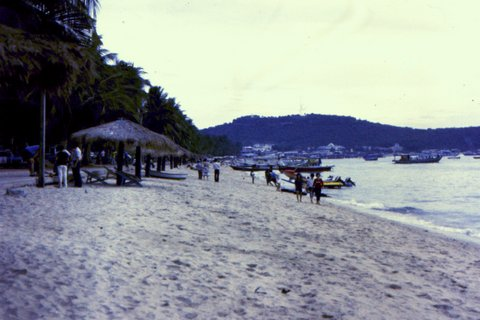
By strange coincidence around the point where I had this about half pulled together, one of the people populating this story, Bruce Behers, contacted me and I joined a Facebook sub-page he had set up explicitly for the CVIC unit (OZ Division) from the USS Ranger's 1979 "WestPac". Which he had already gathered around three-quarters of us into. In the long run this will be fine, there may be an actual reunion in the offing. In the short run it was like someone dropping off an energetic puppy as a gift while you are trying to finish a jigsaw puzzle set up on a rickety card table. These reminisces are partially premised on their obscurity of subject. The people who move through these posts like ghosts are suddenly real people, with names and faces correctly defined and spelled, chatting and posting pictures on the most social of networks. Further, they are exhibiting recollections of the day equaling and exceeding my own motheaten memories. I suppose I could step back quietly take notes and write a more exhaustive pan-perspective version of this in a while. No story is ever truly complete; though, and this one for the moment restrains itself to a simple snap-shot of the demi-monde.
Pattaya Beach Port Call
9:42:59 AM ;;
|
|
|
|
|
Friday, January 25, 2013
|
|
| |
Listing To Port
Once again it is Rock 'n' Roll Top Ten Time. Or rather several weeks past time. Who to champion? I got no idea. I don't pay attention to things like I used to. Dead in the water and listing to port, that's me. But I have a post to write, so its time to trim the ballast tanks and start bailing. I don't really have an extensive nautical metaphor thing lined up. Wish I did, but that last sentence was it. Maybe next time.
My modus operandi is that I keep a little list during the year, mostly at work, where I write down any song which impresses me distinctly, and which I don't immediately recognize. Nothing else goes into it. The last few years when I parse the list at the end of the year I find that I've been noting fewer new bands. This brings me to a question my nephew Grant asked one day recently. This while looking through my iPod: "Is there anything anyone my age (14) listens to that you would listen to?" The short answer to that is probably no (and to the implied verso). Although Nicole, his cousin six years older a junior at Radagast college in Providence, liked Thao Nguyen who I also like a lot. Their (Thao Nguyen and the Get Down Stay Down Band) third album We the Common comes out in a week or so.
There are, I imagine, reasons for this Venn diagram of separateness in his and my playlists. I'll make a stab at a pop culture casuistry. Music among its many almost infinite facets functions as an affinity identifier. By this I mean that that a band; its music lyrics personalities and crafted image can be used as signifiers marking your desire to belong to or be included in certain groups. This portion of popular culture exists as a ready-made artifact especially for the young to accomplish this express task. There is a difference between expending effort singling out new bands versus liking music. I don't listen to music any less than I did before, and I still play my guitar, as in-artfully as ever. It is that I do not care as much whose music it is, or what scene (industry vector) it's emerging from.
It is also true that as I get older and see waves of bands come and go It's easier to spot artists that are getting by on style, often borrowed style, alone. Usually these bands will not be around long. I know there are differing rules for judging style, I've got nothing against retro style, I've loved every rockabilly, garage, ska, soul, Beatle-pop, Tex-Mex and punk rock revival that's come down the pike, believe me.
Now it could be that as a middle-aged person I do not resonate to the themes and obsessions of 12-24 year olds as much as I used to. Or even when it comes to it, comprehend them. The problem with that line of reasoning is that I still thrill to those same anthemic testaments of youth when sung by bands from my youth. I suppose it's simply a matter of privileging one's own cohort. I recognize that all youth is largely a parallel experience but ever in a different country. What I'm saying is that I'm talking 'bout my generation. Of course The Who were not really my generation, rather the Jam, the Clash, Mission of Burma, Dream Syndicate, Minor Threat were. I have mostly been in the alt/punk subculture community since '77 when I first heard the Ramones and Sex Pistols. It is certainly part of how I relate to music generally, that pop music exists mainly as an exterior set of reference points to me.
The way I listen to music also influences things. I like radio over Pandora or Pandora-like things, but not programmed robot pop radio either. Nor college radio for reasons rendered earlier. WFMU is similar to (volunteer djs and self-programmed), but not the same as college radio. Call it curated radio. Stuff happens they react. What-they-play-is-what-you-get. My view is: a good radio station uses the whole road when they drive.
2012 en-noted favorites. In no order, numbered to obfuscate.
- First up Caetano Veloso. One of the founders of Brazilian Tropcali. Another of 1968's irreducible flames. I've written him in my notes before, but this year after listening to Maria Bethania I knew he had to go on the list. He wrote an autobiography in 2002 Tropical truth : a story of music and revolution in Brazil and I'm aware that there is a feature length documentary on Tropicalia out now and making the rounds on the film festival circuit Tropicalia (2012) - IMDb. I saw Searching for Sugarman at the Rehoboth Film Festival last year, maybe Topicalia will be there this year.
- Next a band that called itself the Flower Travellin' Band - Wikipedia. They were a late sixties/early seventies Japanese hard psych band. I'm not sure whether the song I heard was "Satori part i" or ii. There are at least that many parts maybe more.
- In a very similar vein, really, the Groundhogs - Wikipedia a late sixties/seventies British band in the mode of the Pretty Things or Pink Fairies led by one Tony McPhee. I find it surprising that I continue to come across great hard rock bands from that period I was not already familiar with. This shows again that history unless pressed tends to tell a small ordered tale and just pretend it is the whole story. The song I heard was "Garden", but of course there is also Cherry Red
- Another band I liked that turned out to be a contemporary band from San Francisco were The Wrong Words and their song "I will change your mind" a nice example of pop garage psych.
- A song called "Joa" by a Chicago band called Disappears which are a garage rock ensemble with a droney experimental side makes this list too. By the way I wouldn't want my inability to deploy a full suite of modern rock adjectives to keep people from thinking I don't like a sound. It's just that, as yet, there's no app for that. Steve Shelley from Sonic Youth was in this band for about a year early on.
- Next I have two bands named Holmes. First, the band I initially intended New Jersey's Holmes a Lyres-esque rocking band and their song from last year "Free the Preacher" which was possibly my most persistent ear-worm all year.
- Then while I was searching the Internet for something on that Holmes I came across Sweden's Holmes on bandcamp Holmes (Sweden). A very different band but I liked them. Under the unified rules of serendipity both Holmes need to be included in this list. To me they seem a cross of Band of Horses and the Decemberists, even moodier perhaps.
- Takako Minekawa - Wikipedia is a Japanese singer active in the 1990's and on. Her quirky indie-pop is not the same as j-pop by any means. Her song "Plush" is probably the best song about brushing hair you're ever likely to hear.
- Another Japanese singer I heard this year was MI-GU (Yuko Araki), the song was called Spiders. The Mi-gu project seems to involve a Hirotaka Shimizu as well, both from the band Cornelius. She has also done a collaboration with Mike Watt who I still remember from the Minutemen (I saw the Minutemen once).
- Last up David Kilgour - Wikipedia and the song "Today is going to be mine" this song is from his solo career and is off the 2002 album A Feather in the Engine. Kilgour was in the New Zealand band the Clean with which he occupied both ends of the 1980's defining indie pop.
As an addendum to this year's list and perhaps cutting across the new music/old music divide. One takeaway I've had from many years of paying more attention to the lesser stars than the Big Stars of the world, is an appreciation for the quotidian musician. The guy or gal who has to go out on the road and play live in front of people to put food in the refrigerator. This includes those who may in fact make money off their recordings, but must tour so that people know they have recordings. It includes the DC barber who years ago came to an English class at the University of Maryland to talk about the narrative of the Blues, his real vocation. It doesn't matter whether they play because it's their preferred means of living, or having made a youthful start playing in a band and learned no other trade, it remains their only assured way of making money. I'm afraid sometimes that we've made pop music into too much of a young persons game That it's harder to earn a living from it, even as you learn and get better at it.
Part of the problem is that Rock and Roll seems unadaptive as a medium. Too caught up in its role as the purveyor of youthful rebellion. Songs of girls guys and fast cars. Or, at that. songs about slow cars and fast girls. A medium ill-prepared to carry narratives of middle life concerns well. The work that you do just to meet other financial necessities. The entire web of obligations, car payments, marriage and children that is the character of mid life.
You might make the argument that with its fast syncopated rhythms and loudness rock is preternaturally disposed towards the kinetic concerns of the young and nimble. However with its polyglot and polymorphic nature rock and roll is certainly structurally suited towards a wider range of emotional and psychological stances. Yet by and large with bands that get by age thirty let alone forty and continue to put out records the results are revealingly conviction-less. Romanticism and the popular quest always seem the true north of rock, where it ought to be heading, and everyone feels they're leaving sugar mountain too soon.
There are counter examples to this. Those who by design or luck fail to embody the successive layers of precocious juvenilia that marks pop music. I ended this years list with David Kilgour to highlight music of this nature. Mature patient, from the New Zealand that also gave us the Go-Betweens. Closer to home there is also the Pernice Brothers. Whose albums speak of love, and life's transience with an authentic (New England/Cape Cod accented) rock voice. You just don't hear enough Pernice Brothers on the radio.
11:03:11 PM ;;
|
|
|
|
|
Monday, December 24, 2012
|
|
| |
Jam To-morrow
At this time of year I usually try to put together a miniature pixel drawing and write up a small homily behind it. Not really happening this year. I got off too a late start, the moment passed. What I had been working on problematically violated major tenets of pixel drawing. It contained human figures that would need to look human, and other representations of objective things in the real world. It was going to involve a request for J-Rabbit to add New Order's Love Vigilantes to their repertoire. Still Something I'd like to see. Eventually I declared first-idea-fail and set about coming up with an ad hoc new piece to insert in its place.
 There is an order of things; rather a disorder of things. We pass the pieces back and forth trying to find arrangements or balance that would make it acceptable. Often we feel we are close, but the patterns remain intangible. There is an order of things; rather a disorder of things. We pass the pieces back and forth trying to find arrangements or balance that would make it acceptable. Often we feel we are close, but the patterns remain intangible.
I do have a pixel diagram for this Christmas after all. I drew three earths, and assigned them only so much of a story as to hang them in space. They are Jam To-morrow, Jam Yesterday, and never Jam To-day. These are their names. They are in some sort of order and follow each other around the sun. There is no jam on today's earth, you must eat your toast without it.
At the outset of the holidays the Newtown shootings were on my mind, a dour cloud over the season. What happened at the Sandy Hook school was an engendered tragedy. It didn't just happen, it was no impenetrable mystery flung from outside our culture. It was born of who we are. Of what we won't take care of. Of the policy choices we make. The hardest part was the predictable reaction. Not the reaction to the shooting of children. No, rather the knee-jerk reaction of those whose first and only thought was to save their stockpiles of guns and ammunition from any question. Always talking past the elephant in the room.
The NRA and their apologists like to claim a strange victimhood -- that it is not they or their hallowed object, the gun, that kills, but criminals and mad men. By criminal they don't mean of course those who may have broken a law or two, but the criminal other. By madmen: mad yes, but within a society leaves them be to their own devices, to spare the cost and responsibility. And the subset of the mad, who overly shares their predilection for "personal agency"? The NRA is loath for any mental health issue markers on the record that would check the ability to own guns. The gun industry wants to sell guns. It sells guns into a layered increasingly dark market where everyone who wants a gun gets one Whom Does the NRA Really Speak For - Jordan Weissmann - The Atlantic That is what the NRA sheilds.
Garry Wills in his essay Our Moloch - NYRblog The New York Review of Books had this beast's number. Guns are an obsessive kink in the American psyche. A monstorous idiocy. A shadow that looms beyond its actual properties. Whether it's some vestige of frontierism, or the garrulousness of a nation composed of conquistador immigrants is a secondary matter. The trouble is the way we feed our future and our children to it.
For the sake of political viability the democratic party enables this sacrifice. It became conventional wisdom for the party that guns had become a successful wedge issue. It was ceded as an issue for a generation or more. Until its effects might become a public policy concern, a health or insurance issue, like cigarettes or automobile accidents. At some point it will aggrieve enough people and affect enough money to sink on its own de-merits.
When I first heard the gun control debate (or first paid attention to it) the burden of proof hung on the other side. Give them an inch they'll take a mile it was said in defense of broad ownership rights. If they question submachine guns, they may question machine pistols, they may question pistols altogether. Then they'll come for our hunting and varmint rifles. Now after backing off inch after inch year after year that mile runs the other way. Assault rifles, whether semiautomatic or fully automatic are military grade weapons developed as such (if not always sold as such). Fifty or fifeteen rounds in ten seconds? Which is why magazine size is a critical issue. Background checks honored in the breach. "Gun-show" loopholes allowing utterly unregulated gun trade. Concealed carry laws extended to everywhere; on campus, in churches. Most insidious of all anti-data laws. Attempts to hide or obscure information are rarely less than a full indictment on those who attempt it Gun violence research NRA and Congress blocked gun-control studies at CDC. - Slate Magazine.
All this led me to a consideration the nature of bad. Bad in a general way, as in not of or with the good. Not evil per se, but un-optimized unhelpful wrongheaded fear-driven human activity and the attendant misery it causes. The "Kingdom of Heaven, and the Violent bear it away." The patchwork distribution of order and disorder is a point to note. Generally conflict, and calamity is localized. I've seen strife erupt in Vietnam, Cambodia, then Honduras/El Salvador, Rwanda, Yugoslavia, Iraq and now at the end of the Arab spring, Syria. In each of these places the world stopped working for the afflicted populations, yet the rest of the world hummed on like an greased clock -- even excelled.
This is the daily grey rain of reported news by decade and geographic quadrant. There is something to localism. Human prospect is tied to, or to put it another way mired in local conditions. Local culture, economics, leadership and protective governance. The quality of government is worth more to a people than its detractors would imagine who focus only on the quantity.
My provincialism is to look at this balance of order and entropy in terms of the United States. Its unity and well-being. Congress as a political institution is essentially nonfunctional currently. The polarization that has marked recent general elections is still in waxing mode, and likely will be for several more elections. The phenomenon of captured gerrymandered congressional districts is more likely a symptom rather than a cause. The factionalism we see today may simply be driven by the cyclical conservatism described by Richard Hofstadter. Or deeper reactionary-ism , a manifest desire to undo the late progressive century, which others view as a second integral part of the enlightenment.
Either way the stake of these civil wars is whether the unrest and sub-standard performance of our civic congress is significant enough to postpone or make impossible decisions and agreements we need to make, as a society, to maintain the level of cohesion and prosperity we have held.
I think about the Way Forward. Prosperity may slip -- for there will always be periods of wearing out -- of ways and things renewing and rebuilding, but about what can keep things from disintegrating altogether into deprivation war and chaos. This can be conceived being done with with human nature, such as it is. Or with an evolving human nature. An adoption to circumstance paralleling social and cultural institution such as the changes made to accommodate the move from villages to cites. The contact culture that replaced the inter-relations of tribal and feudal culture. Maybe not just metaphorically either. The human brain equaling after a fashion the human psyche evolves to fit the environment it's in.
Perhaps as long as the world had frontiers the path of least resistance for the aggrieved, the pushed aside was simply to keep moving, We have transitioned out of those days long since. The end of frontiers may be contributing to an age of increased conflict. Making new modes of accommodation necessary. This extended nature of humankind will look like madness, or at least weakness, in practice. It will come not from clarified rationality of existing institutions, but from far within the human germ. A thicker sense of things, a second further sight, a visceral apprehension of the nature of others rights.
Against this, and aside from the crude motivations of fear and vengeance, is the superficial rationality of the smart play. This, despite the lip service we pay to the good, is how we live our lives. Breaking rules, sacred and profane, we dismiss as made for ordinary men. Laws and mores are fine we reason -- for small lives that dull order enables -- but not us. The rules that protect the mediocre just hold us back. We hold to an ideology of efficiency and individuality that prizes above all else that which obtains for us. A hyperlocal rationality of advantage.
Ordinary deviations from normal behavior are not held against someone if they are seen as getting ahead by it. A tolerance of transgressions we would not deny ourselves. In the abeyance of group judgement, with its dulling interest in the leveling interest of harmonious order. The smart play is held as everyman's right.
What I'm looking to describe is a deeper rationality. More of the subconscious brought up into conscious so that we are less shielded from the process of our own desires. An awareness that exposes the further threads of our actions causality. In a way that is obvious as an objects color, and beyond the emotive pull of Rousseau's bonds of empathy.
Given the coldness and injustice of so much human interaction. It is against the good to claim that man's nature is as it is. That we must endure war and disorder, ethical systems lived only in the breach, because stepping outside the rule of law brings advancement and fulfillment to a few.
Differing from pure hope or hope alone, the view for a more perfect human future is that it is not a thing that cannot be seen. It can be elicited through reason. Its effect can be imagined. The future is not that distant a country. Other worlds touch us already thinking of them. It is as the white queen says a "poor sort of memory that only works backwards." There will be jam tomorrow.
11:52:56 AM ;;
|
|
|
|
|
Tuesday, November 27, 2012
|
|
| |
Sandy, or just a thing.
Of all the things I read on the late unlamented hurricane Sandy. The best, the most perfect was this Onion article: Nation Suddenly Realizes This Just Going To Be A Thing That Happens From Now On | The Onion. And with a resigned shrug of acceptance, we move on to our brilliant future. It's funny 'cause it's true.
Hurricanes have their own special sense of doom within the disaster matrix. Slow and inextricable they literally take days to arrive, leaving you plenty of time to apply what band-aids you can and make what bad decisions can be made to discount it or stay to watch it. A coastal city in the path of an ocean cyclonic storm is in a devastatingly precarious position Disaster Losses and Humanity's Building Boom in Hazard Zones - NYTimes.com. Perched on the edge of the sea the ocean is Immediate and inescapable. Further on the areas of a harborland reclaimed from low lying marshland the ocean never more than five or ten feet away. This is bad because sea level ain't really level. Wind and tides (moon tides) pile it up. It's lumpy in its own fashion. Five or ten feet mean little to the ocean.
Only a moderate sea level rise moves this untempered lumpy mass to the point where hundred year storms become fifty, twenty-five become ten. And a "ten year" storm lands somewhere on our coasts every year.
Human proximity, adjacency, to areas where full force of nature reigns make for a zone of brittle environments. The edge of oceans We're too close to the sea : Washington Post Fr 23Nov12 oped . Grassland and timberland in dry country is the edge of certain fire. Where mountains smoke - volcanism. By rivers in broad watersheds, floods. Where the rains can come - and go, droughts. I bring up this last to point out that the former are all in the category of immediate catastrophes, drought is a special case of a cruel seemingly invisible (moment to moment) damage, that is often more economically costly in the end.
With Ocean storms the critical factor, the sufficient condition is human density in this brittle environment. The more people living per square mile is proportional to the measure of cost after the fact. It is the extremity of potential reach into the economy before the fact. Density magnifies the border region. In an urban environment within a handful of city blocks the ocean disappears as a reality and is forgotten. This only equals 1/2 mile of tidal marsh, and the ocean remembers and flows Rising Seas, Vanishing Coastlines - NYTimes.com.
WFMU, my favorite radio station, forms a case study of sorts on what Sandy and all future Sandy's can do to us. It is a small free-form radio station. Its online Internet presence giving it a national and international presence that belies its actual breadth of operation. Institutionally it is a non-profit corporation. A union of its former dj's who formed and bought the license from its former college when it closed. They moved the operation from Mount Hope to Jersey City. Downtown, Where the lights are bright and the ocean is close. Monday 21 Nov 2012 was WFMU's very bad day. The flood arriving with the storm Flooding and Flood Zones | WNYC turned WFMU (WFMU, Montgomery Street, Jersey City, NJ) into "Island off the coast of New Jersey." These are station Manager Ken Freedman's words When he found not possible to ride a bike to the building.
When the surrounding land again became dry and they could inspect things they found the record library wherein at least two of every kind of musical genre was housed un-deluged. There was plenty of other damage, though. Equipment: Phones both transmitters, some of the Internet streams. More cruelly WFMU's Fall Record Fair, an 125K revenue event, had to be cancelled due to power outages at the venue it was to be held at the following weekend. The record fair is not only WFMU's signature annual event, a major east coast vinyl record trade meet, but is also how WFMU counts on getting out of any late year fiscal hole. All gone. In total a $250,000 set back Jersey City radio station WFMU-FM still struggling to recover from Hurricane Sandy
I wouldn't go beyond their own talking points, but like thousands of other enterprises in the metropolitan region, making their way day to day, little has to happen for an shoestring budget to become a broken shoestring. WFMU already often has to hold a small and largely silent marathon in the last quarter to ease into the new year. This year they needed that and ran it seamlessly into more urgently vocalized Hurricane Recovery Fundraiser. Such are the new exigencies of weather Major cities will flood, the subways will drown, the internet and electricity will withdraw from us, neighborhoods will be swept into the sea. So it goes. The Rush to Resilience: 'We Don't Have Decades Before the Next Sandy' - Jobs & Economy - The Atlantic Cities:.
Its a greater problem, of course, than mere intemperate weather. Poorly behaved and ill-timed weather. It is a matter of distinguishing weather events from climate change. The issue is not the hot summer heatwave or heavy snowfall, but change in historic weather and precipitation patterns. The change that this bring changes in land use, and in flora, and fauna. That forces change in the world's food production and distribution. Changes that strands and bypasses the infrastructure we have created to provide for our civilization generating surpluses. All which emphases that human expansion into certain environment zone guarantees conflict with nature A Grim Warning from Science by Bill McKibben | NYRblog |.
Concept of concern is that climate not just something we must adjust to. It is a "nature" we cause. Anthropomorphic, the result of mankind's directions on it. There is an irony of sorts in this. As antagonistic as nature is to our manmade environments, we feign our opposition with the nature of things, but do not exist outside these things, separate from them. Our reach becomes nature's reach. Our impact on the planet's systems and cycles is now approaching parity with natural phenomenon, but not through the manner of our consideration but our inconsideration. Warmer still: Extreme climate predictions appear most accurate, study says Washington Post
In the vast collation of environmental renderings, the key one in this discussion is global warming: the effect from green house gases, mainly carbon dioxide. From this, from less water locked up in polar icecaps, sea level rise, a greater energy reservoir in in warmer oceans and resulting climate pattern change. Some of the parameters involved are fairly simple to understand. Co2 levels measured in tons, or parts per million. Air temperature, planetary averaged, measured in degrees Celsius. From this sea level rise measured in meters. Some of it as each effect turns an elliptical gear of another adjacent is not as easy to understand How sensitive is the climate to added CO2? | Ars Technica. The primary adjustment a rational planner would make is to decrease causing it, until it is understood. Not increase causation until it is undeniable and unchangeable In All Probability Climate Change and the Risk of More Storms Like Sandy - Dorian Rolston - The Atlantic.
There is considerable cost and effort to this, so it is also not unreasonable for rigorous questioning. Could man-made green house gas be causing the observed effect? Further is it significant against background of other natural climate phenomenon? I have a metaphor I call the Piccolo Theory, I use to think on this. All sub-systems and cycles forming Earth's biospheric homeostasis (or lack of) is like a full orchestra engaged in a tune. Mankind's contribution to these processes is like a Piccolo among the other instruments (well, really it is like a Sousaphone, but for the sake of a well tempered argument a smaller instrument). It may be hard to pick out, it may be hard to understand its role in the composition. It is part of the arrangement; though, and colors the final sound which would not be the same without it. Our contribution to climate change exists. We own it and are responsible for it.
At the bottom of all these arguments is a lone question. Is all this climate denial and the foot dragging. Of insistence on a clarified mechanism, not merely a statistical model on anthropomorphic grounds alone, never in muddy concert with other process. Is this a principled stand, or is it merely unethical avoidance of responsibility? A blame and cost shifting maneuver? An industrial externality of profound scale? Some people are simply too weak and venal to ever be counted on. In the household of the whole they are a dead loss. The fossil fuel industry will never pay a dime, never cease yoking the world to their own end until all is extracted. Not getting in the way as other forces adjust to events and realignments of the human environment and economy will be the most we hope they contribute. Whatever.
11:29:40 PM ;;
|
|
|
|
|
Wednesday, October 31, 2012
|
|
| |
Luddavist
Before the election I read a short article a slight offhand piece which just didn't seem right. It was a link from twitter where despite my great effort to only follow the sensible, a riot of opinion reigns. When the election was over I re-read the piece: King Ludd is Still Dead - Kenneth Rogoff - Project Syndicate:. It still rankled like a mild affront.
The economist Kenneth Rogoff had become aware that the working class views automation of labor with degrees of anxiety and consternation. Even a fear of technological change. They, he is concerned, believe it will spawn mass unemployment and societal unrest.
Rogoff dismisses this as simple Luddism. Just so many excitable peasants with pitchforks and burning brands chasing a rattling Jacquard-card Frankenstein from our midst. Neoclassical economics, he states reassuringly, predicts this will not happen. People will eventually find jobs; albeit after a long painful period of adjustment. Further, history show us rising living standards and no trend of rising unemployment. This must be true I reflect. Neither Charles III or the Kaiser had an iPad or a galaxy iii whereas today some commoners have two. Unemployment generally when well behaved keeps itself within a standard deviation of the seven or eight percent point that keeps the rest of the workforce in line.
The current days are a period of accelerated technological change, Rogoff admits. Robots (automation) replacing labor. Not just manual labor mind you but the labors of the mind. Chess playing soft machines, he points out, have established themselves as masters of chess efficiency able to play more games faster than ordinary workers. Yet, more people are making a living playing chess than ever before. This is Rogoff's primary and puzzling pivot of the article. To throw this chess metaphor in and hang his hat on it. Even after Deep Blue proved machines (A/I) could play chess better than people, people still play. So clearly the robots haven't ruined chess. Ergo there is no pace of technological change humans can't adjust to.
So King Ludd is dead. Long live King Globalism. Born of the perfect storm of rapid technological change, the relentless search for low wage populations, and the financial sectors il-tamed capture of the world economy. In this world the individual worker is not player as much as piece. Mere rank and file, not even passed pawns with some road clear to a promotion ahead, but hemmed in by circumstance, totally pwned. For the worker modern capitalism is a system of low end adjustments carried on their collective backs. Queens Rooks and Bishops rush by on their dramatic runs. The equestrian class leap over their heads like so many prize show horses.
Rogoff's major take on this adjustment gap is a macro look at it. It is at end a minor problem, and a self sorting one at that -- the adjustment is always made. It is not a threat to theory and thats what counts. Somewhere a gear tugs free of the friction and viscosity of lives. The lines of a graph groan and heave themselves into position. A new equilibrium is reached. All is order and calm.
Technological change may be inevitable, but it is not the workingmans friend. At the micro level of the economy a certain dislocation has occurred. More than that a Tempo lost. The rich grow richer and more distant from laboring servicing America. In any culture at any point in mankind's history it is not some incoherent notion of absolute wealth read obscurely as well-being, but relative wealth and the power this disparity gives the few over the lives of the many.
With just two or three years lost wages from a minor period of structural unemployment in a typical family, a generation's goals are defined down. College plans, property renovations abandoned. For those trying to move out of poverty and into the middle class, it is a life-time postponement of the American Dream.
As a postscript of sorts to this, I offer another link. An article that appeared in the Washington Post after I wrote this Ray Kurzweil on the future workforce : Washington Post. Particularly I note Kurzweil's comments on the ability of dispossessed workers to retrain and adapt directly relating the resources the powerful allow them:
The robber barons of yesteryear hogged the resources and prosperity for themselves. Today, investment banks, special interest groups, and governments divert key resources. I don't see human nature evolving as rapidly as technology will.
10:34:48 PM ;;
|
|
|
|
|
Wednesday, October 24, 2012
|
|
| |
Against Hope
I watched all three of the Presidential debates. The Vice Presidential debate too. I was operating under the idea that things like this are my civic duty. A strange prospect for debates as un-civilized as these.
The first debate was a curious debacle for the president. Curious because he listened, carefully, and gave reasonable and measured answers. If you had caught this on radio or read a transcript you might have the impression he did well. If you watched it, you knew he did not. You knew he he didn't want to be there, being treated like he had to give account. Big dog Syndrome I call it. After four years of being President you grow accustomed quashing the temerity of criticism with directions to the door.
Some pointed out more concretely that President Obama was not given to frequent press conferences and hadn't held one in in half a year or so. He had gotten out of the game of answering questions.
Beyond his undisguised irritability was a subdued aspect, and body language that suggested discomfort Over the next week and days this appearance of unease and personal ennui coupled with an inability to effectively articulate his vision for a second term began to equal an enthusiasm gap among some followers and potential voters The New Obama by Jonathan Schell - Project Syndicate.
Candidate Romney on the other had his strategic goals covered by simply not being the character the overly long campaign season had left him as, while leaving little else to go on The Undisclosed Mitt Romney - NYTimes.com. Much of which was of his own doing. He demonstrated (in all three debates) an impressive command of facts and factites. Factites a word I've invented to refer to nice handsome explanatory phrasing and integer-level date which however corresponds with nothing in the real world. Romney does too much of that. The gaps between his facts and factites is the difference between policy and failed policy. Too much of his myriad grand plans are simply in-actionable or rely on magical thinking about tax reduction.
The debates were of polarizing style. The candidate shedding signifiers the way cats shed fur to shape and hearten their respective base. They were contentious to a fault. Striking many as rude and obnoxious if not angry, bordering on a rage scarcely hidden behind forced uncanny smiles and hollow laughs that hinted at brittle personalities.
The substance of the debates - the part you got when you turned the sound up - was mostly uninformative. Both candidates dodged questions to deliver encapsulated versions of existing talking points. I watched the debates in different ways: sound on, sound off for brief segment, and off but with close-captioning on the best to see if they were saying anything.
At the same time with various second screens up; twitter, fact checkers, snark purveyors, I could see that there was little point on dwelling on the factually challenged pas-de-deux It was a boxing match. It was about landing punches
The debates; though, were just a hobbyists reduction, a model, for reporters and players of the entire 2012 campaign. If you had read a newspaper (but who does that anymore) at any point in the last year; you didn't learn anything new from the debates.
The other notable feature about this campaign is the stunning amount of money raised and spent The New Price of American Politics - James Bennet - The Atlantic:. Both candidates in recent reporting have raised over a billion dollars. By refusing federal matching funds they can raise on their own in unlimited fashion. So much for that segment of campaign finance reform. Thanks to the Supreme Courts ruling in Citizens United Citizens United v. Federal Election Commission - Wikipedia there really isn't much left to McCain-Feingold. Citizens United did leave in place some rules for public disclosure, and the new unlimited funding allowance goes to PACs not to be strictly identical with the campaigns of federal races. The coordination must occur at a distance of at least five feet or involve more than two cell phones.
The signal feature of all this is the degree to which much of this big money is masked from public awareness Campaign finance in the United States - Wikipedia . We have a sense that individuals like Sheldon Adelson and the Koch brothers are putting fortunes into this campaigns. Promising a better ROI than anything else that money could conceivably do. Beyond that we have no idea where Crossroads GPS or Americans for Prosperity get their money from and won't for months or years if ever. Dependent on some investigative reporter working in the dying field of journalism chipping the story out of stonewalls.
Billionaire is a genteel world associated with such men and women when their names become known and they travel down the philanthropical side of their lives. But lets call the such by what they are the Ultra-wealthy and look at whether we want our country and our lives to be ruled by their sensibilities Plutocrats : the rise of the new global super-rich and the fall of everyone else (Book, 2012).
This big money routinely lines itself up with small government, But that's small for them and not for you. Government or not, nature abhors a vacuum. A ruling elite will form and if left to itself will work only for itself. In the absence of a strong government - whose primary mission is advocacy for the people what you get is the privatization of America
The other thing about this election, my own candidate for elephant in the room, is the disappearing discourse associated with such stark rhetoric. When politicians speak from their obsessions, often those of most garrulous part their base the conversations seem unreal and not germane. They insist on sticking to linguistic frames, not engaging. Democrats and Republicans speak right past each other on such significant issue as: 1) Servicing the Debt (more than the mere fact of debt itself), 2) keeping social security solvent, 3) decoupling medicare and pensions from employment, 4) keeping K-12 education uniform universal and reasonably efficient. Its not just that each has their own thoughts on these matters. It's that these problems are treated as rhetorical devices and not actual problems at all.
Those that these messages are aimed at often never notice. The Internet as an external information delivery medium is easy to program to only view-points that reinforce those that are already held. These are further filtered by a myriad of search engine algorithms and the like to hermetically seal a person in their opinions. From there cognitive bias takes over and internally reduce any contravening idea that some how manages to get through. Twitter, apparently, is especially good at amplifying misinformation Social Media Sway | Science & Society | Science News among the predisposed. The idealism of the informed Netizen vs belief communities listening only to themselves.
There is a short story I remember from when I was a kid, a baseball story probably old even then. A rookie decides to slide on, and spike an infielder, A third baseman if I remember, to break up a double play. He does so, cuts him makes him bleed. I don't even recall whether he was safe or thrown out on the play. That wasn't the point. The point was that after the play the infielder casually pulls down his sock for a brief moment and shows the rookie an ankle scared by years of spikings. His jejune rule-breaking made no difference on the play. Calculated cruel unnecessary ineffectual. I give this as a metaphor for the low arrogance of the "So Fact-Check me" camp. Public boundary's lie trampled and torn beneath the feet of, primarily, the Republican challenger in this campaign. Nothing will be gained by this. Some may vote for him for this gambit, but all will add this to their apprehension of the man. In the end it will not move him forward.
For these reason and more; delineated in this article: Six Reasons American Political Polarization Will Only Get Worse by Steven Strauss - Project Syndicate:, the partisan polarization will get worse, perhaps far worse before it gets better. Fundamental race relations lie unresolved in this country. It will be ten years to a generation before the current political acrimony fades to something else.
I support President Obama, and intend to vote for him. Why Obama Now? The long answer involves what nation we want to be. There are many paths. The short answer is that I never expected him to change everything instantly cataclysmically. To bring about a utopian post racial America through charm alone. I took him to be a intelligent thoughtful hardworking honest and pragmatic man. He was the better man four years ago. He is the better man today. That's it, it's that simple.
The Future; it's not just a Miranda July movie. Our future as a democratic nation is at risk. In a sense it always is. The greatest mistake is to suppose there is some untroubled momentum to democracy that keeps it on its path from some great and extraordinary beginning, with little or no active effort on our part. Nor is it a matter only of who gets elected in two weeks. Though, it is about the judges they will appoint who will decide and increasing make law for a generation The Hidden Stakes of the Election by Cass R. Sunstein | NYRblog | The New York Review of Books. It is about the environment, While I recognize that only moderate progress has been made on this front and climate change has submerged as an issue. A Romney administration would treat the environment as a corporate impediment and dismiss its reality and all attendant concern. It is about jobs, and not just jobs, water-treading jobs but good jobs Our Crisis of Bad Jobs by Jeff Madrick NYRblog The New York Review of Books. It is striking against the American dream becoming the American myth Joseph Stiglitz 'The American Dream Has Become a Myth'. It is an accumulating effect of letting little things slide, and what you are willing to let go to gain some comfort and perceived security.
It is about the (Per)cents of it all: the One percent, the Forty-seven percent, and the Ninety-nine percent. Some years ago in the last quarter of the previous century the forged links that held the centripetal forces in this nation in check slipped Principally wealth has massed in just a handful of sectors and begun to accelerate from the mean. Inescapably in its opinions and desires wealth becomes a separate population from the vast remainder. The vast power of that wealth controls and captures the remainder. Makes a servant of it - citizen as consumer or service only. The over-riding facet of this new relationship is wealths dismissive and imperious exasperation with those below the mean, the Forty-seven percent. This nation as it was originated and constituted cannot continue with such concentration of wealth EconoMonitor : EconoMonitor - The Myth that Growing Consumption Inequality is a Myth.. one by one its institutions will hollow out and cease to function and wealth will slip away Race for President Leaves Income Slump in Shadows - NYTimes.com:.
To see how poorly the mainstream media covers this is to realize the mainstream media is just that: corporate and middle class. Representative of the mean, dis-inclined generally to shift in their seats let alone rock the boat.
What world we want to live in, what world we think we live in. Conditions have returned us to a multipolar world after a brief unipolar interval. While still the remaining superpower, our simple will, our petite take on American Exceptionalism, no longer decides the worlds direction Commentary: How American Exceptionalism Dooms U.S. Foreign Policy | The National Interest. We can not sort the world out as out ten year war in the middle east demonstrates, nor shut the world out. Europe's economic chaos has the capacity to become our own. Chinese factories make a critical portion of our material goods.
The economy of the world will gradually emerge from the dualism of Bretton Woods to a bricolage of regional strengths; in markets and resources - in both material and human capital. The economies of China India Brazil, and others. Though this process will not be an even or straightforward rise, they will matter.
The epitome of our shrinking world view was occurred in the third debate 20+ mentions of Israel, 30 or of Iran, one or two for rest of world House essay: The Obama-Romney map of the world - Politics - CBC News. Semi-conscious acknowledgement of weakened status. We have only our own problems the rest of the world is on its own. All we have is domestic politics masquerading as foreign policy. The genuine details of which are rapidly becoming obtuse.
Fundamentally for the future of this country what is out to confront is a our growing nature as a National Security State, the existence Use and Abuse of these powers. Out there lie assassin drones, ubiquitous surveillance, and a new jurisprudence of secrets, special need and not rights.
Against hope, there is only despair.
11:46:50 PM ;;
|
|
|
|
|
Sunday, September 30, 2012
|
|
| |
The Map
A couple of weeks ago a map came through the cataloging unit at the Library where I work as a copy cataloger, a resoundingly clerical occupation. The map didn't come to me but as a federal document it came to our Federal Depository cataloging clerk Cheryl. The map being large and rather colorful caught my attention as she processed it, and I went over to have a look. It was titled Bedrock geologic map of Vermont. Even though it was a Federal document in this guise I could see it was originally produced by an organization called the Vermont Geological Survey.
I paused at this point and scanned all the names of the fairly sizable team that contributed to the survey, looking for a particular name I thought might be there. But I didn't see it.
The name I was looking for was of a childhood friend from my home town. His name was George and he had moved from Massachusetts down to Spartanburg South Carolina in our junior year of High School (to a town called Inman actually). He was my best friend and it made that last year of school drearier than it already inescapably was.
Things progressed; I went into the Navy and had (a not all-together conscious) working class outlook stamped on my psyche. Which years of college later on never undid. George went to Clemson and became a geologist. It was around this point that we lost touch with each other. Losing touch with things and people could be regarded as my life's work, I excel in it. I knew he transferred from U. Alabama at Tuscaloosa to U. Mass Amherst midway through graduate School. He did this while my younger sister Susan was going to school there. I had the impression that after completing school he moved to either New Hampshire or Vermont. Whether I knew this for a fact or whether it just seemed a very reasonable guess I could't say.
It did not seem reasonable to suppose he would have nothing to do with an organization like the Vermont Geographical survey, so I went on to their website Vermont Geological Survey. You can see the map that caught my attention as a thumbnail link in the upper right hand side. I went methodically through all the Links on the left hand side navigation pages until i did turn up a document he had co-authored with them in the Stream Geomorphology section.
I forget the exit trail I followed from there, but soon I was on the website of Vermont's Norwich University Norwich is actually a military school, while George was not a military person, his father a mechanical engineer who worked most of his life with Drapers a loom manuactuer had been in the army during the war and a colonel in the Massachusetts reserves. I found George in the Geology Department faculty section Our Faculty and Staff | College of Science and Mathematics: Geology and saw further that each faculty member had an individual spotlight page for themselves. Here he had written a small testimonial about why he became a geologist. He talked about the hometown Holliston that he and I both came from. He gave tribute to teachers I also knew, and in Mr. Tosti's case had as a teacher as well. I was struck and humbled by this quiet affectionate tribute to these mentors and educators. I still remember our class field trip to Cape Cod and Mr. Tosti's passionate environmentalism.
I have never written about Holliston in all the years I've run this weblog. I feel guilty in this and wrong as well. I liked most of the years I lived there growing up, and most of the people. It was a quiet rural town that became suburban to Boston in the great boomer flood of the sixties. If, in the last teenage years i lived there it seemed empty and claustrophobic, that wasn't Holliston's especial fault. I note that George has moved on to New England's eternally existent frontier.
I write about my years in the Navy, but not my years at college (or really any of the years after). Not of the campus radio station; vortex of a strange avante-punk radicalism and horizon broadening awareness of American music subcultures. The Navy years I follow a tension between trying to give the experience, the places and people justice. I want to write with fine grain detail and even with dramatic cast, through dimming memory. With the insight of a Joseph Conrad. And thre are readers for this. At the same time I don't want to fixate on a small period of the past when I was very young. I suspect, that if I could find a way to bring the thing off with my limited talent and tools - no one is less of a writer than myself. I would draw a line around the Navy years as an outlier let simple direct narrative tell for that. But let some set of stories, a controlled weave of fiction and observation shuttling back and forth speak for the rest.
11:35:28 PM ;;
|
|
|
|
|
Friday, August 24, 2012
|
|
| |
Littoral Combat Ship agonistes
A couple of months ago I wrote a post about challenges facing the US Navy. I was in the Navy for a hitch, a long time ago, and yet still find the Navy and its mission an eradicable point of presence.
I had the opinion that the Navy ought to press forward with one new ship type, the Littoral combat ship (LCS) - Wikipedia, because while it was a troubled purchase I thought there were needs it met. After I finished that post (and when the NYT wrote a big article on the LCS A Smaller Navy Ship With Troubles, but President's Backing - NYTimes.com) I realized two additional things I should have mentioned. One was that what most drove the form factor of the ship was the desire to operate large helicopters from it. The other thing was that people weren't just dubious -- every big program has got the dubious -- there was an extremity of disgruntlement even rabid dislike for this ship. So I decided to revisit whether the LCS program are good ships or bad ships.
One criticism is that the ship is under-gunned. However, it is generally in line with the capabilities of other corvettes, a ship type common in other countries but not traditionally built or operated by the US Navy. It is; though, not comparable with the best of these, nor with any frigates, a larger ship-type it shares size and overall ambition with. This is significant because its unit cost now equals that of a frigate, and the LCS program was conceived as replacing a line of generally successful frigate classes for the US Navy.
Comments swirled that the US's military industrial complex is not building ships of the same quality that other nations can. It's worth noting that for many other countries a ship this size is a capital ship and more care is present in their design and manufacture. There is the also the criticism that the small size leaves fundamental defensive gaps, in anti-air warfare (AAW) particularly. It does not carry the standard area air defense missile. And it also relies on towed sonar arrays rather than sonar integral to the hull. It cannot listen persistently for enemy submarines.
It may be helpful to put up a small table of comparisons to make some of these issues clearer. Listed first is the LCS, then the frigate it is in part replacing followed by the US fleet mainstay the Arleigh Burke DDG. Then a section of comparable frigates operated by other Navies, last an additional section of ships that were specifically compared to the LCS in a Navy postgraduate school thesis. The table is for orientation purposes only, a sketch of key features. I have used the primary weapons as a stand-in for the more complex topic of the sensor and data systems necessary to identify and hit targets. Fire-control systems generally correlate with the weapons installed. Bolting a standard missile launcher to a corvette accomplishes little without upgrading to a SPY-1k or similar radar system to guide it.
Comparisons among light warship types |
| Comparisom groups |
Ship classes |
Dsplcmt t. |
Length ft. |
Beam ft. |
Draft ft. |
speed kts |
Complement |
AntiShip/Sub arm. |
AA arm. |
Helo/Hanger |
Cost (mil) |
US Navy |
Freedom LCS |
2,862 |
378 |
57 |
13 |
45 |
30+/75 |
Mk-3/110 57 mm gun, Mk-44 30mm chain gun, Mk-50 Torpedo, AGM-175 guided missile |
RIM-116 Rolling Airframe Missiles |
2 MH-60R/S Seahawks, MQ-8 Fire Scout +Hanger |
$670 (cw/cyclone class PC $31) |
| Perry FFG |
4,200 |
453 |
45 |
22 |
29 |
176 |
Oto Melera 76mm gun, Mk-38 25mm, Mk 60 Torpedo |
20mm Phalanx |
SH 60 Seahawk +Hanger |
$650 (2009$) |
| Burke DDG |
10,000 |
509 |
66 |
30.5 |
30+ |
323 |
Mk-41 vls: Rim-66 , BGM-109, RUM-139, Mk-45 127mm, 25mm gun | Rim-66, RIM-161, RIM-174, RIM-162, 20mm Phalanx |
2 MH 60 Seahawk +Hanger |
$1,843 |
| Comparable Corvette Classes |
Braunschweig Corvette (Ger.) |
1,840 |
292 |
43.5 |
11 |
26 |
65 |
76 mm, 27mm Guns, RBS-15 ASM |
21 cell RAM CIWS |
S-100 Reconn/Drone +Hanger |
$309 |
| Holland OPV (Neth) |
3,750 |
356 |
43 |
15 |
21.5 |
90 |
76 mm, 30 mm guns, 4x 12.7mm |
None |
NH-90 +Hanger |
$169 |
| De Zeven Provincien Fr.(Neth) |
6,050 |
472 |
62 |
17 |
174 |
30 |
Oto Melera 127mm, Harpoon (Mk-41 VLS), Mk46 Torp. |
Mk-41 40 Cell VLS: SM-2, ESSM, Goalkeeper CIWS |
NH-90 +Hanger |
$532 |
| Absalon SS (Den) |
6,600 |
451 |
64 |
20 |
24 |
100(300) |
Mk-45 127mm, 30mm, MU90 ASW Torp. |
Mk-48 VLS RIM-162, Harpoon |
2 EH-101 +Hanger |
$269 |
| Evaluation and Comparison of Freedom Class LCS… Ozdemir (2009) |
Formidable class frigate |
3,200 |
377 |
53 |
20 |
29 |
70-90 |
Oto Melara 76mm, RGM-84C Harpoon SSM, 12.7mm, A244/S Mod 3 torpedoeso |
Sylver A50 8-cell VLS MBDA Aster 15/30 |
S-70B Seahawk +Hanger |
$175-200 |
| MILGEM (Milli Gemi) class corvette |
2,300 |
327 |
47 |
13 |
30 |
93 |
76mm gun, 12.7mm, Mk 46 Torpedo, 8 tube Harpoon |
Mk-41 VLS ESSM, RAM |
S 70b Seahawk +Hanger |
$250 |
| Steregushchiy |
2,200 tons |
343 |
36 |
12 |
26 |
90 |
90mm gun 14.5mm mg, Redut VLS: (P-800, kh-35 3m-54 Klub), Kashtan CIWS-M CADS, ss-n-29 Torpedo |
AK-630 CIWS |
KA-27 +Hanger |
$150 |
| Sigma class corvette |
1,692 |
297.62 |
42.72 |
11.81 |
28 |
20, up to 80 |
Oto Melara 76 mm, MBDA Exocet MM40 Block II, 20 mm Denel Vektor G12 (Licensed copy of GIAT M693/F2, EuroTorp 3A 244S Mode II/MU 90 |
quad MBDA Mistral TETRAL, forward & aft |
landing pad |
$222 |
| Visby class corvette |
640 |
239 |
34 |
8 |
43 |
35 |
Bofors 57 mm Mk3, Type 45 torpedoes |
RBS15 Mk2 AShM |
landing pad |
$184 |
| Data from Wikipedia.org, Global Security.org, New Wars - Warship Costs |
A point embedded in this table is an idea of the vessels size. There is a rough rule of thumb that only ships around or above 3,000 tons are good open-ocean seakeeping vessels. Below that they are best suited to coastal patrol duties. The LCS is expected to be self deploying, that is it is expected to sail from American ports and cross oceans to take up station for months at a time. It is on the border of comfortably accomplishing that. Small is also often wet, wave are big. The Freedom class variant of the LCS may even be an inherently wet hull design with little ability to take on additional weight in weapons and systems without some redesign.
A better question than whether the LCS is a good or bad ship is to ask whether it is the right ship or the wrong ship. Its suitability for its mission. Despite numerous claims that this is a ship without a mission, the usage and tasks of the LCS are commonly understood. Wide Area Interdiction, both anti nuclear proliferation and other contraband interception as well. Ordinary patrol work and flag presence. The importance of the latter cannot be overestimated.
The Navy needed as well surface warfare (SUW), Mine Intervention Warfare (MIW), and Anti-Submarine warfare (ASW) in shallow coastal sea spaces in the face of asymmetrical Anti-Access / Area Denial. Ninety percent of these ships lives would be spent working in low threat but busy environments in the manner of a Coast guard cutter, and the right ship will have many characteristics of a cutter. Critically for its tasks the Navy wanted Helos. Helicopters in hangers, protected from the corrosive sea elements, able to launch and recover in smooth and moderate sea states. With ranges up to 300-500 miles, at speeds to 170 mph. Able to attack speed-boat technicals, sweep mines, search and kill submarines. Helo is how the Navy spells versatility.
At a general level any navy must take care to be a balanced force. There will always be something approximating a main battle-fleet of capital ships. And a marine troop delivery capability. There is also always the daily task of simply being about, on the water, in the places where things are going on. The basic parameters of this third part of the fleet as the Navy already sees it involves not just power projection over the Littoral, shallow coastal waters, but in the Littoral with an assortment of smaller ships. As platforms engaged in multiple tasks.
What the Navy got for a decade of conceptual trouble was what you could call the Too-New-Ferry-boat. Both of the LCS contracted builders use hulls descending from existing ferry-boat designs. And both incorporate radical stealth features. Sparse geometric slab sides and a determined lack of familiar navy deck clutter. They are by no means the only stealth corvette in existence, many -- most of the corvettes in the above table are also. But they are the first US Navy vessels to have these features. The equally loathed Zumwalt destroyers will have these features also. The Independence subclass is a trimaran, both hulls are derided as so much shaped aluminum (although minesweeping missions are enhanced by Independences non ferrous make-up, minesweepers traditionally were wooden hulled). A community reaction including congress that these ships are not serious and bear a heavy burden of proof otherwise, has settled upon them like top-heavy tonnage "CRS-RL33741 Navy Littoral Combat Ship (LCS) Program: Background, Issues, and Options for Congress".
The name Littoral Combat ship itself rankles. It's not a traditional warship, rather an augmented patrol corvette, a minesweeper, a speciality ship. If severely damaged in combat -- and it is not designed to sustain much damage and continue its mission its damage control resources are minimal -- it is considered totaled and the crew is expected to abandon ship The LCS is not expected to be survivable in a hostile combat environment - USNI Blog. At a certain price point and under certain cost benefit analysis this may be reasonable if sanguine position.
At this point you have to watch the general tenor of the talk as criticism begins slipping into little more than: These new ships, they're not like the Old Ships. The steel fighting ships. The Oliver Hazard Perry, Bagelys, Gridleys, Clemson ships. And when those ships as they came down the ways, similar men stood around and exclaimed: Good solid oak and smooth-bore cannons is what makes a real navy not these iron buckets. Community reaction of this sort is ever present. It is not argument, merely sentiment. A backward looking attitude of reflexive regressive nostalgia.
The whole LCS program inside and outside the Navy has become politicized bureaucratically. In the way that opinions ossify and settle into tribes, The Navy's management claims the program is coming along, external watch dogs are increasingly doubtful A Response to the Navy's "Vigorous Defense" of the Littoral Combat Ship: . In the fleet the LCS is seen as an imposed top-down high concept design. Coming from a narrow academic wargaming corridor perceived as have little or nothing to do with the practical realities of long deployments thousands of miles from home and hostile missile-carrying speed-boats. It is felt that insufficient attention to staffing and training issues for small crew and complex ship. Where every crewmember must be expert or at least qualified on several procedures or pieces of equipment (such multitasking is a constant facet of Coast Guard operations). For the LCS crewing the Navy has borrowed an idea from the submarine force, multiple crews. 3-2-1 crewing they call it: Three crews, two ships, one deployed forward. A rotation unlikely to alleviate on-the-job-training inadequacies. Many if not most of these issues where identified by the time the first two ships hit the water and began sea trials. Some were known from the start of the program but waves of optimism and "can-do" carried things along past the point where they could have been rethought.
Somewhere in a comment section someone volunteered that the LCS program was pushed through for the sake of command billets. True enough I suppose. Of course that absurd line of reasoning indicts every warship below nine thousand tons the Navy has ever built. This is the tip of the paranoid style. You start to see claims the Navy Department has become uniquely and suspiciously incompetent and corrupt. That things are being done for hidden and obscure reasons. And you start to see (as I have) phrases like: "If Reagan were here to see this ship…" Apparently Reagan has become a talisman fetish continually invoked by the handwringing fretful.
The desire for ship to be flawless, lies on one end of a spectrum from where it is delivered quickly, a sum of its incapabilities. There is danger as well in the cadillac syndrome the tendency to keep spending time and money building a gold-platted dreadnaught immune to being sunk. I recently read a book called Neptune's Inferno about the naval battles of the Guadalcanal campaign, Savo, Tassafarona and others and came away understanding that no such ship exists.
There is no one Navy the United States can just build and stick in the water. There are at least three. The Navy built in previous years facing the current situation. The fleet being built against tomorrow's contingencies, and what is called the navy after next a stab at global trends and technology for sea power a generation away. The Navy identifies needs, then looks for ways and means to fulfill them. The Navy knows it needs a global presence and likely will through the century. It knows it needs a medium-sized patrol-escort ship, freeing up high offensive platforms for fleet roles without abandoning interdiction constabulary missions. There is now doubt even within the upper echelons of the Navy whether they have built that ship. This after a critical classified internal review know as the Perez report begain circulating in March of this year. Following this a there was quiet shake-up of the program's management and an advisory board was set up to try to put things back on track CNO Establishes LCS Council.
Beyond the specific need for a shallow draft warship, there is the more abstract idea of rebalancing the fleet. This is the idea of a fleet consisting of Economy A and Economy B ships, generally where the latter are approximately 1/10 cost and 1/25 of fleet hull numbers) The littoral combat ship : from concept to program. Case Study No. 7 (pdf). This reflected Street Fighter thinking, a wargame concept for a small fast hard-hitting ship to set against other navies and para-navies non-capital ship capabilities. At almost all times historically a successful and effective navy for a country is split between "battleships" ships-of-the-line "the van", and patrolling ships corsairs, cutters and sloops of war which made up the greater number, particularly in deployment. From the start it was explicitly expected that these LCS ships operate in a networked manner between each other and into further existing Navy C3 systems to fulfill a inherent scouting mission
The Navy had other ideas for its small ship. It wanted it to be capable of taking on different missions Littoral Combat Ship: An Examination of its Possible Concepts of Operation [PDF]. Certain European navies had tried to parse this with MultiRole Stanflex (standard flex) modules. Where weapon and sensor platforms could be swapped out on medium sized warships by fixing and standardizing their sizes, power and control interfaces. The US Navy taking this one step further conceived of mission modules encapsulating an entire ships purpose inside a module. These modules were intended to be independently transportable and installable on station or at least while deployed. A process only taking a day or so. The Navy now acknowledges that hot swaps of the mission modules cannot be done in-area LCS: Quick Swap Concept Dead | defensenews.com due in no small part to security concerns. The process of switching from surface-swarming to mine to anti-submarine packages would generally need to take place in a rear area and could take a week or more before the LCS unit was back in place. In war games the Navy has run, the red team can always exploit this and force the LCS ships out of the littoral zone at critical junctures.
Multirole units tend toward the patrol auxiliary. Utility feature dense and offense weapon light. This is measured against a multi-purpose (multi-mission) ship like the Arleigh Burke with its larger integrated ASW module, over the horizon surface targeting, and area AAW. The supposedly modest capabilities of the bare "sea-frame" LCS is posited as proof that these ships are disadvantaged in combat and of no use to the Navy though it was never expected to be used in just simple configuration. It is also worth noting that very few of the quite useful Destroyer Escorts of World War Two were lost in combat; because the Navy command at the time knew and understood their limitations. They accepted these limitations in order for the ships to excel at their purpose which was mass production, to be where they were needed; along side every convoy across the Atlantic.
Critically the LCS is designed as a multi generation sea frame to accommodate electrical system obsoleteness. The pace of electronic replacement (think iPods and intel chips) could put three or four generations of gadgets large and small in the LCS hull over their service lives. Unlike some previous ship designs the LCS's electrical supply and bus trunks shouldn't preclude that.
The fact that the Navy talked itself into two hull designs, a trimaran and a planning hull (essentially a giant cigarette boat) for a single stated purpose will always seem to have more to do with industrial appeasement than operational necessity. The Navy has in the past created incrementally different designs towards a goal in a close set of fiscal years, but contracted utterly different designs for the same task seems redundant. Moreover each contractor is fitting out their design with their own sensor suite. There is temptation to read in this that the LCS never fully emerged from its conceptual phase.
There are ways to deal with this. Deploying squadrons with a mix of mission packages. As the Navy approaches deploying these ships operationally they have already concluding the LCS should operate in pairs Birth of the Littoral Combat Ship | U.S. Naval Institute. Perhaps as the LCS builds out and enters the fleet in numbers. It will make sense to fit the designs out more permanently to a primary function. One, a modern surface warfare corvette. In this capacity with local surface suppression, but also multiple over-the-horizon abilities. This is a capability the LCS lost when the Lockheed Raytheon NLOS missile was canceled, and which the short range Griffin does not provide. As well an area AWW sufficient to protect not only itself but any paired units. The other design would then specialize in AMW, MCM and ASW missions.
The dual award block buy contract structured some saving in up front costs. The question is whether these savings will make up for the costs of maintaining two training and logistic regimes over these ships lifetimes. There is still the option, after the two shipyards have delivered ten ships. to "down select" -- pick just one design going forward. With the option of having the other ship ard (or another shipyard altogether build the preferred design How many units does the Navy want to build for an unproven design anyway 8, 24, 40? With the Benson-Gleaves, the Fletcher classes of the war years and Knox-Perry's within the last generation, large order numbers didn't come until the maturity of the class design. Initial numbers were built in small batch's in grouped fiscal years evaluated in service.
There are a number of reasons the Navy would like to build to and maintain a force currently known by the rubric the 300 ship Navy. Politicians have their own and separate reasons. Operationally it is the size the Navy needs to be where they need to be without cutting corners -- without pushing deployments tighter than manpower and material evaluation would caution. This is no small matter and the costs of violating this are enormous. There is another reason the Navy might like to keep their warship number up is risk adverseness. Below a certain level - never a fixed level or even one reducible to a single formula - a military force will become inclined to protect their limited assets, moving them out of harms way. Positioning them where they are likely to never have the chance to accomplish anything at a critical moment. Protecting the national interest and trade replaced with a desire not to have a ship sunk and crews lost. This is to a degree unavoidable, its human nature when confronted with a limited resource.
The Navy needs a large production unit in the fleet. A ship that can exist in numbers that allow it to be deployed in strength to the myriad concurrent trouble spots of the world. It would be ideal if this ship could also be a resilient combat frigate equally capable of operating with the fleet. Affordability is the key factor in their replacement; though. A frigate that could do what the LCS's detractors would have it do would cost significantly more than the LCS. More than the Perry FFGs, built a generation ago and now only marginally useful. They could never be added to the fleet in the numbers and the within the time frame that is the class's reason for being. They would be a ship added for comfort and continuity, and no native purpose.
10:45:31 PM ;;
|
|
|
|
|
Tuesday, July 31, 2012
|
|
| |
Beware of Greeks bearing Games
Again it is Olympic summer. I am looking forward to the games though not as much as I used to. As a kid I thought the Olympics were the bomb; the single best think human beings got together and did as a people. Our other main gig -- World Wars -- lack the dopey charm of reinstituting a set of athletic competitions we barely understand the social purpose of from two thousand years ago.
Part of it is the unfulfilled promise of the exotic. Beach volleyball is... not entirely what I had in mind there. Sailboat racing, crew, white water kayaking, BMX biking, velodrome biking, archery. That's what I want to see, along side the traditional and honorable track and field events which are the heart of the Summer Olympics. Diving Contests I'll tolerate, there is something aesthetic about it. Gymnastics I don't care for, but I know many other people do passionately. And I admit, it can be pretty dramatic. But ever since the network carrying the games discovered they could slew off the non revenue, non bikini games to the cable and streaming side most of what I care to watch has disappeared from the their broadcast game.
I really want to say a special word about fencing in this regard. I always found fencing fascinating and the olympics frankly is the only occasion I've ever seen it on television. I was especially keen to see it this year because my nephew Grant has taking this up; fencing with the Chevy Chase Fencing club (featured in the second segment of this CNN piece: Less known Olympic sports). The air broadcast feed does not seem poised to show any fencing at all this year.
This Olympics seems to be a veritable demonstration of content lockdown in action. NBC's control of web distribution of Olympic events. (1) air broadcast in delay (2) (cable) NBC Sports also largely in delay, (3) web supposedly blanket coverage in Greenwich time, is only available to people who had some kind of cable subscription. They are keeping it largely sealed up. I have heard of no mass resort to proxy servers to watch it in real time. Where as at this same time a half world away my other nephew, Lucas (older sisters family) going through a Chinese immersion program in Beijing had to resort to proxy servers routinely just to get on Facebook. It is what you want and how much you want it, at the end of all endeavor.
Reflecting back to the Beijing olympics in 2008 vs London in 2012, which city really has the most surveillance camera. I think that may be another panopticon gold for Team GB. But we are all Benthamists now.
Maybe the most I can hope for is a short midsummer respite from the election. From the campaign ads that are lizard ugly and getting uglier by the minute. Like flies on sherbet. I blame the candidates certainly for the tone of this election, the press for covering it like the opening of a hometown amusement park. They own their actions and are praiseworthy or blame worthy for it. At end when I reach for the remote to mute the messages of incipient American doom I reflect that our politician are never, can never be more, than a mordant mirror of ourselves. Lets all watch some beach volleyball.
11:00:27 PM ;;
|
|
|
|
| October 2013 |
| Sun |
Mon |
Tue |
Wed |
Thu |
Fri |
Sat |
| |
|
1 |
2 |
3 |
4 |
5 |
| 6 |
7 |
8 |
9 |
10 |
11 |
12 |
| 13 |
14 |
15 |
16 |
17 |
18 |
19 |
| 20 |
21 |
22 |
23 |
24 |
25 |
26 |
| 27 |
28 |
29 |
30 |
31 |
|
|
| Sep Nov |

- Prolegemma to any future FAQ.
- Who are you again?
- paul bushmiller
- what is it exactly that you do?
- at the least, this.
- What is this?
- it's a weblog.
- How long have you been doing it?
- 8 or 9 years. I used to run it by hand; Radio Userland is more convenient.
- Ever been overseas?
- yes
- Know any foreign languages?
- no
- Favorite song?
- Victoria - the Kinks
- RockandRoll? Favorite American song then.
- Omaha - Moby Grape
- Favorite Movie?
Billy in the Lowlands
- Favorite book?
- any book I can read in a clean well lighted place
- Is this one of those websites with lots of contentious, dogmatic and brittle opinions?
- no
- What do you expect to accomplish with this?
- something

"Oh miss Jesus tell me where are your black eyes? Your baby was talking to a stranger"
|


