Have a question or suggestion? E-mail me: toh@umd.edu.
No cost, no ads, no
sign-in/registration, no eye candy, no cookies,
no hype, no Java, no Flash, no kidding. Completely free since
1993.
This essay is available as a
564-page printable document written
in Microsoft Word and saved in Word * and PDF formats.Readability index
* Word 365 displays working GIF animations.
All of the software and documentation
can be downloaded as a single zipped folder called SPECTRUM
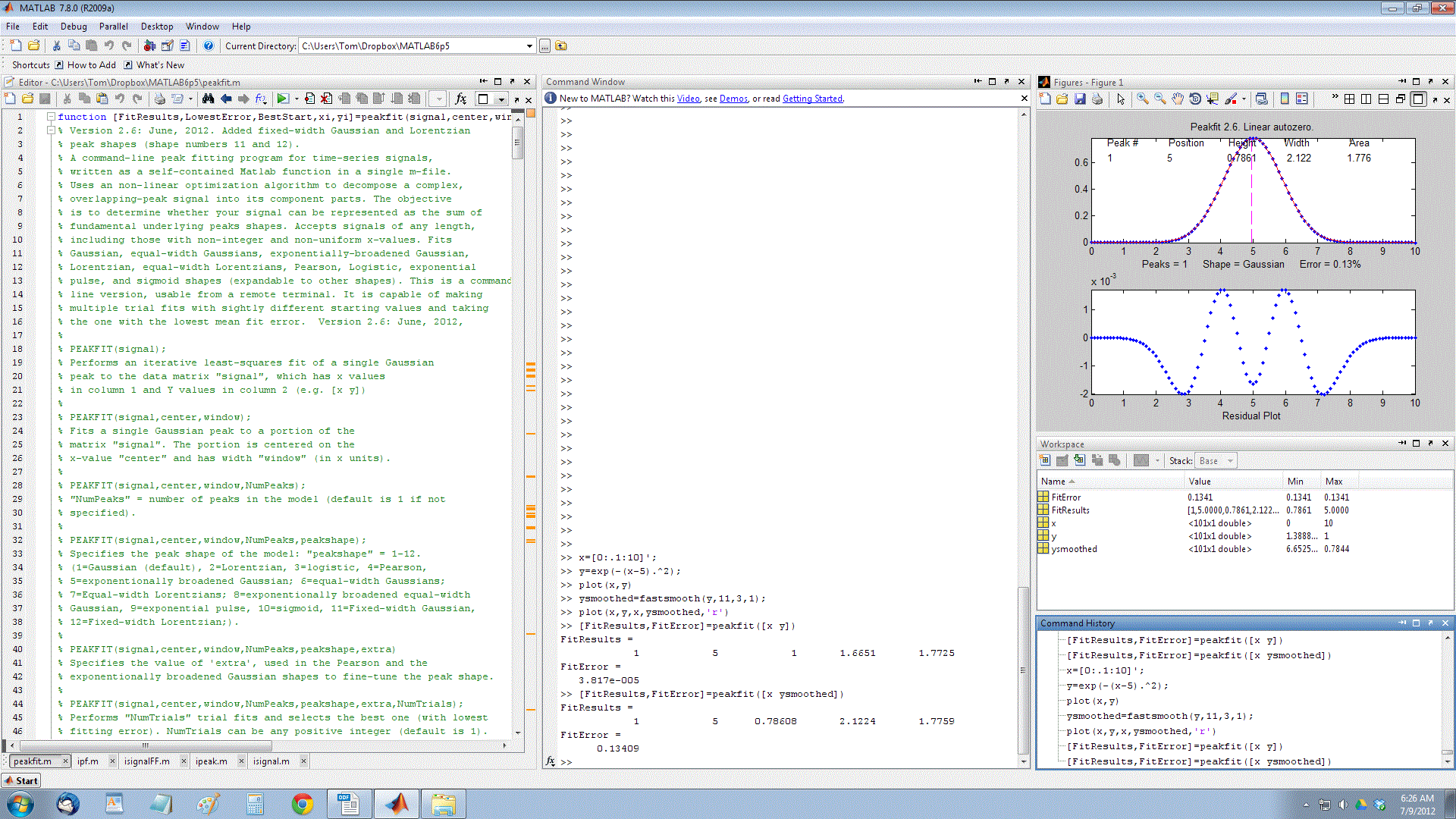
Matlab, a
high-performance commercial numerical computing environment and
programming language that is widely used in research and
education. For Windows, Macintosh, and Linux. Lower-cost
Home and Student versions available.
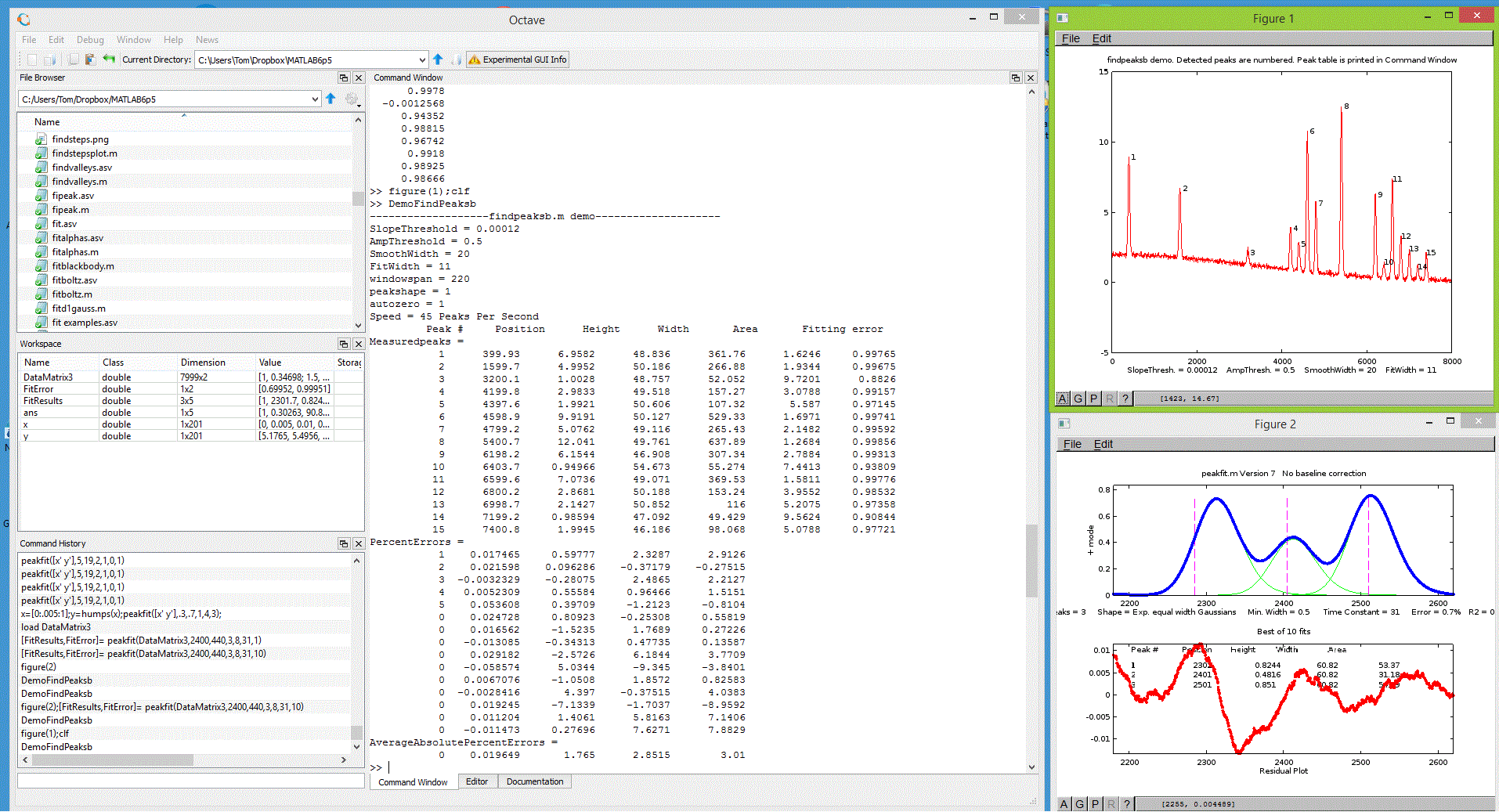
Octave, a freely
downloadable alternative to Matlab, mostly compatible. For
Windows, Macintosh, and Linux.
Python,
with the Spyder desktop
interface, a fast and free general purpose language for Windows,
Unix, and Macintosh.
Microsoft Excel
OpenOffice Calc
Acknowledgements
Thanks to my graduate
students, many of whom worked with the techniques
described within, to M.
Farooq Wahab for his many contributions and for many
fruitful discussions, to Baldassarre Cesarano for his close
reading and typographical correction of this text, to Dr.
Raphael Attie of NASA/Goddard Space Flight Center for
corrections, to Diederick C. Niehorster of The University of
Hong Kong for code contributions, to Yuri Kalambet of
Ampersand Ltd. for
mathematical insights, and to the many email
correspondents who have made suggestions, asked questions,
caught errors, and have shown me new types of data and new
applications that have broadened the scope of this work.
Related presentations for the Rockville
Science Center, Rockville, Maryland
Unsolicited Comments from Users
(verbatim excerpts from emails):
"What I found here is simply
amazing!"
"...a masterful book.
I find your explanations beautifully
clear...."
"It's by far the best
document I've found about signal processing online."
"It is the best source in the
entire internet ... on peak related techniques and
analysis. "
"...the most understandable documentation
I've ever encountered!"
"It is as good as, if not better than, any similar books available
in the market".
"...a clear, organized,
accessible, and intuitive resource...."
"It is a great motivation for
me to find inspiring scientists like you who share
their findings and knowledge with the rest of the community with
the intent of pushing the limits of science."
"I ... have never seen before (I have years of
experience in this field) such a complete
approach towards tackling almost all the analysis
problems from scratch...."
"...the most extensive set of
tools I've ever found for curve fitting and signal
processing!"
"I'm amazed by the
thoroughness of not just the explanations, but also the
codes and documentation within."
"It's simply phenomenal!
"
"I appreciate the fact that your approach is
'applied' and does not resort to complex
mathematics where not needed"
"Your website and scripts are amazing;
I am confident there is no [more] useful content in data
analysis for physical chemistry better than yours...."
"I will certainly use your resources for the rest of my career.
" ...an invaluable resource
in my research."
"...your website resource was able to teach me everything I needed to know in a
really practical and easy to understand way within a few days
and apply it to my ... work (which is incredible!!).
"
"I found your tutorials and explanations among the easiest to understand in this complex
field"
"...a goldmine."
"...my gratitude to you for sharing such high quality content"
"...wonderful and
user-friendly...."
"...your work was a godsend."
"... surely the way into
heaven is to post excellent software online
for others to use to do science."
"I am a great admirer of your excellent work. Your unparalleled contribution to signal
processing helped me to understand the nuances of signal
processing."
"Without your help ...we'd still be slogging through
the data...."
"...many thanks for sharing your brilliant book on the web. I have found
it of tremendous value...."
"it inspires me to make my
own contribution to science and education."
"I wanted to extend my gratitude for the quality of
the guidance and education you provide. I am a professional
analytical chemist, and your site has
kept me well versed and knowledgeable...."
"I ... am very impressed with
the clarity of the presentation."
"I like your writing style because it's clear and concise, and your prose flows
so smoothly."
"The signal processing topics you cover are so wonderfully practical...truly impressive."
"... truly one of best
practical description I have ever seen."
"...thank you for this valuable
treasure."
"Thank you very much for making such an extensive
collection of most valuable material
available to the public !!! Your service to the public (that
part that recognizes its value) is highly appreciated."
"...brilliant work...."
" ...thank you for your amazing
online book...."
"I liked the way everything is setup and
explained."
"...I think it's the best
explanation I've ever seen."
"...thank you for the immense
role your book has played in my perusal of
research...."
"...really incredible work!"
"... a really excellent website...."
"It is a great overview"
"...a very valuable service
to our profession!"
"...an extraordinary labor
of love and a gift to many, many people!"
"Thanks again for your generous contributions to the
scientific and engineering community....your work is greatly
appreciated and will continue to benefit us for years to
come." MathWorks, Inc.
Copyright (c) 2025
Thomas C. O'Haver (toh@umd.edu)
Permission is hereby granted, free of charge, to any person
obtaining a copy of this software and associated documentation
files (the "Software"), to deal in the Software without
restriction, including without limitation the rights to use, copy,
modify, merge, publish, distribute, sublicense, and/or sell copies
of the Software, and to permit persons to whom the Software is
furnished to do so, subject to the following conditions:
The above copyright notice and this permission notice shall be
included in all copies or substantial portions of the Software.
THE SOFTWARE IS PROVIDED "AS IS", WITHOUT WARRANTY OF ANY KIND,
EXPRESS OR IMPLIED, INCLUDING BUT NOT LIMITED TO THE WARRANTIES OF
MERCHANTABILITY, FITNESS FOR A PARTICULAR PURPOSE AND
NONINFRINGEMENT. IN NO EVENT SHALL THE AUTHORS OR COPYRIGHT HOLDERS
BE LIABLE FOR ANY CLAIM, DAMAGES OR OTHER LIABILITY, WHETHER IN AN
ACTION OF CONTRACT, TORT OR OTHERWISE, ARISING FROM, OUT OF OR IN
CONNECTION WITH THE SOFTWARE OR THE USE OR OTHER DEALINGS IN THE
SOFTWARE.
First edition created in
1995. Last updated April, 2025. This site is a retirement
project and international community
service, created and maintained by Prof. Tom O'Haver,
Professor Emeritus, Department of Chemistry and
Biochemistry, The University of Maryland at College
Park. Comments, suggestions and questions should be directed
to Prof. O'Haver at toh@umd.edu,
currently residing in Naples, FL, and in Silver Spring, MD.

 and PDF
 formats. Readability index



 Department of Chemistry and
Biochemistry, The University of Maryland at College
Park. Comments, suggestions and questions should be directed
to Prof. O'Haver at toh@umd.edu,
currently residing in Naples, FL, and in Silver Spring, MD.
Department of Chemistry and
Biochemistry, The University of Maryland at College
Park. Comments, suggestions and questions should be directed
to Prof. O'Haver at toh@umd.edu,
currently residing in Naples, FL, and in Silver Spring, MD.