Problem 5-1.
Solution:
(1) Since 285 of the 300 data range from 104.4 Gpa to 143.6 Gpa,
the 104.4 to 143.6 represents a 95% confidence interval.
According to N(0,1) table, for a 95% confidence interval,
Zupper. lower = ±1.96
s = (Xupper - m) / Zupper = (143.6 - 124) / 1.96 = 10
(2)
The missing data is 129.3
(3)
Mean of the 16 samples is 128.0.
Standard deviation of the 16 samples is 17.4.
For a 95% confidence interval:
Zupper. lower = 1.96
Xupper,lower = m + Zupper,lower s = 128.0 + (±1.96) * 17.4 =
162.1,93.9
(4)
Now we use t-distribution to construct the 95% confidence interval.
For v = 16-1 = 15, a = 0.95, tcritical = 2.131
Xupper, lower = X ± tcritical s = 128.0 ± 2.131 * 17.4 = 165.1, 90.9
(5)
Compare the two judgements obtained from (3) and (4), we can see that for
the same 95% confidence interval, the confidence limits obtained from
t-distribution is wider than that obtained from normal distribution.
Problem 5-3.
Solution:
From the t-distribution table, the critical t-values for 7 degrees
of freedom (v=8-1=7) and a significance level of 10% (=1-0.90=0.1)
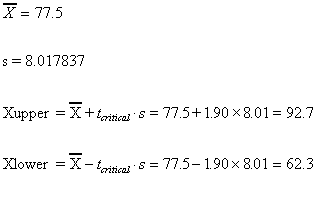
is tcrit=1.90.
He will have a score between 62.3 and 92.7 with 90% confidence
interval.
Problem 5-4.
Solution:
1)

Unpaired t-test is used to compare the two groups.
a. State the null (H0) and alternative (H1) hypotheses.
H0: 1=2 ( No difference in noises between the two sanders)
H1: 1<2 ( The noise level of Sand1 is
lower than that of Sand 2)
b. Select the significance level for the test: =0.10
c. Calculate the critical and observed t-values.
For this problem, a one sided t-distribution table is used (H1 includes "<")
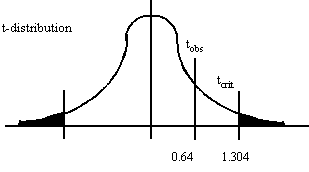
tcrit=t(v=38, =0.1)=1.304
The observed t-value is computed below.

d. Since tobs<tcrit, the null hypothesis
(H0) can not be rejected. Therefore, there is no difference in
the noise level.
(2)
Sand. 1


Paired t-test is used to compare the two groups.
State the null(H0) and alternative (H1) hypotheses:
H0: D=0 ( No difference in noise between the two groups)
H1: D0 ( Difference in noise level between the two groups)
b. Select the significance level for the test: =0.10
c. Calculate the critical and observed t-values.
For this problem, a two sided t-distribution table is used .
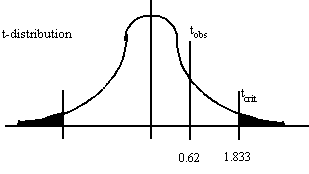
tcrit=t(v=9, =0.1)=1.833
The observed t-value is computed below.
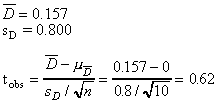
d. Since tobs<tcrit, the null hypothesis
(H0) can not be rejected. Therefore, there is no difference in
the two grou ps.