Homework Assignment 4
Problem 2-4.
Solution:
(1)  = (3.50-3.50)/2 = 0
 = ( 1.712 + 1.712 )/4= 1.462
(2)  = (3.50+3.50)/2 = 3.50
= ( 1.712 + 1.712 )/4= 1.462
Problem 3-1.
Solution:
Let's consider the defective rate of each of the three suppliers when
producing the part we need.
For supplier 1, the defiective rate is calculated as following:
P( Z<1.491) + P( Z>1.509 ) = P( X<(1.491-1.5)/0.003 ) + P(
X>(1.509-1.5)/0.003 )
= P( X< -3 ) + P( X>3) = 2* (
1-P(X<3))
= 2 *(1-0.9987 ) = 0.26%
For supplier 2, the defiective rate is calculated as following:
P( Z<1.491) + P( Z>1.509 ) = P( X<(1.491-1.5)/0.0022 ) + P(
X>(1.509-1.5)/0.0022 )
= P( X< -4.09 ) + P( X>4.09) = 2*
( 1-P(X<4.09))
= 2 *(1-1) = 0
For supplier 3, the defiective rate is calculated as following:
P( Z<1.491) + P( Z>1.509 ) = P( X<(1.491-1.4950)/0.0015 ) + P(
X>(1.509-1.4950)/0.0015 )
= P( X< -2.67 ) + P( X>9.33) =
1-P(X<2.67)= 1- 0.9962 =3.8%
The shade area in the following three figures shows the defective rate of
different suppliers.
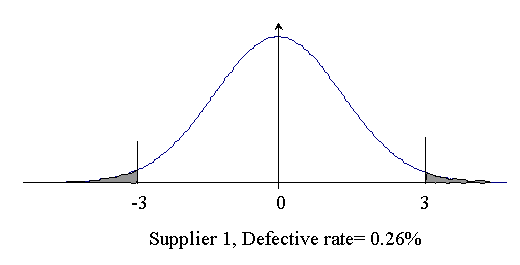
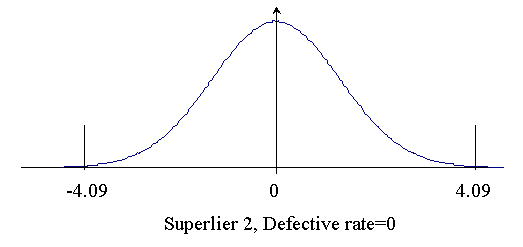
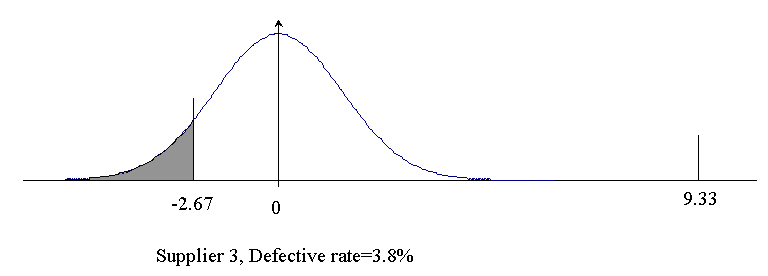
According to our calculation and the figure, we can see that
supplier 2 provides the highest qulity. So we will purchase from supplier
2.
Problem 3-2.
Solution:
a. For a centered process:
 >= 1.25
 <= 0.0004
b. >= 1.25
<= 0.00027
Problem 3-3.
Solution:
(1)  = 1
= 1
 = (USL-LSL)/6 = (200.5-200.0)/6
=1/12
= (USL-LSL)/6 = (200.5-200.0)/6
=1/12
The percentage of non-conforming products:
P(Z<200.0)+P(Z>200.5) =
P(X<(200.0-200.2)/(1/12))+P(Z>(200.5-200.2)/(1/12))
= P(X<-2.4)+P(X>3.6) = 1-P(Z<2.4)+1-P(X<3.6)
= 2-0.9918-0.9998 = 0.0084 = 0.84%
The percentage of non-conforming products is 0.84%.
(2) In order to keep the non-conforming product percentage at minimum, the
center of the process should be the same as the center of the
tolerance.
So:
 = 200.25 and = 1/12
The percentage of non-conforming products:
P(Z<200.0)+P(Z>200.5) =
P(X<(200.0-200.25)/(1/12))+P(Z>(200.5-200.25)/(1/12))
= P(X<-2.4)+P(X>3.6) =
1-P(Z<3.0)+1-P(X<3.0)
= 2-0.9987*2 = 0.0026 = 0.26%
The percentage of non-conforming products is 0.26%.