2.5 Assume that Z represents a normal random variable with mean equals 0 and standard deviation euqals 1.
(1) Determine P (Z>1.50); (2) Determine P (-2.2<Z<2.3); (3) Determine P (0<Z<3).
According to the Cumulative Standard Normal Distribution Table N(0,1):
(1) P (Z>1.50) = 1- 0.9332 = 0.0668
(2) P (-2.2<Z<2.3) = P(Z<2.3) - P(Z<-2.2) = P(Z<2.3) - 1 + P(Z<2.2) = 0.9893-1+0.9861= 0.9754
(3) P (0<Z<3) = P(Z<3)-P(Z<0) = 0.9987-0.5000=0.4987
2.6 The SAT scores for university admission are normally distributed with mean 1055 and standard deviation 75. What fraction of the SAT scores lie between 1100 and 1200?
According to z=
 ,
,For x1=1100, z1=(1100-1055)/75=0.6
For x2=1200, z2=(1200-1055)/75=1.93
According to the Cumulative Standard Normal Distribution Table N(0,1):
P (0.6<Z<1.93)=P(Z<1.93)-P(Z<0.6)=0.9732-0.7257=0.2475
So the fraction of the SAT scores lie between 1100 and 1200 is 0.2475.
2.7 Products come form a machine. An inspector picks up four products and measu$ the diameter of each of the four products. The average of the four measured num$ will be plotted on the control chart shown in the figure. The upper and lower control limits are constructed based on the principle of
 limits, i.e.,
  below
and a$
the center line, respectively.
below
and a$
the center line, respectively.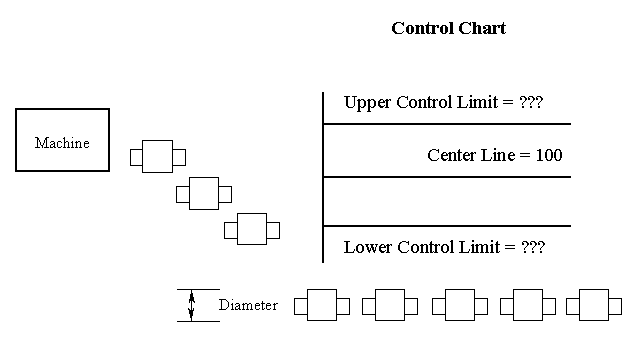
We know that the diameter produced by the machine varies with mean = 100mm and standard deviation = 0.12mm. Calculate the upper control limit and lower control limit for the control chart. Remember that we are using the principle of
limits.
In this question, we know the population mean and population standard deviation.
Population mean is:
 =100mm.
Population standard deviation is:
 =0.12mm
Now, the inspector picks up 4 products as a sample every time, and measure their average value. According to the Central Limit Theorem, the mean of the sample equals to the mean of the population, which is 100. And the standard deviation of the sample is:
Standard deviation of the sample:
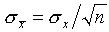 =0.12/2=0.06
The upper control limit = 100 + 3*s = 100 + 3*0.06 = 100.18
The lower control limit = 100 - 3*s = 100 - 3*0.06 = 99.82
2-8. In problem 7, assume that a new inspector is assigned to this position. In$ of picking up 4 prodcuts, he picks up 9 products. Should the center line be modified? should the control limits be modified? If yes, determine them. Provide your comments when you do your calculations.
According to the Central Limit Theorem, we know that the mean of the sample equals to the sample of the population. So even though, now the inspector picks up 9 products, the mean of the sample keeps unchanged. As a result the centerline of the control chart should keep unchanged.
But according to the Central Limit Theorem, when the size of the sample changes, the standard deviation of the sample will change too. So the control limit should be modified.
Standard deviation of the sample:
=0.12/3=0.04The upper control limit = 100 + 3*s = 100 + 3*0.04 = 100.12
The lower control limit = 100 - 3*s = 100 - 3*0.04 = 99.88