ENSE 627 QUALITY MANAGEMENT IN SYSTEMS
Spring 1998
Homework Assignment 9, Due 6:30 pm, April 15, 1998
Chapter 6. Design of Experiments
6.6 Assignment Problems ( Page 6-28, 6-29 )
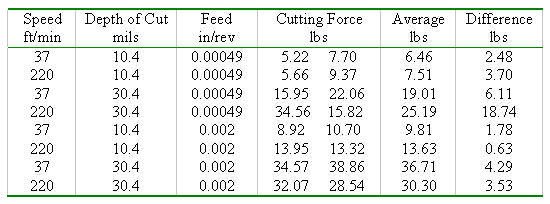
6-4. The following table are data in standard order from a
 factorial
design. The three variables are cutting speed, depth of cut, and feed. The
system response is the cutting force measured during the tests. You may
notice that two individual runs were performed at each of the eight tests.
factorial
design. The three variables are cutting speed, depth of cut, and feed. The
system response is the cutting force measured during the tests. You may
notice that two individual runs were performed at each of the eight tests.
(1) Calculate the main effects and the effects of two-factor interactions
(assuming the three-factor interaction is negligible).
(2) Estimate the standard error of an effect.
(3) Identify those effects which are significant with respect to the
estimated standard error.
(4) Derive an empirical model which describes the functional relationship
between the cutting force and the three cutting parameters.
(5) Interpret the derived empirical model.
6-6. A  factorial design was conducted producing
the following test results.
factorial design was conducted producing
the following test results.
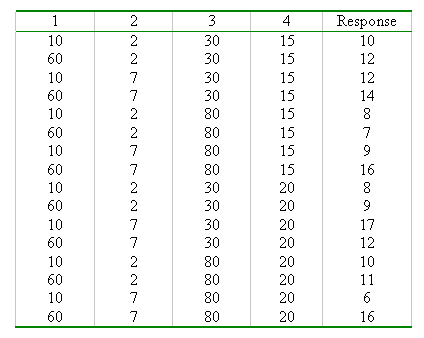
Calculate the estimates and derive an empirical model representing
the data.
6-7. Use the data provided in Problem 6-6.
(1) Decompose the 16 runs into tow data sets. The first data set resembles
the results from a fractional factorial design with the generator equal to
I = 1234. The second data set resembles the results from a fractional
factorial design with the generator equal to I = -1234. Write all the
confounding patterns associated with each of the two generators.
(2) Calculate all the estimates based on the first data set and derive the
empirical model.
(3) Calculate all the estimates based on the second data set and derive
the empirical model.
(4) Combine the results obtained in (6) and (7) and derive the empirical
model.
(5) Compare the three models derived in Problem 7 with the model derived
in Problem 6. Comment on your observation.