Homework Assignment 6
Problem 5.6.1
Problem 5.6.2
Problem 5.6.3
Problem 5.6.4
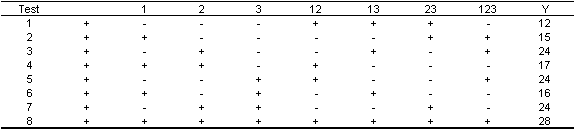
1. A 23 factorial design was conducted
to study the influence of temperature(x1), pressure (x2), and
cycle time(x3) on the occurrence of splay in an injection-molding
process. For each of the eight unique trials, 50 parts were make
and the response observed was the number of incidences of the
occurrence of splay on the part surface across all 50 parts. The
design matrix and test responses are given in the table.
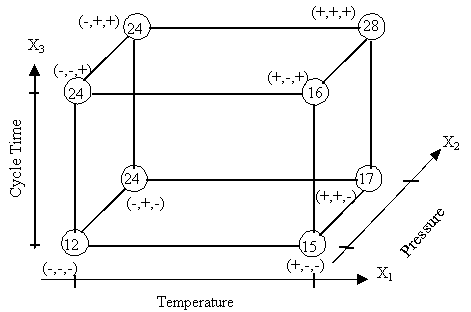
a. Draw the geometrical representation of this experiment and
label each corner of the cube with the corresponding test conditions
(e.g. +,-,+) as well as the test response.
b. Calculate the main effects of all three variables.



c. Calculate all the two- and three-factor interaction effects.




d. Write down the appropriate mathematical model, assuming that
all estimated effects are to be included in the model.


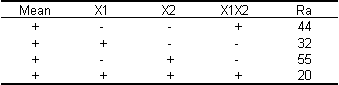
2. A 22 factorial experiment was
conducted to determine the effects that tool surface coating (x1)
and the application of cutting fluid(x2) might have on the surface
finish of a turned part. The low level for each of the two variables
represented the absence of the technology in question(i.e., no
surface coating, no cutting fluid). The high level represented
the technology at some commercially recommended level. The response
is the part surface finish in microinches( Ra value)
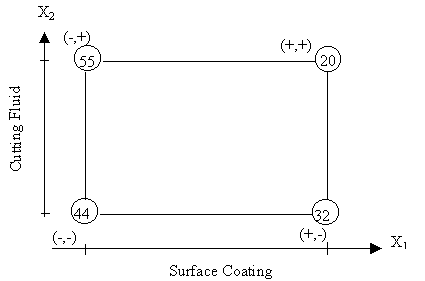
a. Draw the geometrical representation of this experiment.
b. Calculate all the variable effects.



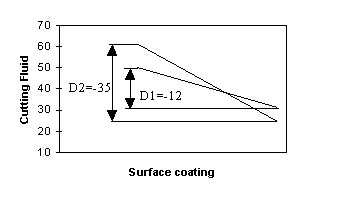
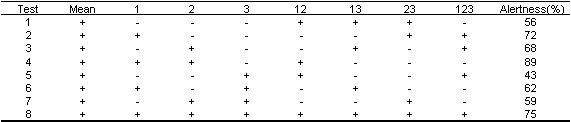
3. A 23 factorial design was constructed
to test the effect of three different variables on the alertness
of students I an early morning class. The variables tested, the
design matrix, and t responses are shown in the tables.









4. The following table are data in standard
order from a 23 factorial design. The three variables
are cutting speed, depth of cut, and feed. The system response
is the cutting force measured during the tests. You may notice
that two individual runs were performed at each of the eight tests.
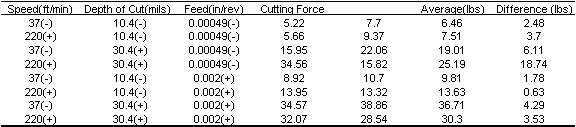
(1) Calculate the main effects and the effects of two-factor interactions






(2) estimate the standard error of an effect.

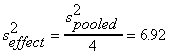


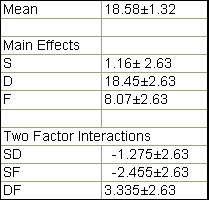
(3) The significant effects are depth of cut and feed.
(4) Derive an empirical model which describes the functional relationship
between the cutting force and the three cutting parameters.
