Several recommendations can be made for future work to test different
structured models. Besides varying the pore size and shell thickness,
some other interesting model variations include testing different strut
thickness, plate offset distances, ridge geometry, and plate thickness.
However, it is important to use a control model from which only one feature
is varied at a time. This isolates the cause of certain changes in
stress as different models are analyzed.
Varying the strut thickness will create more or less support for different pore sizes. While it is important to reduce the amount of material within the core of the ridge, it is still important to maintain strength within the lattice of the plate. As the FEA results showed, larger pore sizes cause greater stress concentration on the structure, however, increasing the strut thickness between pores may simultaneously reduce stress. It important to keep in mind that although increasing strut thickness will decrease the stress for larger pore sizes, it also increases the material within the core.
The plate-offset distances effect the amount of interconnectivity between the plates. Interconnectivity is another important consideration when designing the dental ridge because proper interconnectivity between the plates allows for the blood to flow properly through the structure. Greater horizontal and vertical offsets of every second plate will cause less material overlap between the plates.
The geometry of the structure presents another interesting design consideration. The geometry of the ridge should have some type curvature to most realistically represent the real life bone structure. However, the geometry of the plates within the core of the structure can have any geometry as long as they provide adequate support and interconnectivity. The geometry of the ridge tested in this analysis was that of an ellipse with a major inner diameter of 20mm and a minor inner diameter of 10mm. The plates within the core were simply flat rectangular plates and were stacked along the height of the ridge. Ellipses of different major to minor diameter ratios, cylinders, or even some 3-point splines could be tested.
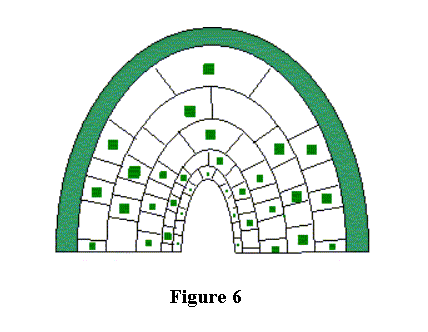
Additional tests were done on an elliptical shell and a cylindrical shell, both without inner core material, to show the difference in stress due to varying the shell geometry. Appendix C shows four analyses, two shell thickness cases for each shell geometry. The elliptical shell shows an overall lower stress distribution the ridge. Higher stress exists on the sides of the shell in both cases. Also, the geometry of the plates within the core can be changed to follow the curve of the shell, where it would be hollow in the center most part of the core (see figure 6). This model would still allow interconnectivity between the plates as long as they were still offset and may be a closer representation of the actual pore layout within a bone. The geometry of the pores could also be circular instead of square.