Methodology
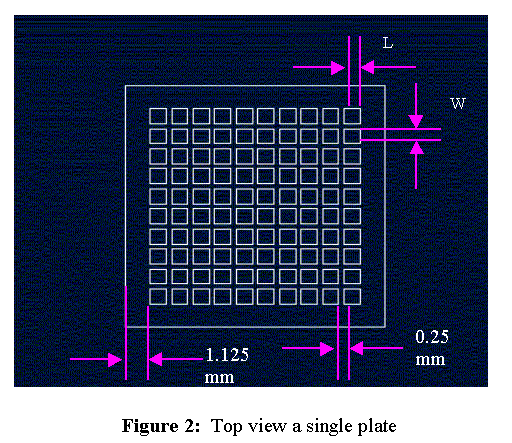
The first step in forming the dental ridge was to model a single flat
plate with a length, width and thickness of 1.0 mm. Square
pores were cut from the solid plate to generate a lattice through the core
of the structure.
-
Different Cases:
-
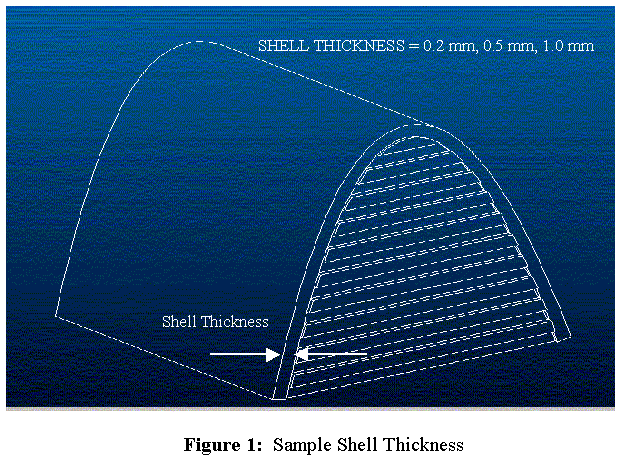
Varied Shell Thickness:
There were four distinct structures that were created, three of which
were analyzed due to computer problems that the team faced. In all
the structures that were created and analyzed, the pore size and the shell
thickness were modified one at a time while the strut thickness, distance
of pore from edge and the thickness of a single plate were held constant.
The dimensions of the shell thickness used were:
-
Varied Pore Size with Constant Strut Thickness:
A constant strut thickness of .25 mm was used with following pore size
dimensions:
-
0.5 mm x 0.5 mm
-
0.75 mm x 0.75 mm
-
1.0 mm x 1.0 mm
-
Layering Information
Once the lattice of the first plate was formed, it was copied into
nineteen more layers, making a total of 20 layers. The second plate
was offset from the first plate 0.25 mm in both the x and y-planes.
The rest of the plates were offset in an alternative manner. Thus,
the second, fourth, sixth, eighth and tenth plates were offset in the same
manner from the first, third, fifth, seventh and ninth plates.
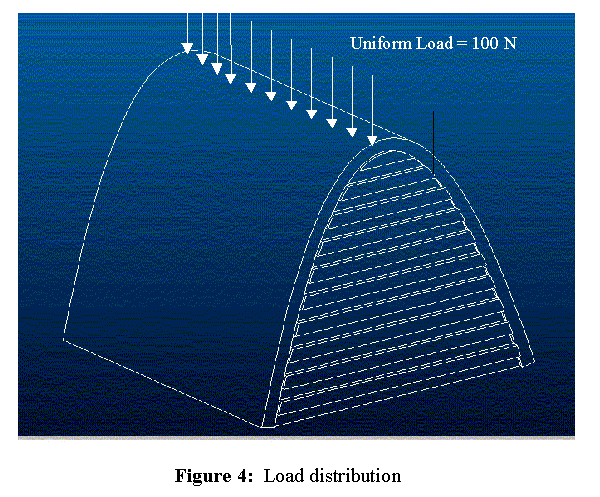
The analysis of the structures depended on an applied uniform load
of 100 Newtons per unit area. The team divided the structure and
applied the load to only one fourth of the shell. The load was uniformly
distributed along the top axis of the ridge as shown in Figure 4.