|
|
Address Modes Commonly Used in Commercial Processor Architectures: Operands in memory can be fetched and stored (and in general operated on) using a number of addressing modes. The most common addressing modes are Immediate Example: Load immediate (operand is in the instruction code): LDI R0,1; (1 is loaded into R0) Relative Example: Load relative (operand is in location PC + address) where the address is a 2's complement number- LDR R0,100; The operand in location PC + 100 is loaded into R0. Direct Example: Load direct (operand is in address)- LDD R0,100; The operand in location 100 is loaded into R0. Indirect Example: Load indirect (operand is in address in address)- LDT R0,100; The operand in location whose address is in 100 is loaded into R0. Indexed Example: Load indexed (operand is in the location whose address is in the index register)- LDX R0,100,2; The operand in location (IX)+100 is loaded into R0; IX is incremented by 2 after the load. Register Example: Load register (operand is in the location whose address is in a register)- LDG R0,R1; The operand in location (R1) is loaded into R0. Autoincrement Example: Load register+ (operand is in the location whose address is in a register)- LD+ R0,R1; The operand in location (R1) is loaded into R0. R1 is incremented after the load Autodecrement Example: Load register- (operand is in the location whose address is in a register)- LD+ R0,R1; R1 is decremented before the load and the operand in location (R1) is loaded into R0. 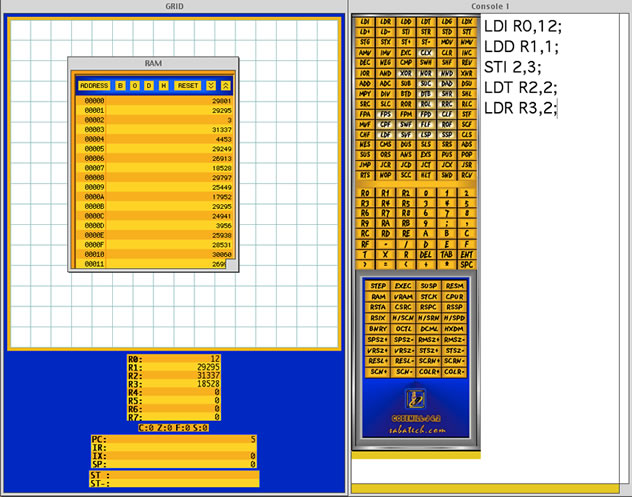 |