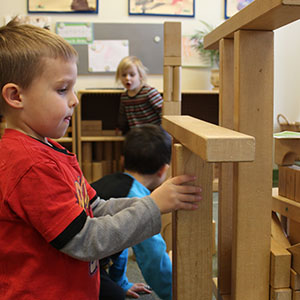
Preschool classrooms at the CYC include children ranging from three to five years of age. Research shows that multi-age groupings benefit both younger and older students in the classroom. According to Dr. Lilian Katz, an international leader in early childhood education, "Mixed-age grouping resembles family and neighborhood groupings, which throughout history have informally provided much of children's socialization and education (from The Case for Mixed-Age Groupings in Early Education, 1990)."
Children's personal and social development is enhanced through the building of relationships within the classroom community. Teachers and children interact through conversation, free-choice of activities, and daily class meetings in which children participate in the progression of the class study. Children are encouraged to explore and discover within their immediate world, and teachers act as recorders of their ideas and experiences. Children are expected to learn to follow classroom rules and routines, and are given the needed assistance in developing positive conflict resolution skills.
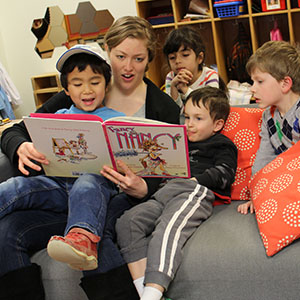
When a child walks into a classroom at the CYC, a language-rich environment will surround him or her. Book areas are an integral part of every classroom, where a child is able to spend quiet time looking at books on his own or within a group. Books are also integrated into other areas of the curriculum, with non-fiction picture books available at the science table or books about shapes displayed above the math center. Through exposure to different types of children's literature, the teachers encourage a deep appreciation of reading. Children will see the teachers writing down their ideas during meetings and work with language experience charts, thus being exposed to language and literature within a meaningful context. Teachers become aware of individual children's stages, and in turn provide the appropriate materials and experiences to build upon every child's development.
To encourage mathematical thinking, preschool children need to be given the opportunity to explore and experience. Inviting materials are available for counting, sorting, measuring, patterning, and seriating. Teachers model appropriate ways for using materials and children are given the choices of what to use. Children can set up a table with sorting trays and a basket of small, plastic farm animals. They then have the opportunity to look at the materials and choose criteria by which to sort them. Each classroom has an extensive block area in which children can build using Unit Blocks and explore issues of size, proportion, and position.
Building skills through experience also applies to scientific thinking. Given magnifying glasses, children can explore their class gardens, the class pet, or a leaf collected on the playground. Many study topics provide scientific experiences for observations, such as "Gardening" or "Insects." Teachers assist the children by asking scaffolding questions and encourage them to become scientific thinkers who ask questions and research answers.
Each CYC classroom features a dramatic play area that allows children to explore the world through imaginative play. From clothes to dress up in and props that encourage play, to large hollow blocks to create structures to interact in, children use the dramatic play area to try to better understand the world around them. Teachers observe play and encourage children to represent their experiences through play. For example, following a field trip to a veterinarian's office, children may wish to create their own version within this area. Teachers help children decide on props and rules to allow for this representation. Opportunities such as these help to build children's social studies learning.
Art experiences include drawing, easel painting, collage and clay. Daily exposure to these materials allows children to continue to build their skills throughout their years at the CYC. Children are given the opportunity to express themselves freely through these media and are encouraged to share their work with others. Throughout the week, classes participate in group music and movement activities, such as fingerplays, singing, or creative movement activities based on familiar stories.
Children develop physical skills through movement and activity. Morning and afternoon playground time is part of the daily schedule to allow for gross motor activity. Our playground offers the opportunity to run, climb, slide, ride tricycles and scooters, and play ball. In the classroom, children develop fine motor skills by working with art and writing tools, puzzles, and computers. Various manipulative materials are available for children to explore while developing their fine motor skills.