


American Museum of Natural History
November 22nd, 2025: New York City, New York
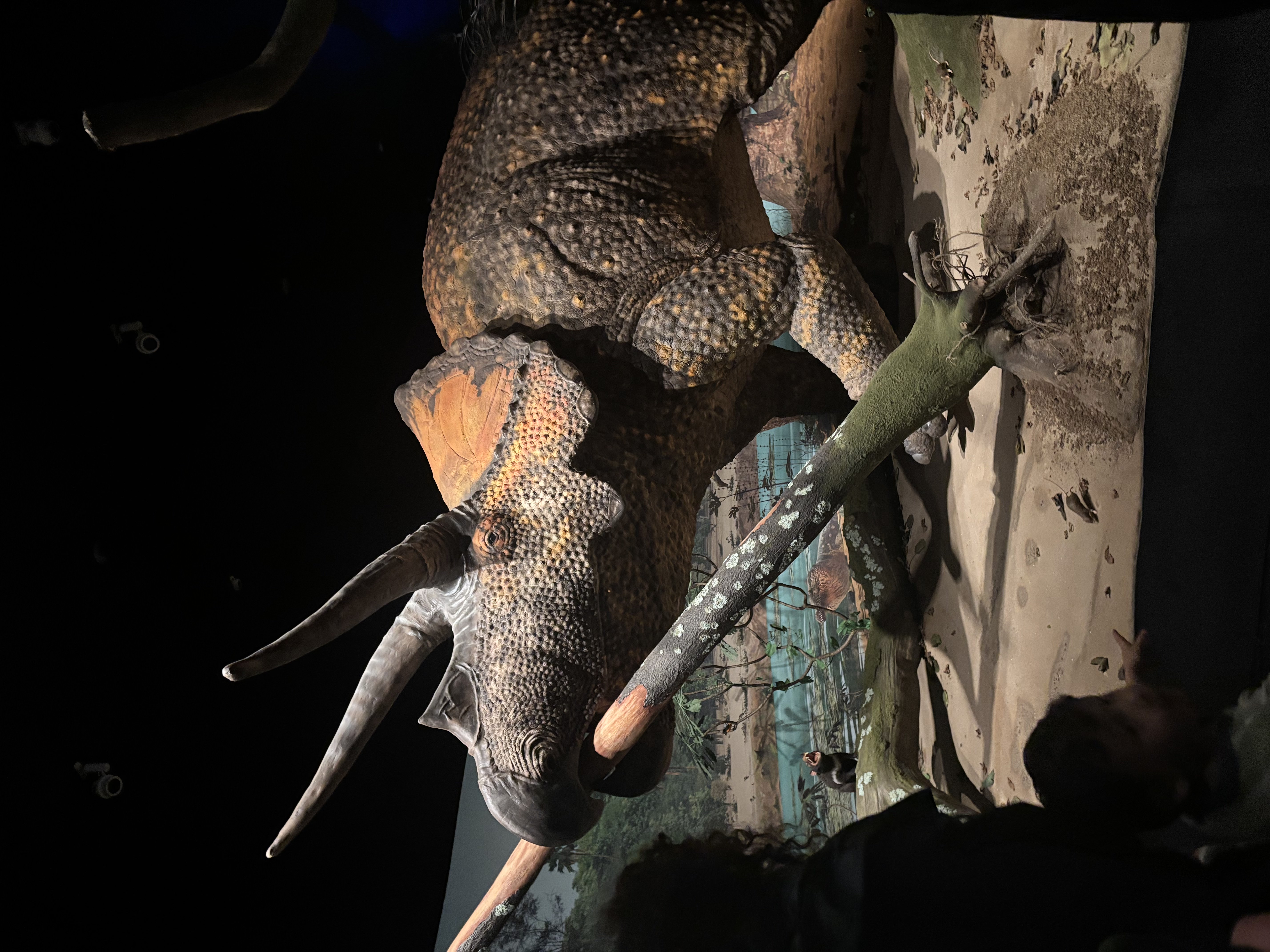
Life Size Model of a Triceratops in the Impact: The End of the Age of Dinosaurs Exhibit
On November 22, 2025, scholars in science and global change had the opportunity to travel to the American Museum of Natural History in New York City to explore different exhibits focused on paleontology, biology, and astronomy. The first stop was the 10:30 AM guided tour of the temporary exhibit Impact: The End of the Age of Dinosaurs. This exhibit worked like a walkthrough timeline of the asteroid impact 66 million years ago, moving from the world before the strike, through the extinction itself, and into the recovery of life afterward. One of the displays I liked most was the Triceratops habitat near the beginning. It had a large model of the dinosaur with a projected background of the sounds and environment it would have lived in, which made it feel really immersive without having to read a lot of text. Later in the “aftermath” section, there was a small station where you could lift a screen and smell the smoke from fires that would have followed the impact. It sounds simple, but it made the event feel much more real. The overall message tied everything back to Earth's history today and showed how the extinction of dinosaurs opened space for the mammals that eventually evolved into us.
After that, I went on a guided tour of the Hall of Vertebrate Origins with Dr. Merck. The whole hall is organized using cladistics, so the room is set up like a giant evolutionary tree. The lines of the tree are drawn across the floor, connecting different fossil specimens at the “branches.” One of the most memorable fossils we saw was Stenopterygius quadriscissus, an ichthyosaur fossilized while giving birth. It showed how some marine reptiles eventually evolved to carry eggs inside instead of laying them on land. We also learned about Pterosaurs and how one of their fingers evolved into the main support for their wings. One issue with the hall is that some of the evolutionary placements are outdated, like where the turtles are located on the floor diagram. Since the tree is built into the floor, updating it isn't simple. Using projected lights or a small handout with the corrected layout might solve this problem without completely rebuilding the exhibit.
For the self-guided portion of the trip, I explored the North American Mammals Hall. This hall is organized by region and biome, which makes it easy to follow. I was especially interested in the Mountain Goat display, which mentioned that baby goats can climb almost anywhere their mothers can within just a week of birth and can scale 75 feet in a minute. Another display that stood out was the White-Tailed Deer from New York. It explained how removing predators like wolves and cougars caused deer populations to grow too large, which now prevents new trees from growing and actually harms the deer long-term. I also stopped by the American Mink display, set in the New Jersey Pine Barrens. It explained how wild minks are deep brown, while farmed minks are bred in many colors for fashion.
Later in the afternoon, I went to the Space Show titled Encounters in the Milky Way, narrated by Pedro Pascal. The show focused on how our galaxy formed and evolved and took us from the solar system out to the edges of the Milky Way. The visuals were a mix of real scientific models and cinematic effects, which made it really engaging while still based on actual data. One thing I learned that I didn't know before was about the collision between the Sagittarius dwarf galaxy and the Milky Way, which scientists confirmed using data from the Gaia mission. Seeing that on a huge dome screen made the scale of the galaxy feel even more unreal compared to Earth.
Looking back on the whole visit, it's clear that the American Museum of Natural History puts a lot of effort into accessibility. I noticed plenty of elevators and open walkways that made it easy for people with strollers, wheelchairs, or mobility aids to move through the museum. They also included tactile objects like touchable fossils, which help visitors who are visually impaired. Many of the screens around the exhibits offered different languages, and maps were available in multiple languages too, which helps a lot for international visitors. Overall, the excursion blended clear science communication with engaging and accessible exhibits, and it made the experience both fun and meaningful.