


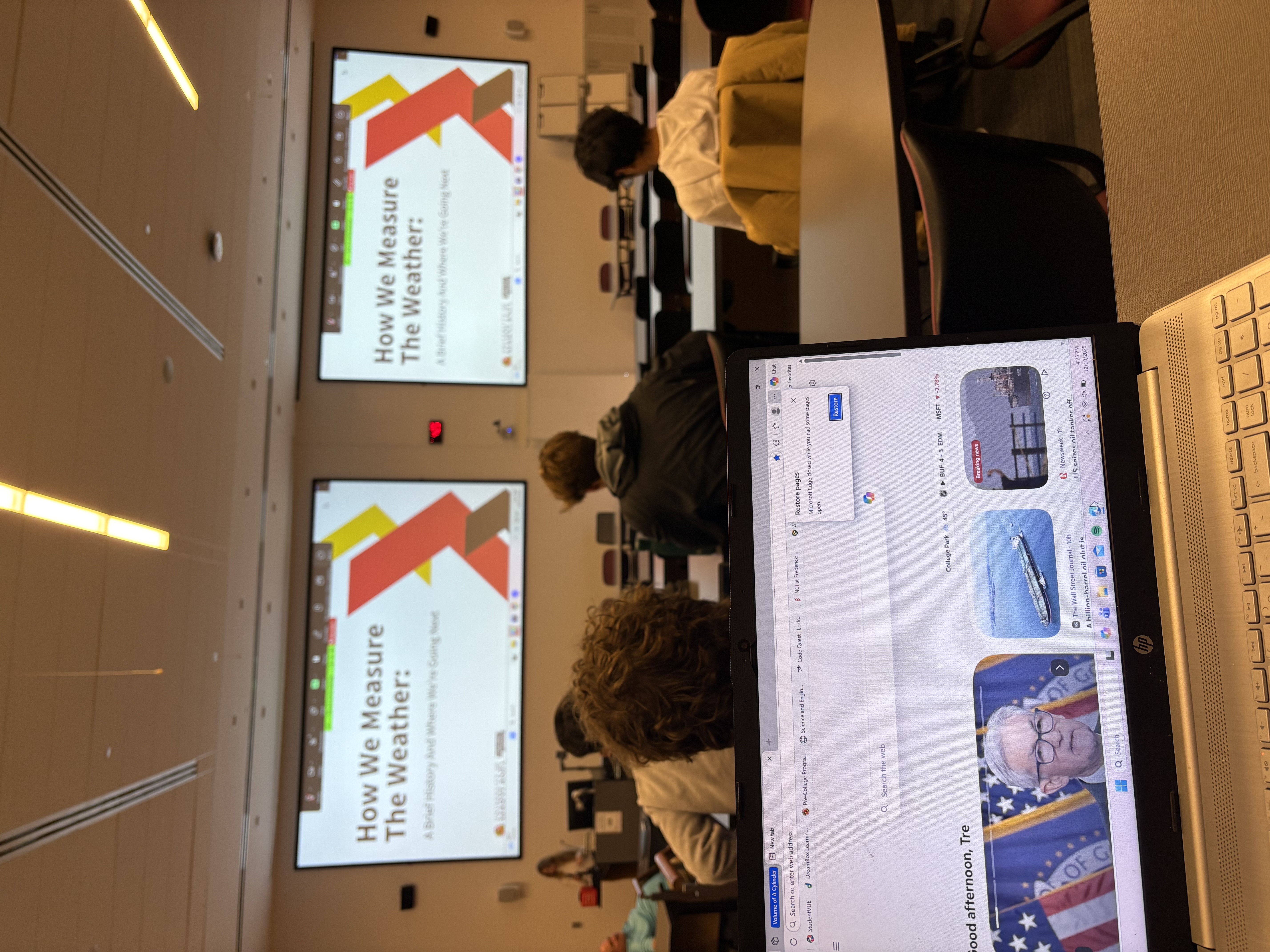
The seminar began covering the development of meteorology, delving into the history of the rain gauge, stating meteorology had been developing since 3rd century India during monsoon season. Through sanskrit and verbal communication they were able to cover how much water was gathered in a season. The first quantifiable/measurable form of meteorology came from Korea in 1442, where measurements on a stick were recorded and dated from 1442 to around 1908. Temperature, measured by the change in volume of mercury in glass in the mid 18th century, Pressure, introduced in the 1650’s with the barometer, and Humidity, measured by the change in lengths of hair to record how humid an area was. The largest leap came with the telegraph, making maps of temperature more possible with the transfer of data globally allowing for easier record transfer. Secondly, Hyde covered how the vast growth of technology of the 19th-20th century led to the loss of human touch in the 1970s as the information age led to a disinterest in weather stations, specifically in Maryland we reduced from 60-75 stations in total to around 15 today. The level of information has also been reduced from expansive knowledge of the weather, including clouds/specific data, down to only the highs,lows, and humidity of an hour increment. Fun fact, Maryland holds the world record for most rainfall in a 1-minute increment at 1.23” on July 4th 1956. With the digital transition, it's possible to tell the differing temperature between streets with the large amount of backyard sensors. However with the varying quality of stations, it's impossible to be sure of the validity of data transmitted by these stations. Hyde states we have everything, but nothing all at once, meaning we have so much unfilterable garbage in terms of data. To improve on this, the Maryland Mesonet is monitoring and maintaining proper data, including temperature,wind,humidity, rainfall, sunshine/clouds, and snow depth. The Mesonet aims to bring back the legacy of intricately measured and stored data of weather across the state. Overall, this leading front on better measuring and integrity of weather data is aimed to strengthen the practice of meteorology to better benefit everyone affected by weather, (which is everyone!).
The seminar led by Hyde is an astounding overview of the practice of meteorology, and in my personal conclusions I wholeheartedly support the Maryland Mesonet’s mission toward expansive and accurate meteorological data. To first cover the non-objective topics brought up by Hyde, the history of meteorology is a much more expansive and important topic to recall when looking at the innovations and events that transpired before the information age. One of the highlights of the presentation that I found extremely interesting was the meteorological reports leading up to D-Day in Normandy. The reports of the weather played an extremely crucial role in determining the weather on the possible dates of the planned siege, where had they been inaccurate or misleading, many issues could have arisen regarding the allies sieging the beach. Hyde mentioned that the humidity could have led to tanks sinking in the sand, or that the water level/waves had they been too high would’ve caused the infantry boats to sink effectively leading the effort to fail. This great feat led to not only trust being placed into the study, but was used by Hyde to showcase the great importance of accurate and reliable weather data. Hyde then effectively went into more objective/arguable points in the existing practices of meteorology after reinforcing the importance of quality meteorological reports, by showcasing weather stations currently operating in Maryland. All of Hyde’s work was extremely well reinforced with maps showcasing the locations of current stations, then by showcasing photographs of independently owned, all the way to government operated stations. This served to showcase that while the data may appear consistent and accurate of cumulative reports over the state, some of these stations are influenced by conditions such as shade, areas of higher heat, and even jet fuel emissions at stations near airports. Hyde made a great claim that when looking at a cumulative map, it would be near impossible for even a meteorologist to properly cite the accurate data set for a region. This entire section was devoid of fallacies, and was supported solely by factual qualitative and quantitative evidence from the existing sensors. His showcase of technology employed by the Maryland Mesonet then provided a sense of relief due to the extreme quality the team takes in their now 39 stations across the state. Overall, even with a very very beginners level of knowledge of the practice of meteorology, Hyde makes it abundantly clear that reliable data does exist, but is so over skewed with inaccurate reports across the state that there is no sure way to be proud/certain with our estimations in our region. The loss of meticulous care for our meteorological data has absolutely tarnished the practice of the years, but is able to be salvaged with just the human touch (as nicknamed by Hyde) with the attention to detail being provided by the Maryland Mesonet.