


National Zoo
Sunday, May 3, 2026
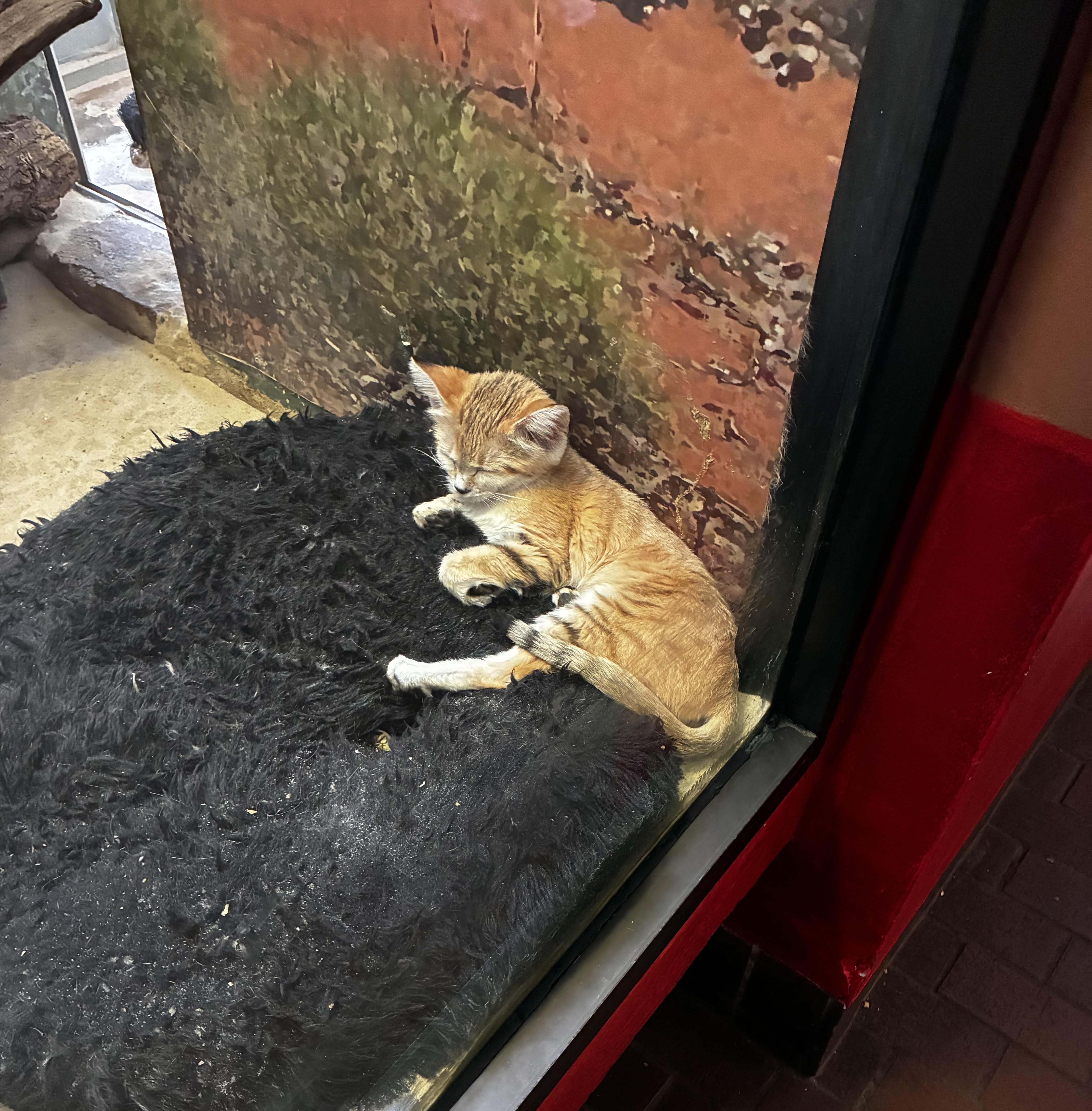
A cute sandcat!
Reptile Discovery House
Considering the fact that my family has a pet snake, it makes sense that my first stop was the Reptile Discovery Center. Entering the building, I wasn’t surprised by the layout; there was a looping hallway that had reptile exhibits on both sides of the walls. The first animal that caught my eye was the snouted cobra, a venomous snake that was lounging in its sandy enclosure. It was like the opposite of my family’s snake (a Florida king snake), who is very active within his tank. I looked at a couple more snakes like a puff adder, false cobra, and the cutest, a Timor python. I also couldn’t leave the zoo without seeing a terrapin (go terps!). Each animal display gave the enclosed animal’s species, their place of origin, if they’re venomous, poisonous, or neither, and a random fun fact about them. I appreciated how each endangered species was also highlighted as endangered with a plaque. Furthermore, each display (of endangered species) made sure to emphasize how humans impacted that species, and how we can work to reverse our negative impact. I admired how there were multiple ways that the center conveyed information to guests. For example, I saw interactive displays with sensory features (such as lighting and touching) that intrigued children to learn more about the animals they were looking at. The Reptile Discovery Center was very inclusive, especially for children. Close to the exit, there was a section where guests could get different animal illustrations screen printed onto t-shirts, which is fun for anyone, but especially for kids. There were also coloring pages which lots of children were occupied with. The Reptile Discovery Center was very inclusive, informative, and entertaining. It was a good start to my zoo excursion.
Amazonia
My next stop was Amazonia, a small recreation of the Amazon Rainforest. Walking into the exhibit, it felt like a traditional indoor exhibit with lots of fish tanks and one larger exhibit that had stingrays and flamingos. Walking deeper into the exhibit, I saw a massive fish tank which had many different fish like redtail catfish and barbells. I liked this exhibit quite a lot because it wasn’t too overwhelming with an overload of information; instead, it was very simple. For most of the fish, there was a simple diagram showing what they look like, their species name, and a simple fun fact. The first downstairs area seemed a little bit old and was kind of dingy, so when we walked upstairs into a massive recreation of the Amazon Rainforest, I was quite amazed. Walking through the double door system that kept the birds inside the exhibit, I was hit with a warm, humid environment. When I looked into the trees, I saw different parrots and plants. Looking around, I also saw more flamingos, small bodies of water and so much more. This exhibit was really immersive, and while it didn’t explain much of what was inside, Dr. Holtz and Dr. Merck were explaining all about the environment and its niche facts, so I didn’t feel like I missed anything. Walking through the rainforest and out of the second set of double doors, we then went back downstairs down the other side. Here, there was a large hall that felt like a renovated version of the previous described entrance to Amazonia. Here, there were lots of displays of amphibians, of which poison dart frogs were my favorite. Additionally, there was lots of written information, explaining the importance of different displayed species, but also how human impacts have dwindled many of their populations. This side of the hall felt more technical. In fact, it even reminded me of the National Museum of Natural History. While the information was very helpful, it was presented mostly through plaques with lots of text, so I often found myself skimming through them and not retaining the information as well. Still, the Amazonia house was a really great interactive exhibit.
Small Mammal House
My last stop was the Small Mammal House. I made the mistake of waiting until the end of my trip to go there; when I walked up to it, there was a line going a pretty long way outside of the house. Thankfully, it moved pretty quickly, and I found myself at the front after around ten minutes. Similarly to the Reptile Discovery Center, there were exhibits on both sides along the walls. This exhibit definitely had the cutest animals. My favorites were the screaming hairy armadillo, fennec fox, rock hyrax, and prehensile-tailed porcupine. Beside each exhibit was general information about that species, quite similar to those found in the Reptile Discovery Center. The small mammal house had a really informative display that spanned across pretty much the whole building. Essentially, it showed different functions and features that are shared by many different mammals. It was very insightful because it included images and concise descriptions that tied them together. This information could be easy to understand for anyone due to its simple form of presentation, though I will note that they were positioned quite high on the walls, so children may have a tough time seeing them. The Small Mammal House was a great way to round out my trip, simply because of how cute the mammals were.
Education
I really enjoyed my time at the zoo, partly because of a nostalgic feeling, but also because of the many interactive learning opportunities. In the Reptile Discovery Center, one of my favorite examples was a moving diagram called “What’s Inside,” that showed how humans and reptiles are surprisingly similar. It was a double door, one side of which was a human, and the other side was a reptile. On the outside of each door, there were diagrams of internal organs like the brain, heart, ovaries, and more. To aid this visual representation, there were text blurbs that discussed the differences and similarities between these organs in each species. Opening each door, on the inside of the panels were similarly formatted diagram and text blurbs, this time explaining the similarities and differences between the bone structures of each species. This display was really nice because the door-like structure practically begged guests to open it and learn about how reptiles and humans are surprisingly similar.
Allowing guests to see and touch different aspects of the animals was a very common form of educating I found throughout the zoo. In the Reptile Discovery house, there were bones of different animals that guests could touch, simply to illustrate how close they are to each other. Similarly, in Amazonia, there were more animal bones in addition to hides that guests could touch and ask questions about.
The thing I appreciated most at the zoo was their recognition of how humans have negatively impacted so many animals. There were always signs and plaques talking about how we as humans have destroyed ecosystems and killed many animals in the process. While this is sad, the zoo was able to convey this information in a way that should inspire audiences to actually make a change.
Overall, I felt as though the zoo was quite inclusive and easy to process for many different audiences. The zoo did a great job in their interactive displays and exhibits, though I will note that I felt as though there weren’t enough of them. For me, that wasn’t a problem because I simply enjoyed just observing the animals, but I can imagine that people who want to learn more may have gotten bored of reading off of plaques. Still, for me, this was not a major problem because of how many animals there were and how effective the available interactive displays were.
Animal Welfare
Throughout the whole zoo, animals seemed to have really comfortable looking enclosures. It is very clear that the managers of the zoo truly prioritize the animals’ welfare. Specifically, I noticed that the very small animals (like frogs, for example) had very purposely cultivated habitats that were heavily regulated to mimic their natural environment. While this attention to detail didn’t exactly scale up for the larger animals, I’m assuming that it’s a purposeful decision and that the larger animals simply are more resilient and don’t require as much attention to their habitats. One of the cutest things I observed within the Small Mammal House was that every animal in each habitat seemed to have its own small personal blanket, which they must be emotionally attached to.