


Event name: Self-guided
Event time and place: Washington, DC November 23, 2025
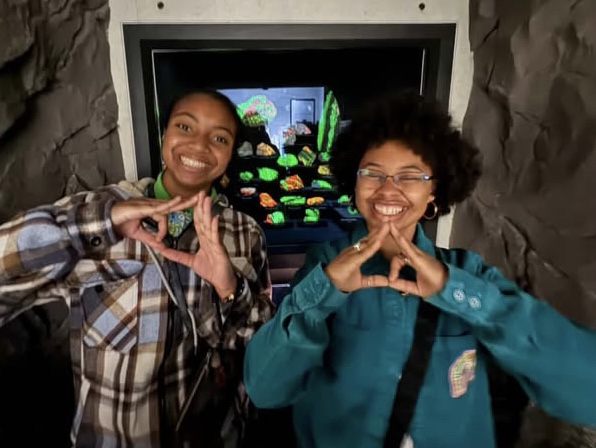
Me and Lia in the mines throwing the SGC sign. Thanks Annabelle for the picture!
Starting on the first floor in David H. Koch Hall, we look at fossil data, which captures climate on the scale of deep time—thousands, millions, or billions of years in the past. There was a trail of dioramas showing the changing climate of regions in the United States from the late Cenozoic to the early Paleozoic. It effectively conveys the magnitude of the change as viewers literally walk back in time and reveals climate to have been both warmer and cooler in the past. In fact, while the climate is on a warming trend today, Earth has been in a period of cooling for a long time. Atmospheric CO2 levels were 50% higher, the global temperature was 2.8-6.7oC higher, and the global sea level was 100 m higher only 19 million years ago at the Harrison Formation in Nebraska; atmospheric CO2 levels were 4 times higher, the global temperature was 8.4-9.4oC higher, and the global sea level was 100 m higher even 150 million years ago in Colorado. These changes in sea level and temperature are correlated to impacts on CO2 levels and can disrupt ecosystems enough to cause a mass extinction event. A timeline of Earth history showed the evidence of changes in life and climate along with periodic events of mass extinctions. For example, the mass extinction event of tropical marine species was triggered by the spreading of plants on land in the late Devonian period as they absorbed CO2 from the atmosphere and triggered a cooling event. This exhibit was effective in communicating current and future climate change because it illustrates how climate change today is reflected in the past so that we can learn from it.
The deep time exhibits also lead us to the more recent history of humans and their impact on the Earth. Humans are always engineering new ways to thrive, which requires use of Earth’s resources. It has recently gotten to the point where human activity has drastically impacted life and the landscape in a period coined as the Anthropocene. The “Human Change the World” exhibit in the human origins hall focuses on the costs and benefits of land use and innovation, which adds a new perspective on human impact on the environment and climate rather than de-emphasizing others, as some may believe. It discusses how humans altering the landscape for industry, agriculture, and housing displaces wild species by domesticating the land for profit. Statistics showed that 83% of the land surface was directly affected by humans by 1995. The high population density encouraged by these innovations creates a high output of waste, which breeds disease and leads to epidemics. The global map shows the distribution of the human population, with the count above in billions and continuing to increase. This conveys the enormity of the human population and our inevitable impact on the Earth.
A very important modern innovation whose impact on the climate is not thought about as often is the production and use of cellphones. The “Cell Phones: Unseen Connections” temporary exhibit discusses the origins, history, and impact of cellphones using multimedia. There is a display and a QR code that visitors can scan to learn more about how much we use our phones today and internet culture as a whole through a scripted text chat. It effectively conveys how important cellphones are to daily life because it simulates real-life use and is accessible for those with phones, which is most people today. The technological impact conveyed by the real networking system and board game is that large amounts of data can be stored and transported across the globe and into space. The comic book story murals highlight some of the positive and negative social impacts of this. For example, social media allows people to connect in order to create social change and share perspectives, but the large quantity of information can cause stress and potentially spread misinformation. The influence of cellphones on society is significant, but what about the climate? The display of the ores and minerals at the front shows all the resources that go into making the parts of phones. It is effective because it illustrates how different elements and compounds are extracted from the Earth to develop modern technology. These materials are non-biodegradable and cannot be thrown away, however. The creation of cellphones has a large global footprint of about 73% of emissions per phone as data displays, so extending the use of phones can reduce the impact. Disposal of e-waste is not possible, and it should instead be dismantled and repurposed for materials. Diagrams show an example of a sustainable lifecycle for cellphones, and photographs capture people working around the world contributing to the process.
Part of why these climate factors are not always fully discussed is because emissions and other environmental data cannot be visualized with the naked eye, especially not on the large scale. The semi-temporary “Earth Information Center” (EIC) exhibit in collaboration with NASA displays dynamic global datasets displayed in a way that is mesmerizing, intuitive, and informative. For example, there were atmospheric flow models of greenhouse gases and pollutants across the globe in color over time. The CO2 specific one even showed the sources and sinks. There was also data on the concentration of lights around the globe, comparing two years and coloring the lights to show the increase or decrease of light pollution. In addition to the many other climate datasets, they presented environmental documentaries that connected the data to social and ecological issues. This exhibit is very effective in communicating environmental data and issues to the public. Even just sitting on the chair and watching the big screen, we learned so much.
The dynamics of the ocean illustrated in the EIC connect directly to the topics Sant Ocean Halls focuses on, like the ocean’s importance and how human activities harm ocean and human life. “The Changing Ocean” exhibit features a library of interactive videos on the importance of ocean dynamics. The video “No Sunlight? No Problem!” explains how the biology and cycling of nutrients allows for life without sunlight in a way that is simple for the average viewer. Organisms closer to the surface and microbes die and fall to the sea floor, causing their bodies to decompose under a thick layer of microbes. The methane gas is released in what are called “cold seeps,” and the microbes provide the nutrients needed to sustain a diverse ecosystem without sunlight. "Fool's Gold" was similar, as it highlighted the benefits iron pyrite particles have on the ocean by basically being fertilizer for the sea, providing vitamins for bacteria and plants alike. This video particularly captured my attention by being formatted as a silly daily news article skit so children and adults alike can be amused and learn something from it as well. Human activity, unfortunately, has disrupted the delicate balance of the ocean ecosystem, as the “Human Connections: Who Should Care for the Ocean? Everyone!” exhibit explains. To explain the ocean acidification effect, it shows a graph relating the increasing CO2 in the atmosphere to the acidification of the ocean over time. It also illustrates the impact with an interactive slider showing the progressive death of coral due to acidification. Plastic pollution in the ocean is conveyed by collected debris and provides pictures of how it has harmed marine life who ingest or get caught in plastic. It also provides a possible solution by repurposing plastic debris instead of discarding it. Human influence does not just affect wildlife but also coastal towns. My favorite art piece in the “Ocean Focus Gallery: Art x Climate: Artists Reflect on Climate Change” exhibit is “Used to Be: ‘Isle de Jean Charles’” by Changsong Li (2023, digital). This piece shows the location of Isle de Jean Charles, which used to be home to a tribe in Louisiana and is no longer habitable due to ocean level rise as a result of climate change. It also marks GIS data like oil and gas lines, population density, and elevation. I have been interested in the way that GIS data can be used to convey a story and enact change since I did a personal project using similar tools and want to expand its applications to something meaningful.
Earth’s climate has always been changing and has driven evolution and the types of organisms that can survive. Only recently have humans begun making a large enough impact that some experts call for a new period to characterize this time. The technologies so significant to today’s society impact global environmental trends, which can be observed through data visualization or the effects of resulting pollution and climate change. I really enjoyed getting to delve into climate change through many facets. While exploring, I also got to see other places that interested me, like the Gems & Minerals section. I have already been there recently, but I got to let loose in the gift shop buying new specimens for my collection and take a picture (above). We also explored the “Lights Out: Recovering the Night Sky” exhibit, which was fascinating. It is so crazy that with the four hours we were there and our DC scavenger hunt earlier in the semester, so much more of the museum still needs to be explored. I will definitely be back in the future!