


Event name: Scholars in the Eastern Shore
Event time and place: Dorchester County, MD April 18, 2026
The first thing that I was shown on the tour of Horn Point Laboratory was the oyster nursery. Oysters are important to the health of the Chesapeake Bay because they are efficient at filtering the bay water of excess nutrients, algae, and other organics. Excess nutrients specifically can lead to eutrophication which is associated with hypoxic or anoxic conditions and decreased biodiversity. They studied the needs and behavior of this species to strategically breed, feed, raise, and deploy new oysters in a controlled environment that maximizes their survival and populations. The temperatures and transportation of oysters and their food specifically were crucial and had to be monitored due to their relationship to breeding and growth signals. Oysters must also be deployed close to existing populations since they are stationary in adulthood. The monitoring does not stop after deployment of oysters, they also check in on the growth of the population and environmental conditions.
The next part of the tour was the scientography room which maps scientific data for visualization. Some of the main factors being measured by their instruments were temperature, salinity, pH, dissolved oxygen, and turbidity. This data is important for monitoring the health of the bay on a general and regional level. Some of the instruments used by the laboratory to collect data were attached to buoys and gliders on boats or autonomous vehicles. The scientists there use this data to create informational figures and track progress toward environmental goals. Connecting back to the oysters, variables such as temperature and salinity are important for the health of the oyster populations the laboratory is trying to restore. Many other effects can also be monitored using this data like eutrophication, ocean acidification, salt water intrusion, and excess erosion.
We also discussed additional efforts related to the Horn Point Laboratory and the health of the Chesapeake. One of which was the project to restore Swan Island. The rising of the sea level and increasing erosion puts coastal and island communities at risk of losing land. Swan Island had almost completely become submerged. This project aims to recover this lost land by excavating dredged material and building up the edges and raising the elevation of the island. Once complete, the island will be given over to nature to restore the ecosystem that was displaced or lost. This huge engineering effort is an important model for other possible restoration projects. The laboratory is largely involved in the research on techniques and progress of the mission using satellite imaging to visualize the land area and green cover.
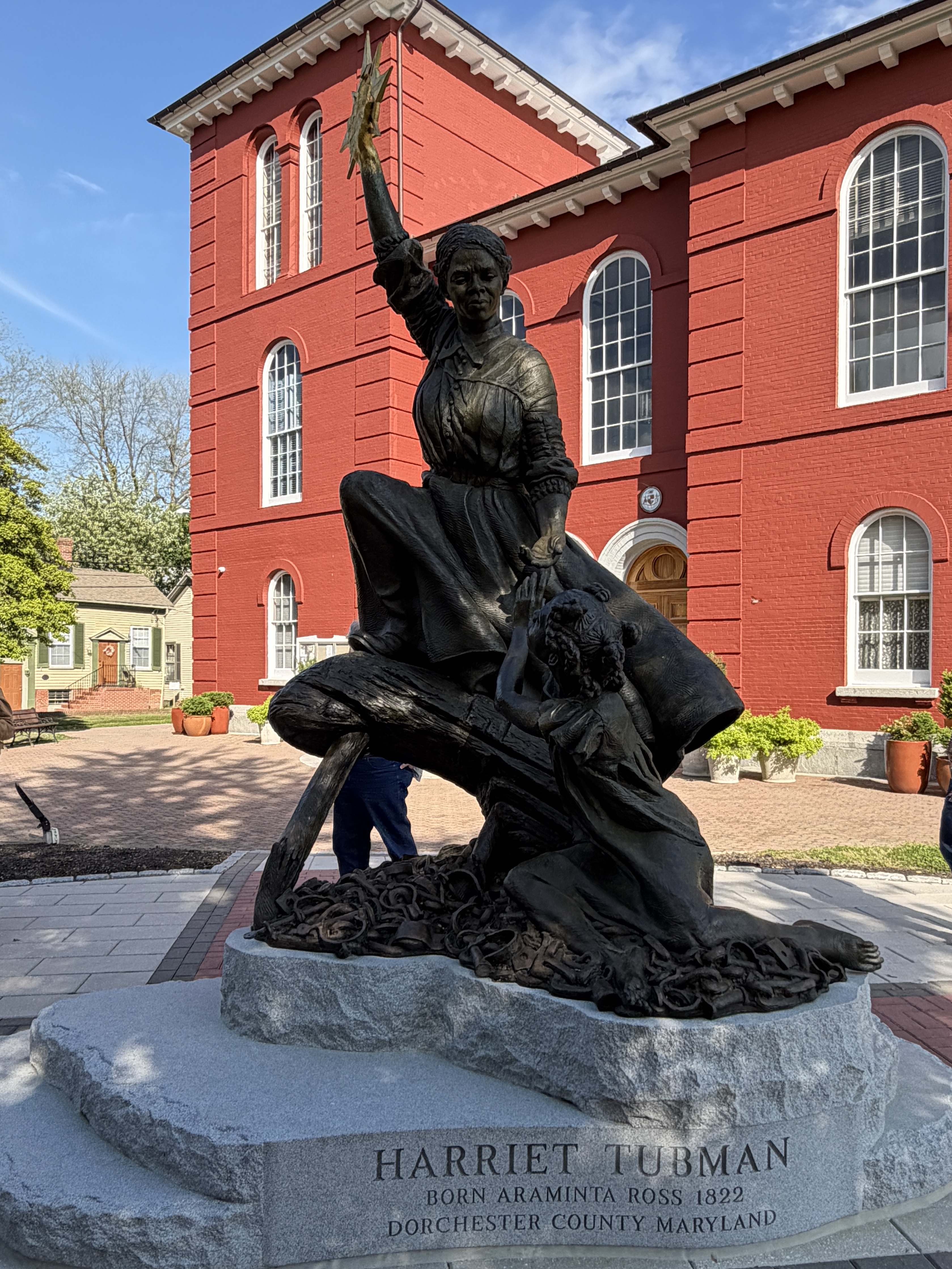
Sculpture of Harriet Tubman to celebrate her
path to freedom starting in Dorchester County, MD.
Harriet Tubman, formerly known as Araminta Ross, was born and raised as a slave on a farm in what is now Dorchester County, Maryland. We drove around the area to different historical sites related to her upbringing there. Because Maryland is a northern border state with a lot of trees, she grew up in an environment where she had exposure to “free” blacks in the city and wildlife on errands with her father or friends of her owner who borrowed her labor. It was these skills that she developed and proximity to freedom that gave her the ability to become the legendary Harriet Tubman as the statue in the picture illustrates. We learned more about her legacy at the museum. Unfortunately, this area that made Tubman who she was is in danger due to rising sea levels. So close to sea level, much of the area will be submerged in a few decades. Efforts are being made to preserve records of the area's history using virtual reality and LiDAR. When driving through the nature preserve, we also noticed effects on the animal populations and plants like the “ghost trees” which died due to saltwater intrusion yet still stand.