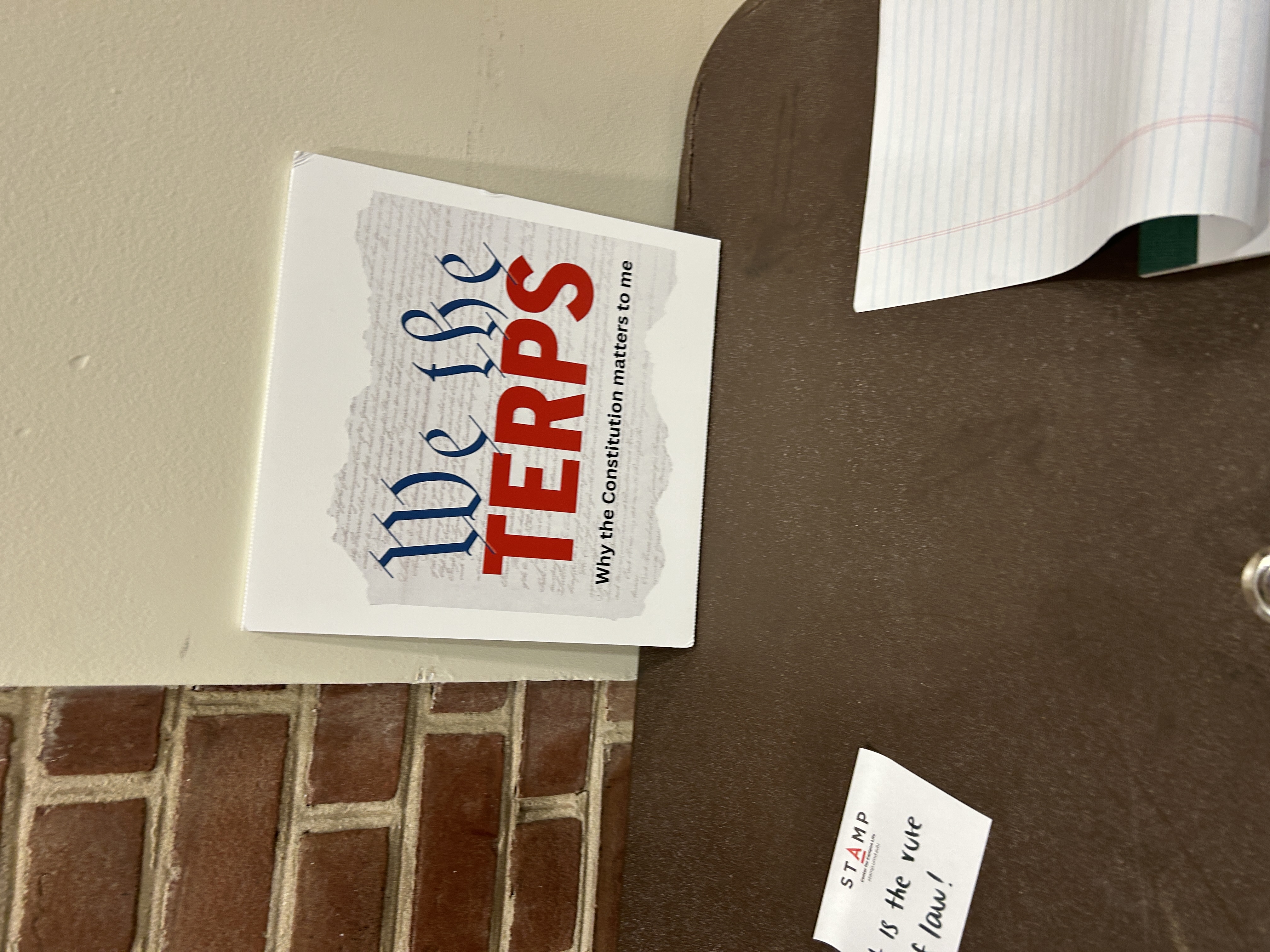


Event name: 14th Amendment Constitution Day Presentation, by Dr Michael Ross
Event time and place: 9/17/25 in the Stamp Student Union
Dr Ross began before the Civil War, with background on tensions surrounding slavery in the United States. These tensions reached a fever pitch in the late 1850s with the Dred Scott decision, in which it was decided that black Americans were not citizens and could not sue in federal court, and that the Missouri Compromise was unconstitutional. The situation eventually led to the Civil War, after which slavery was abolished in the United States. In the wake of the Civil War, there was an effort mostly led by Northern politicians to "reconstruct" the South, which meant to build back up their government in such a way that Southern states would be loyal to the Union and protect the rights of black Americans.
A central push in the Reconstruction effort was the passage of the 13th, 14th and 15th Amendments. These respectively abolished slavery, enforced equal rights, and established voting rights for black Americans. Dr Ross began here to focus especially on the 14th Amendment, the subject of the talk. He spoke about how after the war, Southern state governments established so-called "Black Codes," laws meant to restrict the rights of black Americans. These included not being allowed to own guns, sell alcohol, have large meetings, or even be seen congregating in a group of any size in public. The 14th Amendment was thus passed to prevent state governments from making any law that infringed upon the right of US citizens to equal protection under the law, and enforced due process in all 50 states. Dr Ross emphasized the difference between substantive and procedural due process. Substantive due process ensures that the laws themselves are fair and constitutional, whereas procedural due process ensures that the laws are carried out in a fair and constitutional way.
Dr Ross then outlined the use of the 14th Amendment in later American history, including its more nefarious use by pro-corporation actors in the Gilded Age and later. These law firms and political lobbyists attempted (and were often successful in) reframing the 14th Amendment as legislature that protected corporations from the government in the same way it protected individuals. Overall, since its passage the 14th Amendment has had sweeping effects, being used as a cornerstone of civil rights and privacy from the government, a tool in the debate over political lobbying and redistricting, as well as in the debate over birthright citizenship. It is one of the most active and dynamic areas of American federal law, and the rapid changes that occur in its interpretation and use consistently have a broad and long-lasting impact on the way the United States is governed.
I found Dr Ross's talk very convincing. Not only did I learn a great deal of new information about the 14th Amendment and its use in America's past and present, but I was made aware of the thematic shift that has occurred in the types of actors that use it, from Northern post-Civil War lawmakers enforcing the rights of genuinely disenfranchised Americans to the organized law firms and political action committees of the last century. Though he did not bring it up, I am aware of the use of the 14th amendment in Supreme Court cases pertaining to corporate personhood, such as Santa Clara County v. Southern Pacific Railroad Co., or the notorious Citizens United case. I noticed no logical fallacies, save for the vulnerability that these type of arguments almost always have, which is that the "data" was not collected in a systematic or quantitative way. Rather, it was selected by Dr Ross and other historians before him as points that fit their narrative. I happen to think that this narrative is a fairly good model of the forces at play regarding the use of the 14th Amendment, but since it is not quantitative or systematic, it is also somewhat non-falsifiable, which means it is hard to make an argument that it is objective. However, this could be easily remedied with some tweaks to the manner of the presentation and argument, such as making a similar but more quantitative claim. For instance, uses of the Amendment could be categorized using something similar to an h-index, where cases are given a value by how many other cases cited them in their decision. This h-index could be broken down by case category, thus establishing a quantitative framework for evaluating the most common manner of use of the 14th Amendment over time.
For me, the most compelling and persuasive element of Dr Ross's presentation was the focus on modern uses of the 14th Amendment. He made it clear that the 14th Amendment, unlike many of its contemporaries, is nowhere near dead. To the contrary, it is one of the most active areas of the Constitution, and is formative to almost all modern areas of legal controversy, from birthright citizenship to the power of political lobbyists, and thus the vast effects that money in politics has on the functioning of our political, legal and judicial systems. The 14th Amendment is a fascinating example of how historical developments build on one another in unpredictable ways. The change in the use of the 14th Amendment is similar to how evolution often repurposes elements of older biology to accomplish a new task, such as using digestive tissue to form the lungs. In the same way, the Constitution constantly remolds itself to adapt to modern times, striving imperfectly ever towards that eternal promise that this new birth of freedom through government for the people, by the people may never perish from the Earth.