


Event name: Smithsonian National Zoological Park
Event time and place: Washington, D.C., May 3, 2026
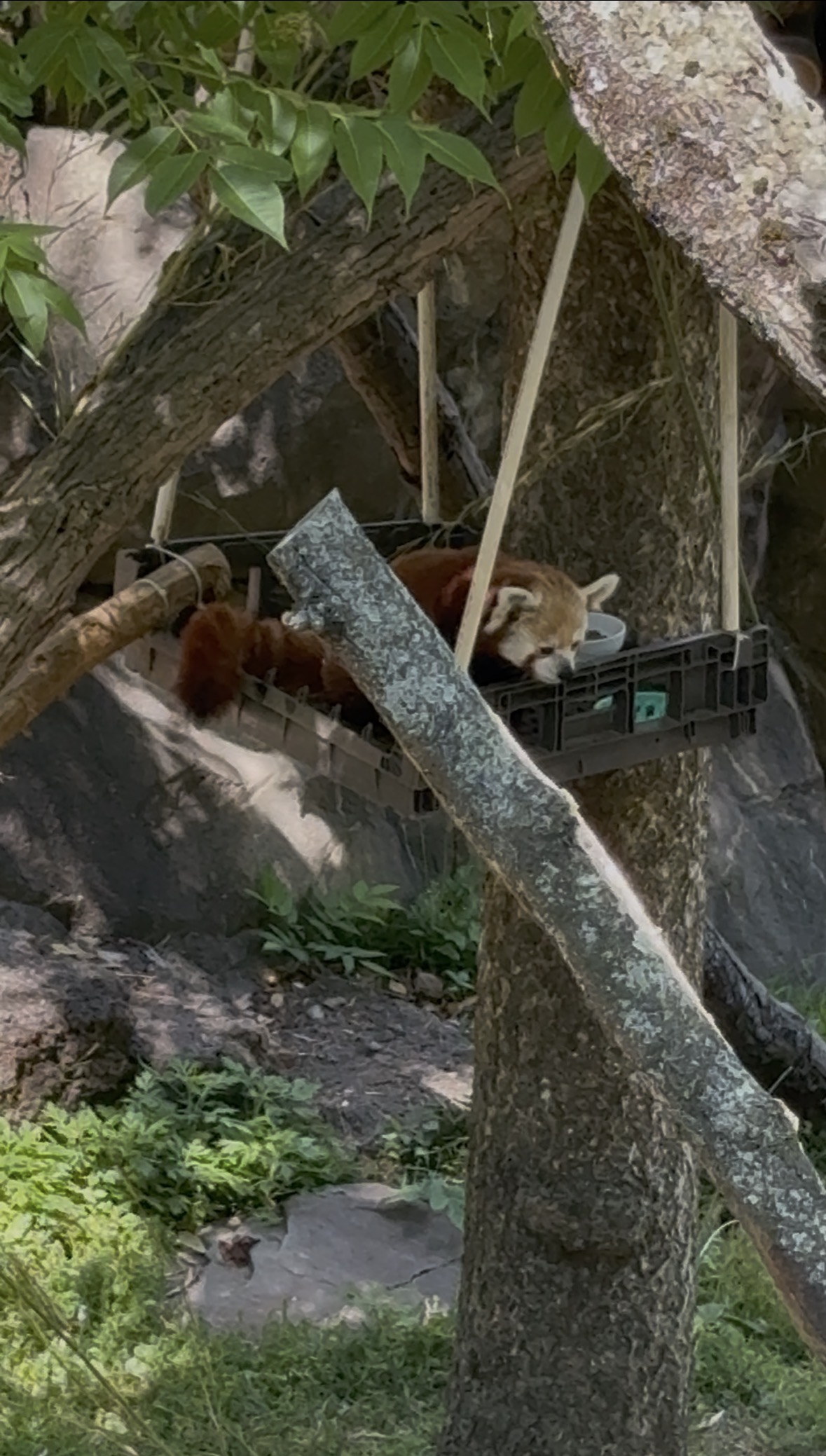
My favorite animal, the Red Panda, at the zoo
On May 3rd, 2026, On May 3, 2026, our Science & Global Change cohort met at the Connecticut Avenue entrance of the Smithsonian National Zoological Garden. Throughout the morning and afternoon, I explored three major buildings: the Bird House, the Small Mammal House, and Amazonia, the latter of which included a guided tour with SGC faculty. The trip provided a firsthand look at how the zoo balances the display of diverse wildlife with its role as a major center for public education on ecological issues and global climate change.
Zoo Buildings: Bird House
The Bird House is organized around the theme of migratory birds and their flyways across the Americas. For each species, the signs list common and scientific names, images to help identify males and females, and maps showing where they migrate. During my visit, I saw the Blue Grosbeak, Yellow-rumped Warbler, Northern Pintail, and Ruddy Duck. The building features several interactive displays that go beyond simple text, such as the "Food to Fit the Bill" station where you can see different beak shapes and the "Shrinking Stomachs" display that explains how Red Knots change their internal organs to survive long flights. I found these displays very informative because they explain how birds actually survive. The information in this hall seems aimed at a middle school to adult level due to the detail on migration and ecology. I noticed that many visitors were paying close attention to the migration maps, tracing the paths the birds take across the world.
Zoo Buildings: Guided Tour of Amazonia
I attended the 11:30 am guided tour of Amazonia, which is a large building designed to feel like a real rainforest ecosystem. The information for each species focuses on their specific forest layer and diet. During my time in this hall, I saw the Roseate Spoonbill, Brazilian Rainbow Boa, and the South American Lungfish. I also explored the aquarium section, which featured a wide variety of fish including the Sunshine Pleco, Silver Dollar Fish, and the massive Arapaima. This building has many unique displays, such as a massive beetle portrait made entirely of beetle specimens to show the incredible diversity of the species. There was also an interactive temperature display where you could press buttons to see the survival thresholds for amphibians versus the fungus currently affecting them. These displays were very effective at making complicated biological and environmental data easier to visualize. The hall is designed for a general audience, and I saw many people stopping to interact with the buttons and examine the specimens.
Zoo Buildings: Small Mammal House
The Small Mammal House groups smaller animals together and provides "Fast Facts," maps of where they live, and their conservation status. Four species I saw there were the Sand Cat, Golden-headed Lion Tamarin, Red Ruffed Lemur, and Fennec Fox. Beyond the printed signs, this building uses skeletons and comparison displays that show how different animals have evolved similar traits to survive. These helped me understand how the animals move and climb. I think this hall is aimed at an elementary to middle school education level because the information is broken into small, easy-to-read sections. Even though it was very crowded, I saw many parents reading the conservation signs to their children and talking about why certain animals are endangered.
Education
The zoo uses creative, multi-sensory ways to teach the public about ecosystems. Throughout the various houses, the zoo utilizes audio stations where visitors can play recordings of different animal calls and vocalizations to learn how to identify species by sound. Another major educational tool is the use of skeletal displays, which show the internal anatomy of different mammals to explain how their bodies are adapted for running, climbing, or swimming. In Amazonia, there is a tactile coral reef display featuring a dead coral specimen that visitors can actually touch, and in the Bird House, there are mechanical beak stations that demonstrate how different shapes are used for specific diets. These multi-sensory methods are more effective than just reading a sign because they allow people to use their hands, ears, and eyes to understand complex biological and environmental concepts.
Animal Mental/Emotional Welfare
The zoo has added specific features to provide a more interesting and comfortable environment for the animals. One example is the O-Line, which is a system of high cables and towers that allows orangutans to travel between buildings. This provides them with the vertical space and freedom of movement they would have in the wild canopy. A second example is the Amazonia rainforest environment, where birds and monkeys live in a large, open space with real plants and high humidity instead of small cages. This allows them to engage in natural social and foraging behaviors. Additionally, keepers use sensory enrichment, such as spreading different scents like spices or extracts throughout an enclosure to encourage animals to use their sense of smell to explore their habitat. These additions reduce the stress of captivity by mimicking the complexity of the natural world.