


Event name: American Museum of Natural History Field Trip
Event time and place: New York, NY, November 22, 2025
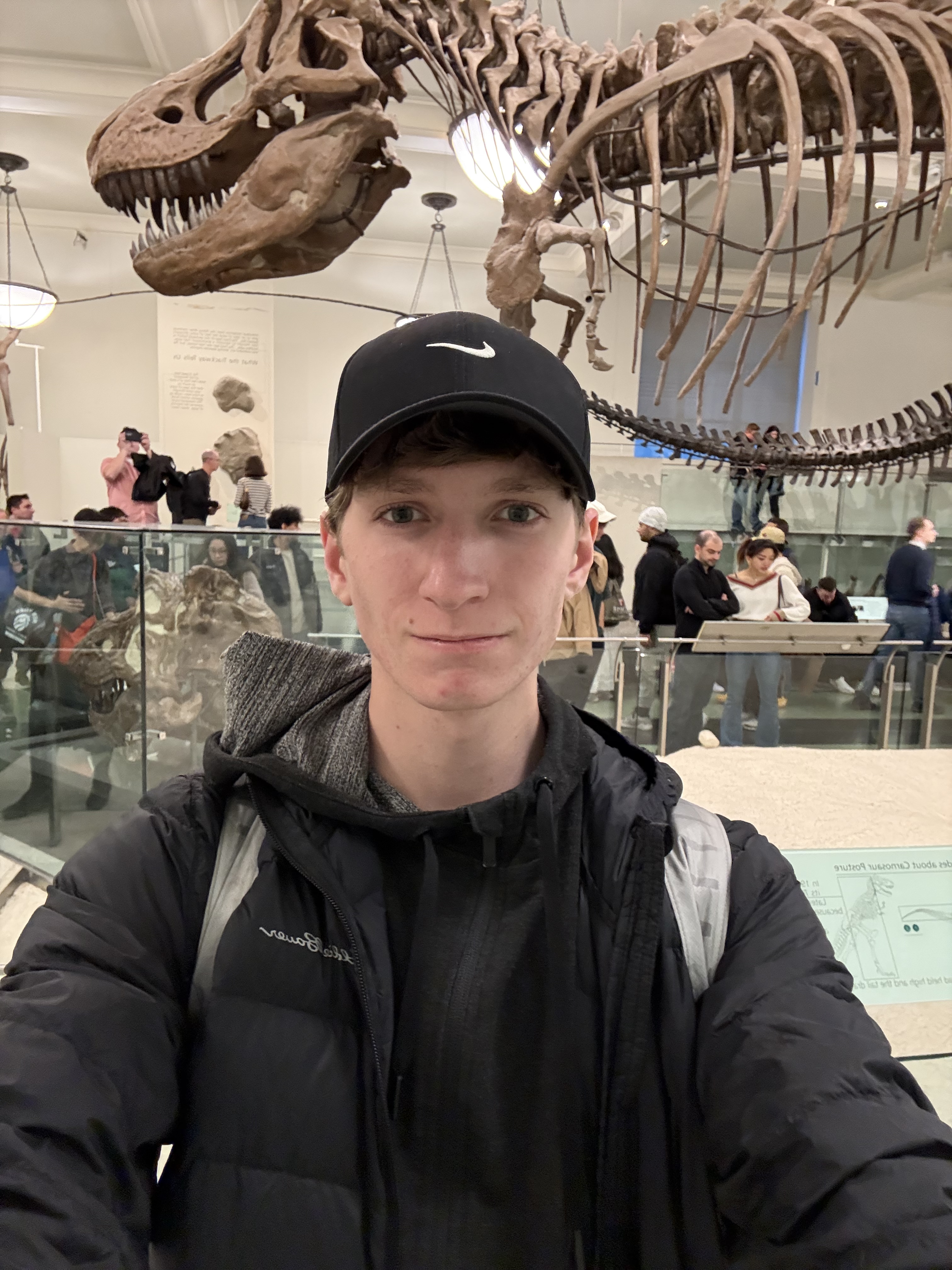
Nathaniel Folliot in front of the T.Rex Skeleton
On November 22nd, 2025, our Science & Global Change cohort traveled to the American Museum of Natural History in New York City. Throughout the day, I attended four guided experiences: the Impact: The End of the Age of Dinosaurs tour with Dr. Holtz, two fossil hall tours with Dr. Merck and Dr. Holtz, and the planetarium show Encounters in the Milky Way. The following is a narrative summary of what I learned during the trip and how the museum presents major scientific ideas to the public.
Impact Exhibit: The End of the Age of Dinosaurs
The Impact: The End of the Age of Dinosaurs exhibit focuses on the asteroid that struck Earth 66 million years ago. The exhibit illustrates the event through visual displays arranged as a chronological timeline, showing life before, during, and after the impact. One display shows a Triceratops intact before the impact and later only its skull remaining. Panels explain the asteroid’s destructive effects, and there is a video in the middle focused on the impact itself. Visitors could even smell smoke to get a sense of what the Earth might have smelled like at the time. The displays also explore alternate scenarios, such as what might have happened if the asteroid had hit the ocean instead of land. Later displays show how life returned, highlighting surviving small mammals and ferns, which led the way in repopulating plant life. I think these approaches were effective for casual visitors. The dioramas gave the event immediacy, while the geological specimens grounded everything in physical reality. The exhibit also connects the ancient event to the present by discussing asteroid monitoring programs and showing how sudden environmental change can destabilize global ecosystems. It frames extinction not as a distant curiosity but as something humans today can learn from.
Fossil Halls: Tour with Dr. Holtz and Dr. Merck
The fossil halls are organized according to evolutionary relationships, essentially as a giant family tree of vertebrates. Instead of arranging fossils strictly by era or type, the museum groups species by shared ancestry. Wall diagrams show branches of the vertebrate tree, skeletons are positioned in evolutionary sequence, and each room transitions smoothly from one major clade to the next.
During Dr. Merck’s vertebrate tour, I learned that the earliest vertebrates had no jaws or teeth. Jaws evolved later, originally as separate upper and lower pieces not attached to the braincase. Another highlight was learning about lobe-finned fishes, which have limb-like bones inside their fins. This feature connects them to all land vertebrates, including humans, showing the evolutionary path from water to land. An outdated element in the hall is the placement of turtles alongside other sauropsids as if they are equally related. Turtles are actually closer to crocodiles and birds. Updating this information would require reorganizing signage and diagrams, which is challenging because the physical layout of the fossils is fixed.
During Dr. Holtz’s dinosaur tour, I learned that early dinosaurs were bipeds with functional hands and that some plant-eating dinosaurs eventually became quadrupedal as they grew taller. Another fascinating point was that dinosaurs grew from tiny hatchlings to massive adults in about 30 years, indicating a high metabolic rate. Many of their joints had thick cartilage to reduce weight while supporting large sizes. One outdated feature is the grouping of tyrannosaurs with allosaurs; in reality, tyrannosaurs are more closely related to raptors and ostrich-like dinosaurs. Another outdated element is the T. rex mount, which was built using scaled-up allosaur legs instead of the proper limb proportions. Updating these displays would involve significant reconstruction.
The Space Show
The Space Show this year was called Encounters in the Milky Way, and it focused on how stars, planets, and galaxies interact over time and shape our solar system and galaxy. The show mixed real data from the Gaia telescope with visualizations to show things like star positions, motions, and galactic structures. It was clear that some of the images, like the star maps and trajectories, were based on real measurements, while others, like fly-throughs of Oort Clouds and galactic interactions, were just visualizations to help us understand. I learned new things, like that our Oort Cloud stretches 1.5 light-years from the Sun and that the star Gliese 710 is on track to pass through it in a little over a million years, which could send comets flying into our solar system. The show really emphasized how dynamic the galaxy is and how past cosmic encounters helped shape our solar system.
General Thoughts
The AMNH accommodates a wide variety of visitors. Exhibits include multilingual signage and audio guides for international guests, while wide walkways, ramps, and elevators make the museum accessible to those with mobility challenges. The museum also combines physical fossils, panels, videos, and interactive displays to engage visitors of all ages and educational backgrounds. Sensory considerations, such as clear signage and careful lighting, ensure that exhibits can be appreciated by people with different visual or auditory sensitivities. Overall, the museum successfully balances scientific depth with accessibility, making complex concepts understandable and engaging for a broad audience.