Speculative Narratives and Environmental Resilience
Dr. Mitchell Adam Pavao-Zuckerman
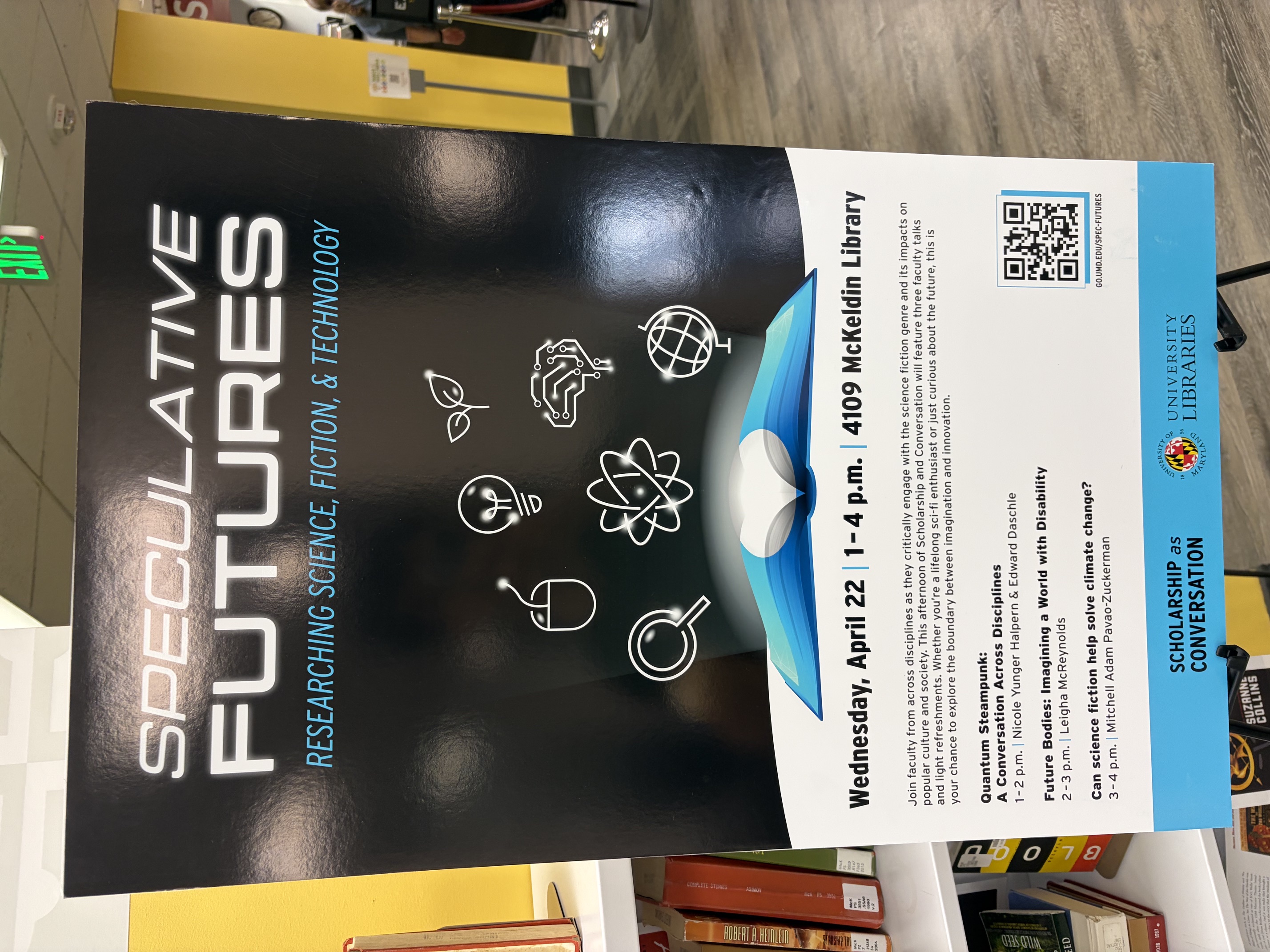
April 22nd, 2026 — McKeldin Library
When I attended the talk by Dr. Mitchell Adam Pavao-Zuckerman, I was struck by how he connected the world of stories to the very real problem of climate change. His main argument was about how science fiction is a tool that helps us imagine and shape our future. He explained that as the climate changes, we are faced with a massive challenge. We need to build a future that is safe and fair, but we cannot build it if we cannot even imagine it first. Dr. Pavao-Zuckerman suggested that we are currently suffering from a "crisis of imagination." This means that even though we have a lot of scientific data about global warming, we struggle to see a clear path to a world that actually works for everyone.
During the seminar, Dr. Pavao-Zuckerman discussed how science fiction acts like a laboratory for society. In a science lab, researchers test how chemicals react; in a science fiction story, writers test how people and societies react to new technologies or environmental shifts. For example, he pointed out that while a scientist might focus on the technical details of a new clean energy source, a science fiction writer focuses on how that energy source changes a person’s daily life. Will it make things cheaper? Who will have power over it? By asking these questions, speculative stories help us think about the ethics and social systems behind our technology. This perspective is vital because it moves the focus away from just "fixing the planet" and toward creating a society that is humane and equitable for every person living on it.
I found his points about "resilience" to be particularly convincing. Usually, when we hear the word resilience, we think about things going back to the way they were after a disaster. However, Dr. Pavao-Zuckerman argued that we should use imagination to build a "new normal" that is better than the old one. We participated in short interactive exercises where we had to reimagine possible futures. Instead of focusing on scary, end-of-the-world scenarios, we were encouraged to think about how communities might organize themselves to stay safe and healthy. We talked about how urban spaces could be redesigned to grow food and how neighbors could work together during weather emergencies. These exercises made the huge, overwhelming problem of climate change feel much more manageable and grounded in everyday life.
Reflecting on the talk, I believe his reasoning was very strong because it bridged the gap between science and the arts. He did not ignore the hard facts of climate science, but he showed that facts alone are often not enough to inspire change. One area that could have been explored more was how to deal with "bad" science fiction stories that only focus on doom and gloom without offering any hope. These stories sometimes make people feel like giving up instead of taking action. However, his focus on positive "world-building" was a great way to counter that negativity. He made it clear that by changing the stories we tell, we can change the actions we take in our real lives today.
In conclusion, the talk helped me see that solving climate change requires more than just better engineering or more data; it requires a new way of thinking. Storytelling is a form of technology that allows us to practice being brave and creative. I left the seminar with a better understanding of how the books we read and the movies we watch can actually influence real-world policy and innovation. It was a powerful reminder that the future is something we are currently writing together, and we have the power to make it a story worth living in.