


Katie Mack Speaker Event:
Thursday 05/07/2026 11-12:00 pm at The Physics Buliding:
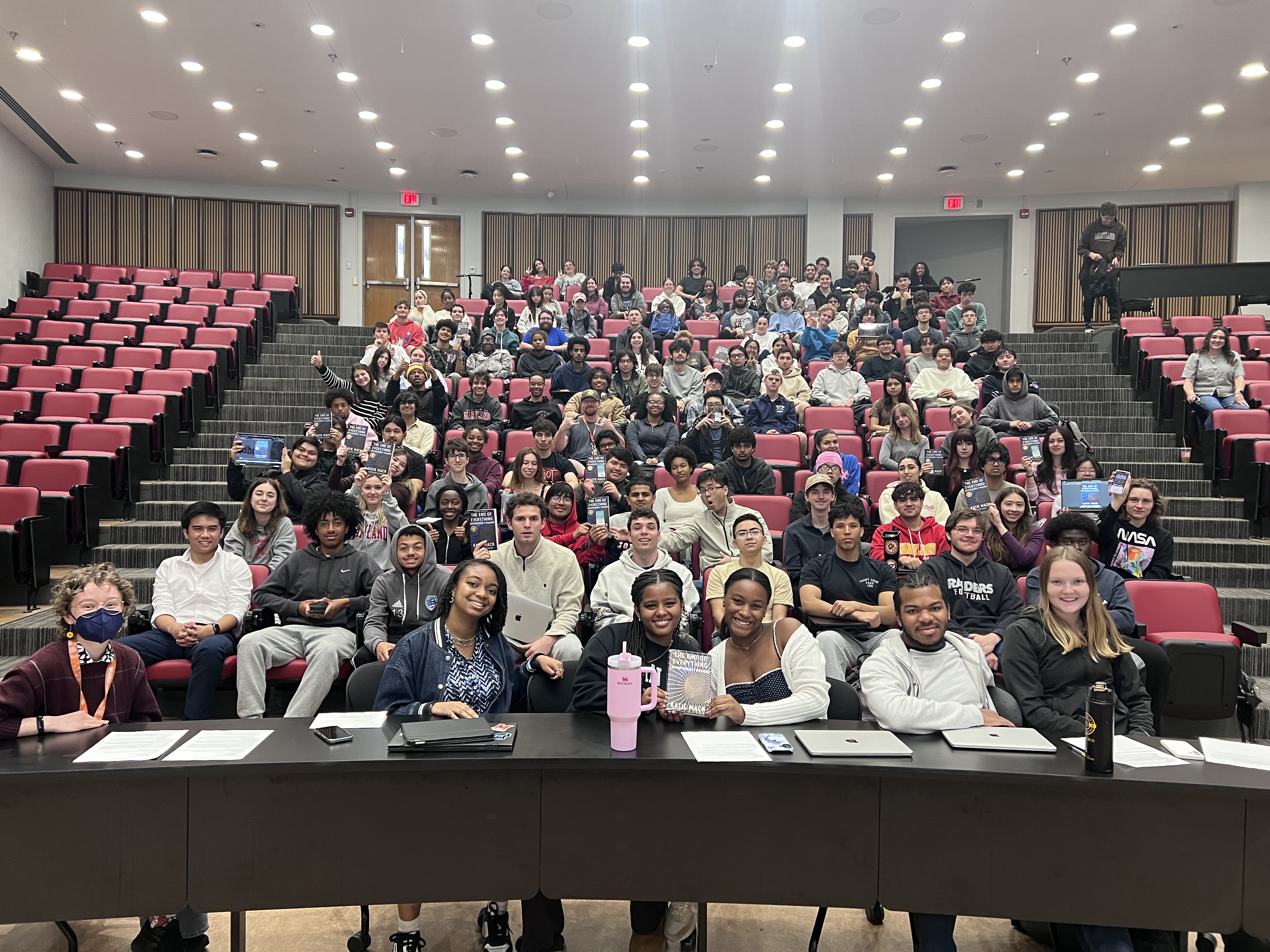
A picture of my class holding Katie Mack's book
The main points of the presentation by Katie Mack, who is the author of The End of Everything (Astrophysically Speaking), connected closely to our Astronomy 101 class since we had spent a significant portion of the semester reading and discussing her book in detail. The talk felt like a direct continuation of the course material rather than a separate event, and it helped reinforce many of the concepts we had already learned. During the presentation, she revisited and expanded on the major theoretical frameworks that describe the possible long-term fates of the universe. These included scenarios such as the “Big Freeze” or heat death, where the universe continues expanding until it becomes increasingly cold and diffuse; the “Big Crunch,” where expansion reverses and the universe collapses back in on itself; vacuum decay, which involves a sudden transition to a lower-energy state that could fundamentally alter physical laws; and the “Big Rip,” where accelerating expansion eventually tears apart galaxies, stars, and even atomic structures. She explained how each of these possibilities arises from current cosmological models, especially those involving dark energy and the observed accelerating expansion of the universe. A major emphasis of her talk was how these predictions are rooted in observational astronomy and theoretical physics working together. She highlighted how measurements such as redshift data from distant galaxies and observations of the cosmic microwave background radiation contribute to our understanding of how the universe has evolved and how it might continue to evolve. At the same time, she made it very clear that many of these outcomes are not certain predictions but conditional possibilities based on what we currently know. One of the most important ideas she reinforced was that scientific knowledge in cosmology is constantly evolving, and even small changes in our understanding of dark energy or fundamental physics could significantly alter these long-term projections. This helped connect the abstract ideas from the book to the broader scientific process we study in class, especially the idea that models are continuously tested and revised.
The main points were very convincing, and they felt strongly grounded in scientific evidence and consistent with what we have learned throughout Astronomy 101. Her explanations aligned with key course concepts such as Hubble’s Law, cosmic expansion, and the role of dark energy in shaping the large-scale structure of the universe. Rather than presenting conclusions as fixed or absolute, she consistently tied her ideas back to observable data and acknowledged the limits of current scientific understanding. This made the discussion feel credible and reflective of how real scientific research operates. Her willingness to emphasize uncertainty actually strengthened the overall argument, since it showed that the conclusions were based on evidence rather than speculation or overconfidence. No major logical fallacies were evident in her reasoning. The structure of her explanations followed a clear scientific approach, where claims were supported by data and clearly distinguished between well-established results and theoretical possibilities. Some ideas, such as vacuum decay, are highly speculative and cannot currently be tested directly, which limits how strongly they can be evaluated. However, she clearly identified these as hypothetical scenarios rather than confirmed outcomes, which helped maintain scientific integrity. One minor challenge was that certain sections moved quickly through complex material, which made it difficult at times to fully absorb each concept in real time. Despite that, the presentation was engaging, informative, and effective in connecting advanced astrophysical ideas to the foundational concepts covered in class.