


Event name: Horn Point Lab & "Underground Underwater"
Event time and place: Dorchester County, MD April 18, 2026
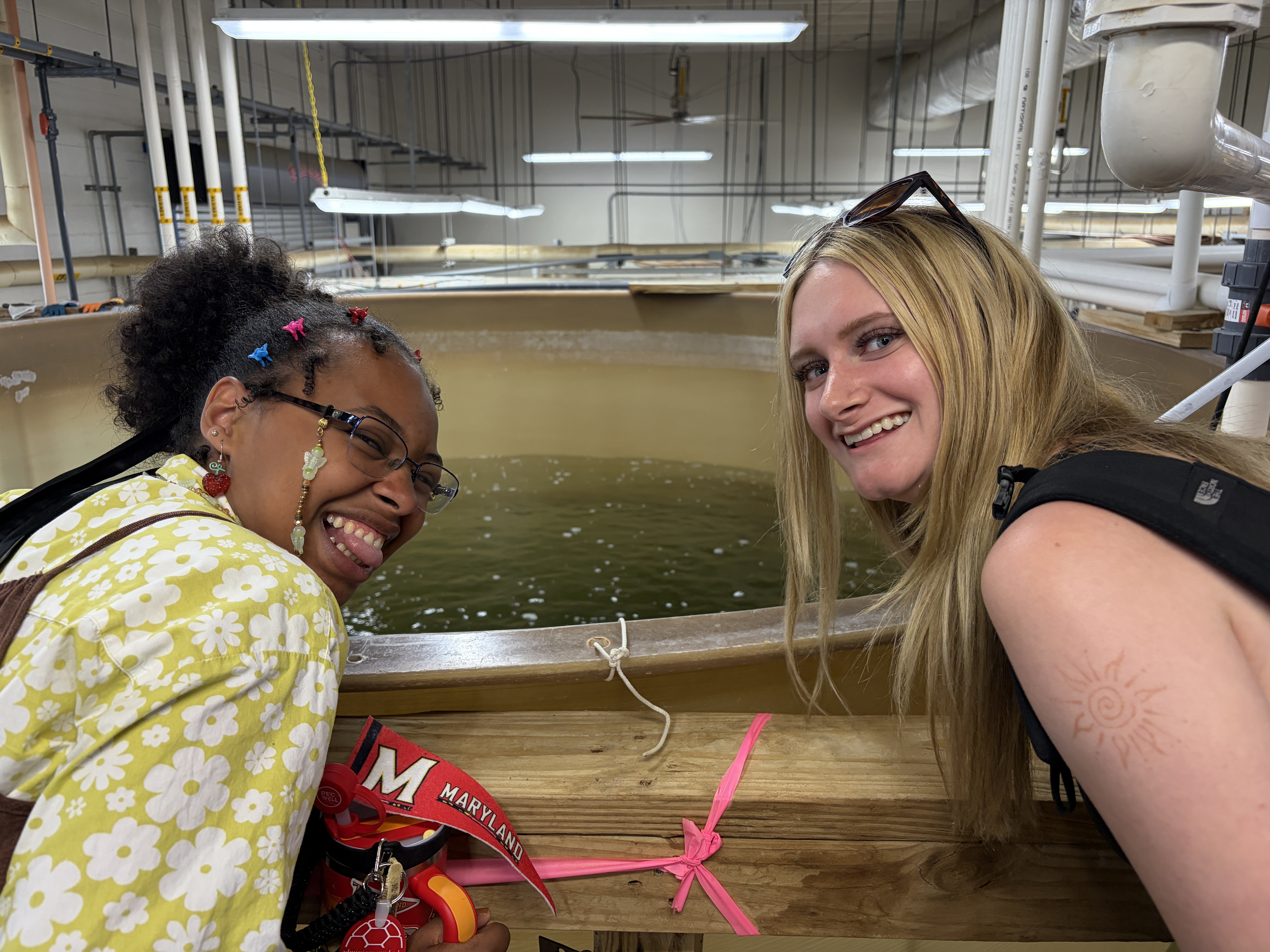
Me and ETE Scholar Madison looking over the large tanks for the oyster hatchery at Horn Point Laboratory!
To start off, one of their main projects at Horn Point Laboratory was hatching oysters from start to finish. Oysters are a very important animal to the bay because they filter out all of the water in the bay in a matter of days! But because the oyster population in the Chesapeake Bay is already decreasing because of overfishing, and their environment is slowly dying over time, Horn Point has made it one of its purposes to become an oyster hatchery. Horn Point does this by controlling oyster reproduction in their labs under constant supervision having environmental scientists observing how certain oysters reproduce in order to see if an oyster is a female or a male. This is important in the research because female oyster eggs are often limited, so to save the most potential baby oysters, the oysters reproducing have to be observed. Once the eggs are fertilized by a male oyster, these scientists look at the oysters under a microscope to see how they're growing over time, and once they meet a certain age, they get moved into these giant tanks (seen in the picture I attached to this report!) with nutritious algae for food. This green algae mixture is also made in the labs to make sure that the baby oysters are gaining as many nutrients as they can in order to give them the best chance of survival in the Chesapeake Bay, and once again, when they grow older, they are thrown into the Chesapeake Bay to settle into their new environment and help filter the bay.
Then there is their coastal line resilience research. This research is centered around protecting the coastline of the bay due to the constant erosions its facing because of its low elevations and its high-risk flooding areas. They plan on fixing this by using their oyster hatchery project to make some sort of armor to break the water from constantly eroding the coast of the Chesapeake. Oysters manage to live their whole lives settled in one place. If they move, they wouldn’t be able to survive for a long time, and the best place for them to live is wherever the most oysters are! So, by building oyster veneers, which are materials made for oysters to attach themselves in order to make a hard cluster of oysters, this could help stop the water in the bay from eroding the coast because of the cluster of oysters actively blocking the water from hitting the shore too harshly.
Lastly, in the Chesapeake Bay, plastic pollution has become more and more prominent over the years, and in order to combat and observe this, scientists over at Horn Point Laboratory have been setting up cameras and microscopes to not only look at regular plastics but microplastics as well. These observations would overall help clean the bay because they will also be disposing of the trash once it’s observed, but it would also help find the sources of the plastics and see how different plastics degrade over periods of time.
Ultimately, Horn Point Laboratory's environmental initiatives are important to the overall health of the bay, and the people running the labs, scientists, directors, and graduate students alike love to reach out to the community! They do this by opening the lab for tours so people are able to explore their projects and research, like their oyster hatchery, coastal line resilience research, and how the microplastics entering the bay are moving throughout the watershed. They give guided and non-guided tours to the public, so no matter what, people are able to come in during opening hours and witness all of the work and research they are doing to benefit the bay in the long run.
Now moving onto the guided tour, scholars went on about Harriet Tubman's childhood, the Underground Railroad she went through in pre-Civil War Eastern Shore, and how the railroads are slowly getting erased due to sea level rise. Throughout the tour, we often were told about how Harriet turned her knowledge as a slave to help herself and a plethora of other slaves escape from the slavery still going on in Maryland to the upper north states and even Canada. One of the ways she used her knowledge to guide her and the others to safety was her use of the North Star. Harriet realized that the North Star could be used as a compass because it was directly above the Earth's North Pole, so when she was traveling with others at night, she used the North Star to find true north and went up to more northern states like Pennsylvania. Over time, though, due to sea levels rising in the Eastern Shore, parts of the Underground Railroad that Harriet used to help herself and others gain their freedom in the north are slowly disappearing underwater, causing this railroad to barely be traceable in the next few years.
All in all, I had a great time learning about the research and projects going into the Chesapeake Bay, as well as learning about the enriching history of Harriet Tubman's life and its impacts in the Eastern Shore!