


Event Name: National Zoo Excursion
Event time and place: Smithsonian National Zoo in Washington, DC on 5/3/2026
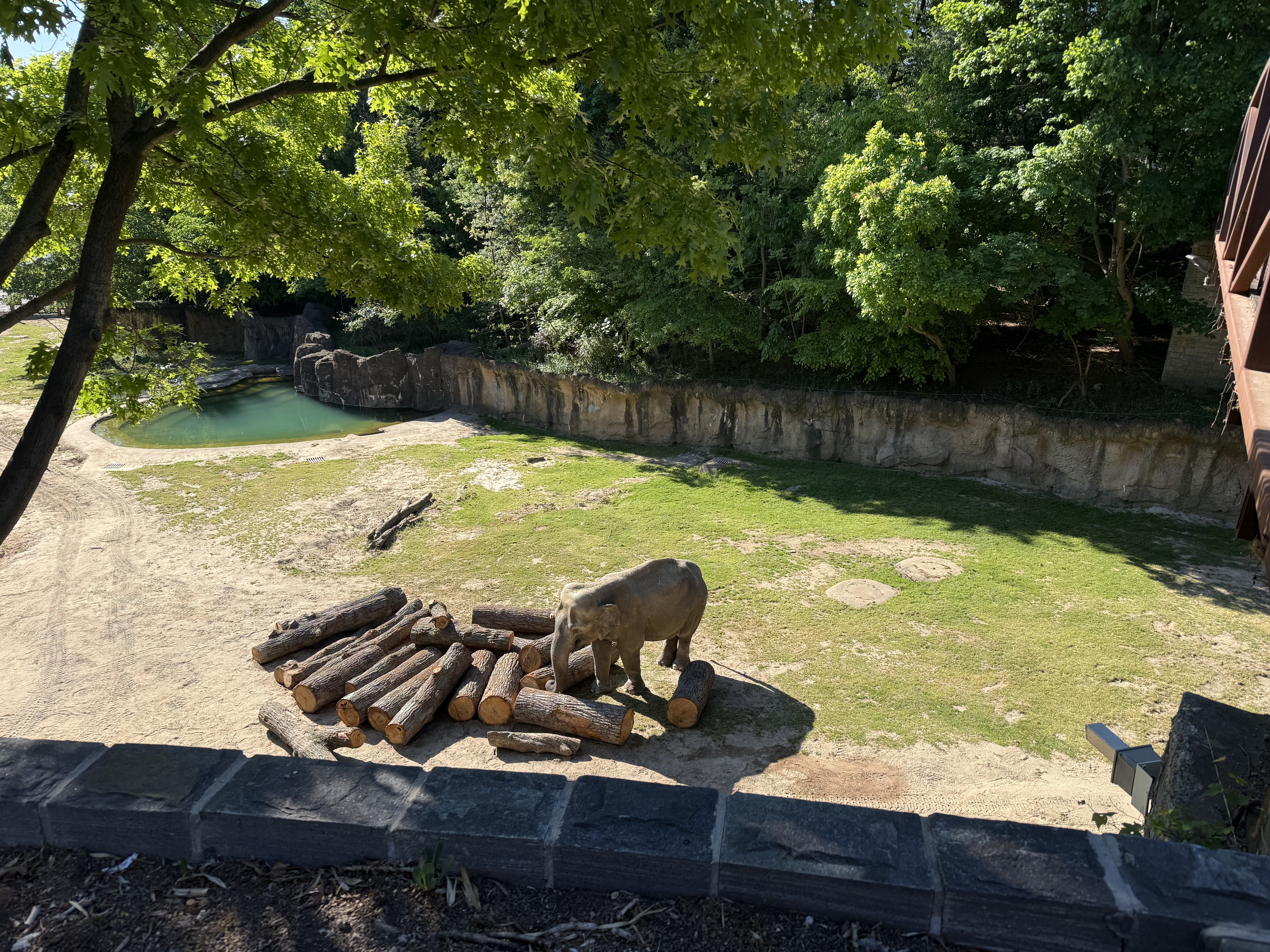
Asian elephant in its enclosure.
Growing up, I frequently visited the Smithsonian National Zoo with my family. I always enjoy seeing the animals, walking the gorgeously landscaped paths, and viewing the design of various exhibits. As such, I feel very familiar with the various exhibits, animals, and the zoo grounds. However, attending the National Zoo with scholars allowed me to learn new information and view the zoo more critically.
The first building that I visited was the Small Mammal House. Plaques hung near the enclosures for each species that listed their common name, scientific name, geographical range, diet, and habitat, along with a couple of fun facts. While roaming the house, I saw several mammals, including a screaming hairy armadillo, a prehensile-tailed porcupine, naked mole rats, meerkats, and Goeldi’s monkeys. In the building, there was a display on the walls featuring X-ray images, as well as a couple of skeletons in glass cases. I believe that the hall could provide valuable information for all education levels, but I would guess that it was specifically aimed to appeal to upper elementary schoolers or middle schoolers, given the easy language used and the silly attention-grabber headings. In this house, I did not see anyone pay attention to the information on the plaques or displays except to identify the name of the species.
The second building I visited was the Reptile Discovery Center. Similar to the Small Mammal House, each species was accompanied by a plaque that listed its common name, scientific name, habitat, and range as well as a fun fact. In this center, I saw various reptiles such as a shingleback skink, painted terrapins, a tomistoma, and a Cuban crocodile. I also saw several unique displays, such as an illustrated panel comparing the anatomy of humans and reptiles. The panel could be opened like a book, and on the outside it displayed the organs of humans and reptiles, and on the inside it displayed their skeletons. Additionally, there were several skeletons of snake skulls enclosed in cases that demonstrated how they can drop their jaws to swallow large animals. I believe that this house is aimed at a slightly older age range than the small mammal house, perhaps at a middle or high school level, given that the information provided was slightly more wordy. However, it could still be applicable for all ages. I saw two people in this house avidly reading the information on the plaques and displays.
Finally, I visited Amazonia twice: once on my own, so that I could take my time browsing the exhibits, and then again for the guided tour. Nearly all of the species had a plaque next to their exhibits that contained the species’ common name, scientific name, and a brief fact. The plaques on the small fish tanks merely listed the common name and scientific name of the species. Amazonia contained numerous fish such as redtail catfish, black doradids, and red piranhas, as well as animals such as freshwater stingrays and arrau turtles. One unique display that I saw was of a metal eel in which you could touch both ends to make a power connection, highlighting how eels’ bodies are filled with electric organs. I saw several children interacting with this exhibit. Given that the information on the plaques is provided in easy-to-read sentences and small paragraphs, I believe that Amazonia is aimed towards a younger age group and education level, such as upper elementary school or middle school. Other than the children interacting with the eel, I did not see any non-SGCer paying attention to the information other than to read the names of the species.
Zoos aid the public’s understanding of animals and ecosystems by providing opportunities to observe different species in reconstructed habitats. Through observation, the public can gain general knowledge about what types of animals and species exist, how they behave, and the types of ecosystems they inhabit. Additionally, zoos aid in the publics’ understanding by allowing people to interact with knowledgeable zookeepers and employees, either through casual conversation, organized shows, or interactive tables. Through these conversations, the public can learn about animals and ecosystems in an engaging way and use the opportunity to ask any unanswered questions.
All of the exhibits that I encountered today had been adapted to fit the animals in some way. In particular, I noticed that the Asian elephant enclosure included large logs for the elephants to interact with as well as swimming pools to play, bathe, or cool down in. Furthermore, the river otter exhibit consisted of a man-made pond connecting to a small river, a small net for the otters to rest in on shore, several fallen branches and logs, and some small toys for the otters to play with. These features made the exhibits more comfortable and interesting for the animals.
Overall, I had a wonderful time at the zoo, and I look forward to returning again in the future!