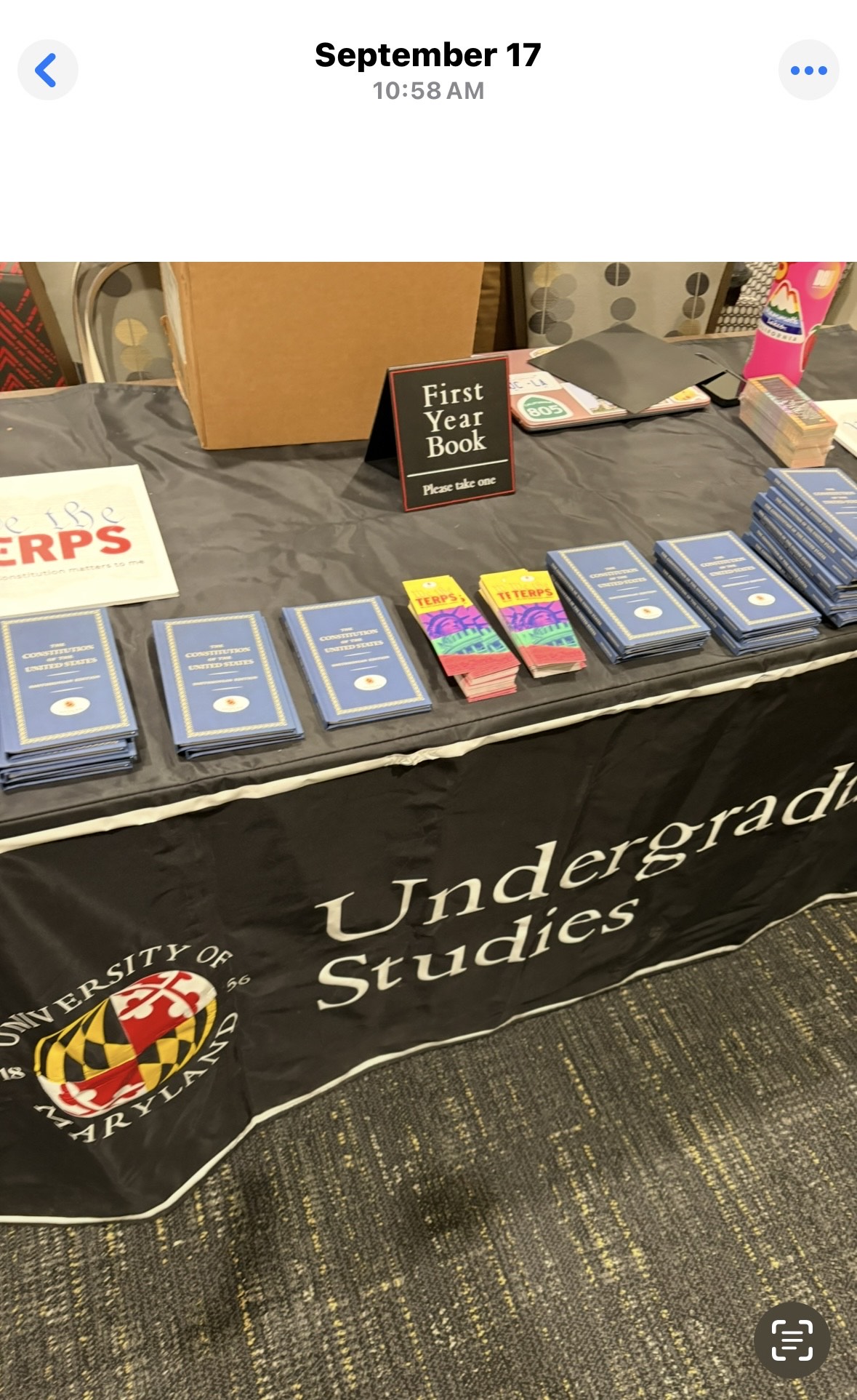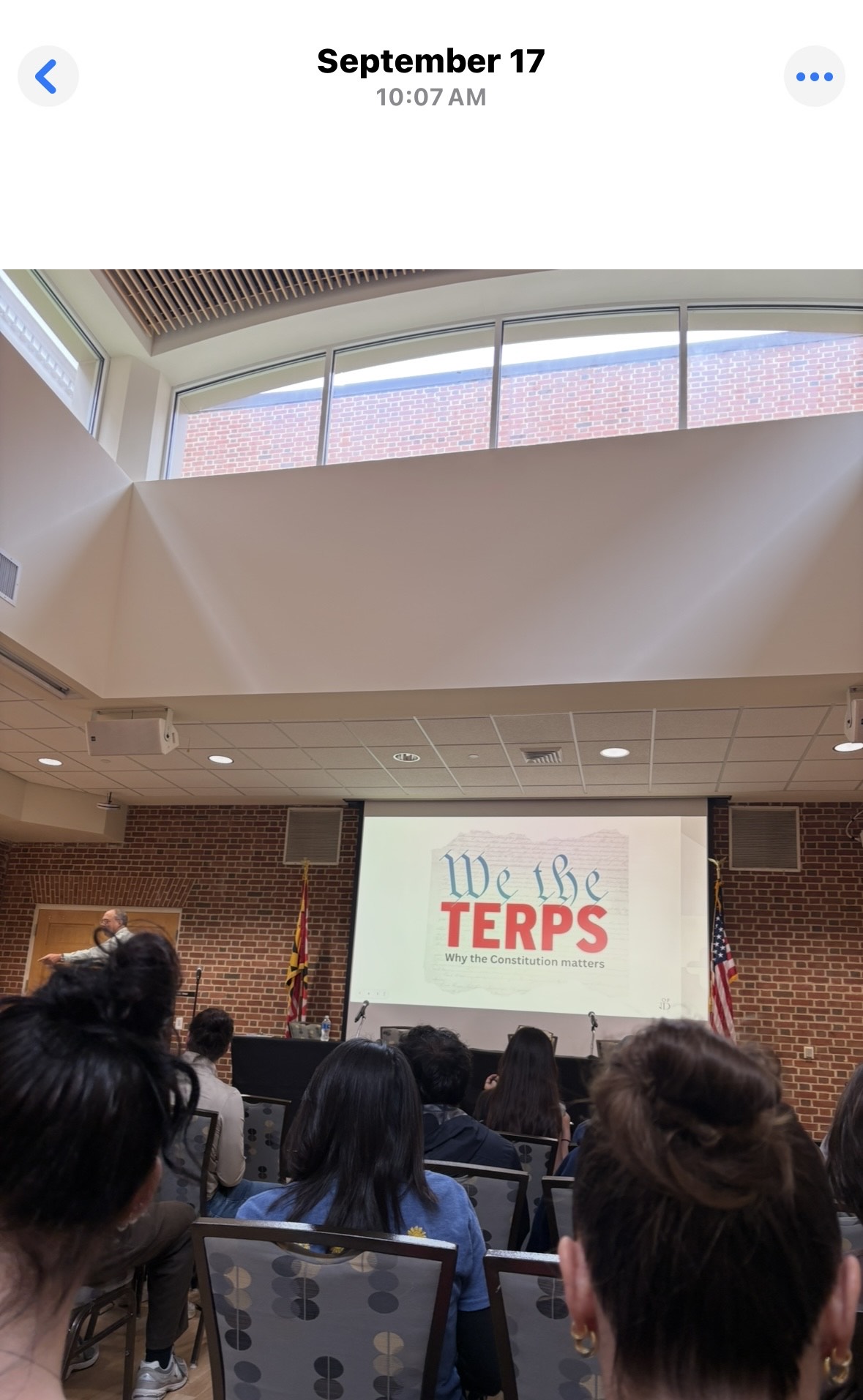


Event name: We the Terps (Why the Constitution Matters): A Day with the U.S. Constitution
Event time and place: 09/17/25, 10am to 2pm at the Stamp Student Union Prince George's Room
Summarize the major points/concepts of the presentation, talk, performance or other event, In particular, what aspects or issues about the U.S. Constitution were addressed?
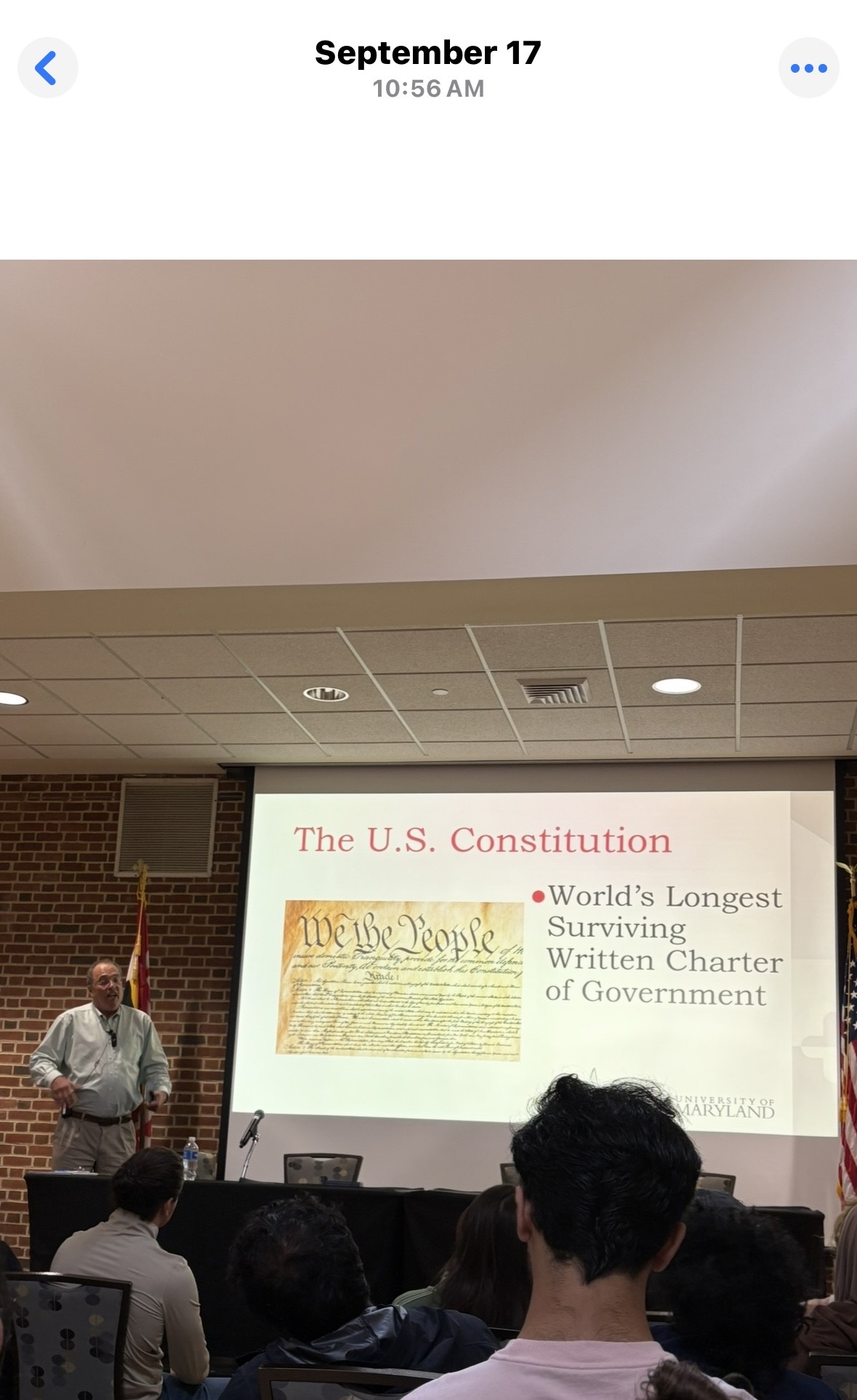
Dr. Michael Ross is a history professor at UMD with research expertise in the 19th century, Constitutional history, and the United States. His job as the presenter was to discuss the body of the Constitution, from the Preamble through Articles one through seven. Even though I had to leave early, I think the main point of the whole presentation was to discuss how the Constitution impacted our nation at the time of its creation and why it matters to this day. As college students, we are learning how to become independent adults in society with the right to vote, and many of our viewpoints are being shaped during this time. This means that it is important that we are not ignorant to the contents of the Constitution because they have laid the foundation of our country's government that is constantly changing.
Did you find the main points convincing? Did you observe any use of logical fallacies or other failures of critical thinking? If so, what were they?
For the portion of the program that contained Dr. Ross' presentation, he was not necessarily trying to convince anyone about or argue anything, he was simply educating us about the contents of the body of the Constitution. At one point he did argue that Article I Section 8 was the most important in terms of long term effects.
He began with the history of the creation of the Constitution. This included the creation of the Articles of Confederation, where there was no president, no judicial branch, no power to tax, and the economy was faltering. These articles failed ultimately, and led to the creation of the Constitution. Firstly, Dr. Ross began his dive into the Constitution with the Preamble, which he pointed out inspires a lot of language today. He then discussed Article I which details the powers of Congress. He detailed the significance of Section 8 to support his claim that this section is the most important in terms of long term effects. This section gives Congress the power to tax and spend for the "General welfare," and contains the Commerce Clause that is a living clause that has grown in its power. The Commerce Clause was a big factor in the Supreme Court case United States V Lopez. This section also gives Congress the power to declare war and raise and support armies. It also contains the Necessary and Proper clause which was a key factor in the McCulloch V Maryland Supreme Court case that was a debate over the creation of a National Bank and the state's ability to tax it. After this, Dr. Ross summarized Article II which details the powers of the president and things like the electoral college, being a natural born citizen, and the oath of office, and Article III which addresses the judicial branch powers. After this he moved on to discuss Article IV which governs relationships between states and the federal government. Then Dr. Ross read through Article V which details the process of amending the Constitution, and Dr. Ross expressed how this article made the Constitution easier to amend than the Articles of Confederation. Next, he discussed Article VI which establishes the Supremacy Clause. Finally, Dr. Ross read through Article VII, which established the Constitution's procedure for its own ratification. Because Dr. Ross was just reading through the Constitution during this portion of the program, he did not use any logical fallacies or failures of critical thinking. Starting this program with a complete overview of the Constitution before discussing why the Constitution matters was a great way to ensure the audience had a background of the contents of the Constitution to be able to understand why it matters.
Unfortunately I had a class from 12pm-1:50pm that day, so I could not be there for the Q & A session at the end. I left around 11:00am after Dr. Ross had finished speaking in the transition between him and the next speaker because I didn't want to leave in the middle of the next speaker's presentation.