


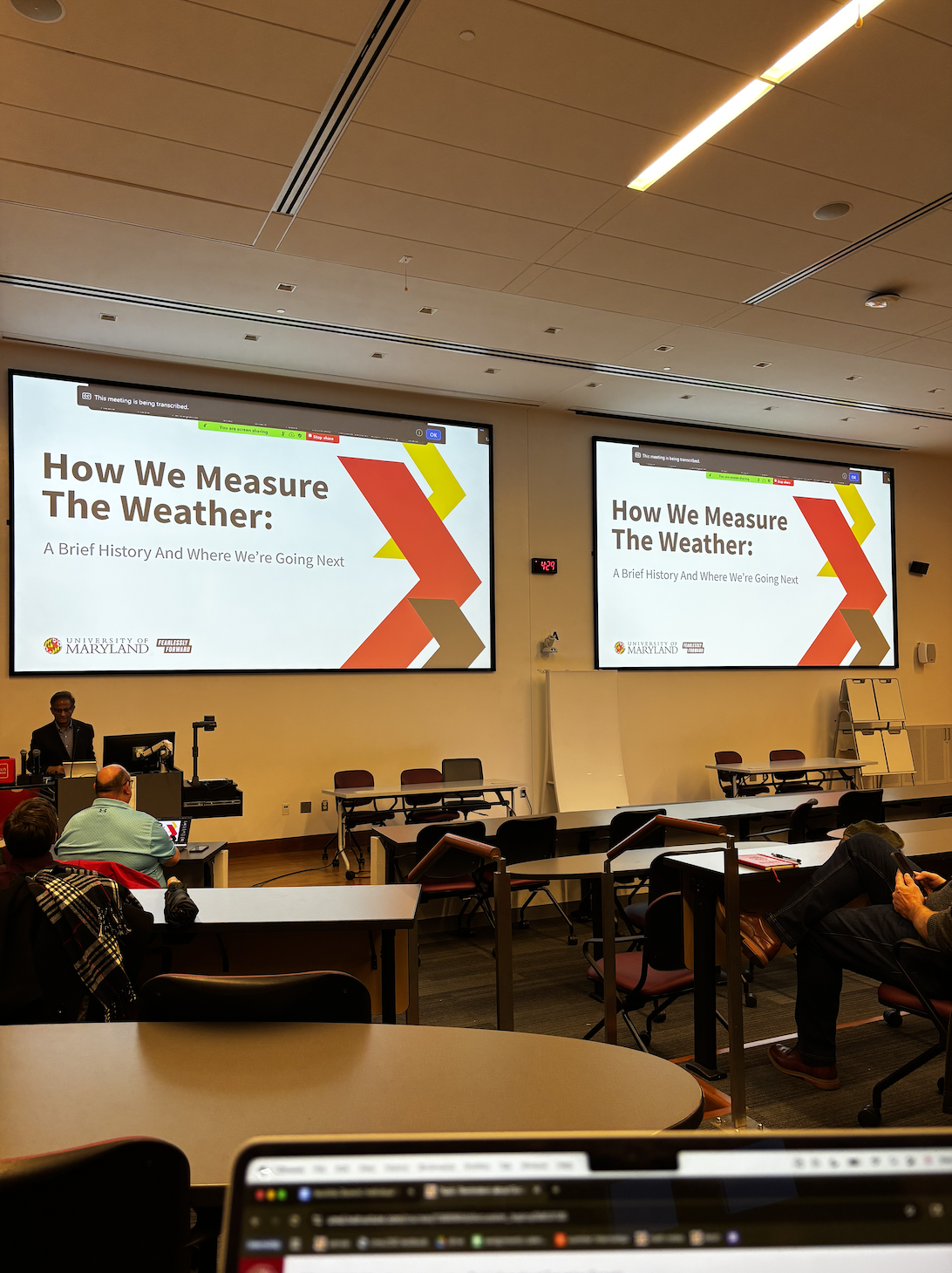
The speaker, James Hyde, began his lecture by supplying a quote from William Edgar Knowles Middleton, a well-known and respected meteorologist who made major contributions to the field. Middleton once said that meteorology could not be said to have existed before the invention of the thermometer and barometer - both of which being relatively modern instruments. However, Hyde disagreed with this statement, which came as a shock to me. He mentioned that weather measurement instruments can be dated to as far as Ancient India, where they used containers to measure rainfall. The “original mesonet” (i.e. recorded measurements of weather pattern) was located in Korea.
After that introduction, Hyde continued to summarize the history of weather measurement. He mentioned the early thermometer, barometer, and hygrometer (which used horse and beard hair to measure humidity). Hyde then shifted the topic of conversation to meteorological evolution and the challenges of the digital transition. Since 1970, we have lost a significant amount of data stations in Maryland alone. In addition to that, we have lost a great deal of written data about weather patterns, making it difficult to make reliable conclusions about climate change.
That being said, instrumentation is advancing rapidly, and we are now able to get data every 3 seconds. The accuracy of our data is increasing as well, giving meteorologists more reliable data to make conclusions with. Weather stations are densely populated and can be found in backyards, highways, airport runways, etc., and they all feed data to the mesonet. Unfortunately, many weather stations are not in optimal locations or conditions, which may result in skewed data. For example, some stations are set too close to the concrete ground, which would measure the temperature to be significantly higher than it actually is.
Lastly, Hyde concluded the event by focusing on what is to come. In 2024, more data stations were built and a website containing real-time weather data was created. As of now, around 40 of those stations are complete, and by the end of 2027, the entire network is expected to be built. He mentioned that weather is meant to be trusted and accurate, and has a variety of use cases in agriculture, commerce, and the overall population.
I found many of the speaker’s main points convincing, particularly his disagreement with William Edgar Knowles Middleton’s statement. Meteorology is more than just the measurement of temperature. While that is a vital part in conclusions and policy made regarding the field, weather measurements have existed for longer than just a few centuries. It is important to recognize that part of history. Since rainfall is directly tied to agriculture, food security, and human survival, I found the argument that rain was one of the realist and most important weather variables to be well supported.
On the other hand, I was less convinced of the “loss of the human touch” in weather data collection. The speaker emphasized that in the past, people would get up at 8 am and manually record data. Nowadays, data is being recorded every three seconds. However, Hyde viewed the loss of a human touch as a bad development, when I believe that it could be seen as positive as it gives us more close together data to base decisions on.
I was also surprised by the claim that despite technological advancements, we now only receive three summary values: high temperature, low temperature, and precipitation. This contraindicated my prior assumption that modern instruments would continuously collect far more variables. Even in the weather app on my phone, I get more variables such as wind speed, air quality, UV index, and more. While I am aware that public-facing summaries may be simplified for general understanding, the speaker could have clarified the distinction between raw data collection and what is commonly reported to the public.
One tool from Sagan’s toolbox that I realized the speaker used was “a chain is as strong as its weakest link.” This was especially clear in the discussion of poorly placed or uncalibrated weather stations. Even with advanced technology, unreliable stations can skew entire datasets, particularly when data is aggregated across networks. The point was convincing and aligned well with many real-world concerns I’ve learned about in classes and on my own such as data integrity and standardization.
A logical fallacy that I noticed from the presentation was false dichotomy/black-and-white. At several points in the presentation, the transition from human-observed weather stations to digital ones was framed as a tradeoff, implying that increased automation comes at the expense of human involvement and data quality. This can be misleading, because it says that there are only two opposing opinions: manual observation or automated instrumentation. In reality, these approaches are not mutually exclusive as they can complement one another with automation providing high-frequency and high-quality data and the human touch ensuring proper station placement and care.