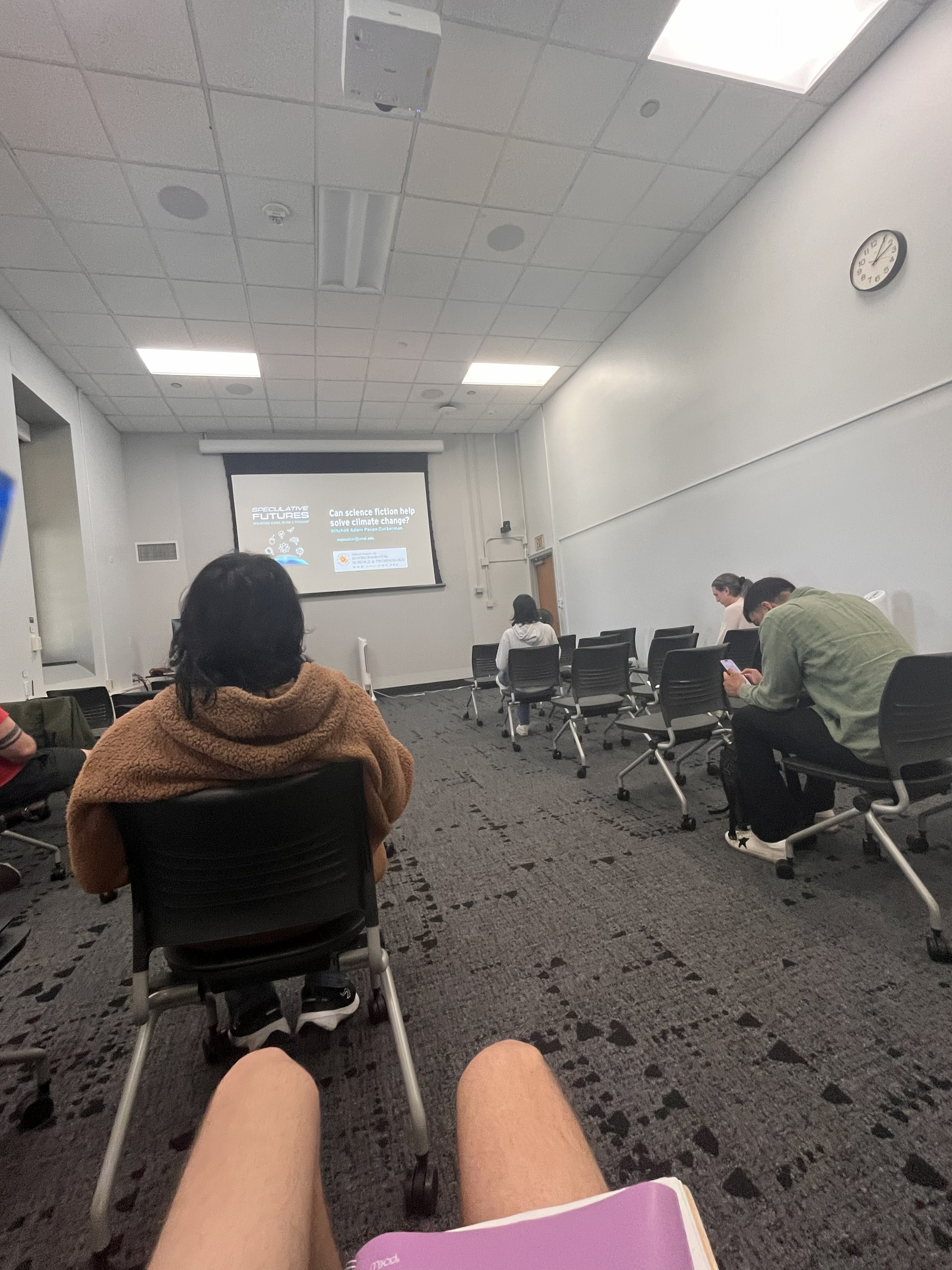
Name of Presenter/Organizer: Dr. Mitchell Adam Pavao-Zuckerman, Urban and Built Environment Sustainability Lab leader and Honors College Professor Title of Presentation: "Can science fiction help solve climate change?" Date and Location of Talk: Wednesday, April 22, from 1:00–4:00 PM in McKeldin Library 4109
The talk was held in a meeting room in the McKeldin Library, where both students and faculty alike could unite to learn from the speaker, Dr. Zuckerman. He began by introducing the work he does on campus, including a course for freshman students about the topic of understanding and combatting climate change. In his presentation, he asked the audience to talk about any works of science fiction they had recently read and what the significance of the climate is in each of those works. I raised my hand and talked about how I’m reading The Road by Cormac McCarthy, and how the desolate and apocalyptic state of the climate drives the somber and gritty mood of the text. Other participants mentioned other works, and Dr. Zuckerman used our various examples to demonstrate the dichotomy between different types of climate fiction. Some works of science fiction are "futuristic" in the sense that they present technologies that transform life in a certain way, while others take the idea of transforming the climate to a degree that makes life more challenging. He highlighted that science fiction is not only an "escapism", but also describes how humans will connect with each other and our world’s environment in the future. He related how acclaimed Canadian author Margaret Atwood believes that "[Sci-fi] tells us about what we are now".
Overall, I appreciated how Dr. Zuckerman made the presentation interactive by asking the audience to give their perspective on some of the topics. This made the presentation more engaging and made it easier for the audience to connect with the concepts as they were asked to think for themselves about some of the topics. This was demonstrated in the section about how humans are often considering the future, but that we must establish what the future is and when it "begins". Dr. Zuckerman posed the question to the audience of how many years into the future would we expect the majority of things in our life to be different. Everyone had different perspectives on how to answer this question, and it was interesting to consider how we may define what the future is. In considering the future, Zuckerman proposed considering how climate change will impact those related to us, such as our children and grandchildren, as a way of framing how the choices made today will define how climate change progresses. The presentation included some information that has been discussed in Colloquium, such as the model of climate change in the future, and how there are multiple possible outcomes based on different severities depending on what action is taken today.
Dr. Zuckerman spoke about how there is more psychological success in causing action towards preventing climate change by promoting hope and how the world can fix the problems, instead of considering climate change as an outright doomsday event that is impossible to defend against. Even though climate change threatens to be catastrophic, all actions that go towards preventing this threat will be a positive outcome. He addressed the notion of "Imaginaries", which are visions for the culture of a place, particularly cities. An example is New York City as "The Great Melting Pot". "Imaginaries" are the notion of how ideals for a place give them a culture which influences life there, which is something that exists in the real world and many science fiction texts. In all, science fiction helps us to consider future scenarios in order to plan creative solutions. The presentation helped connect the dots between how fiction writing and real science can interact and help bring awareness to issues that can lead to demonstrable social change.