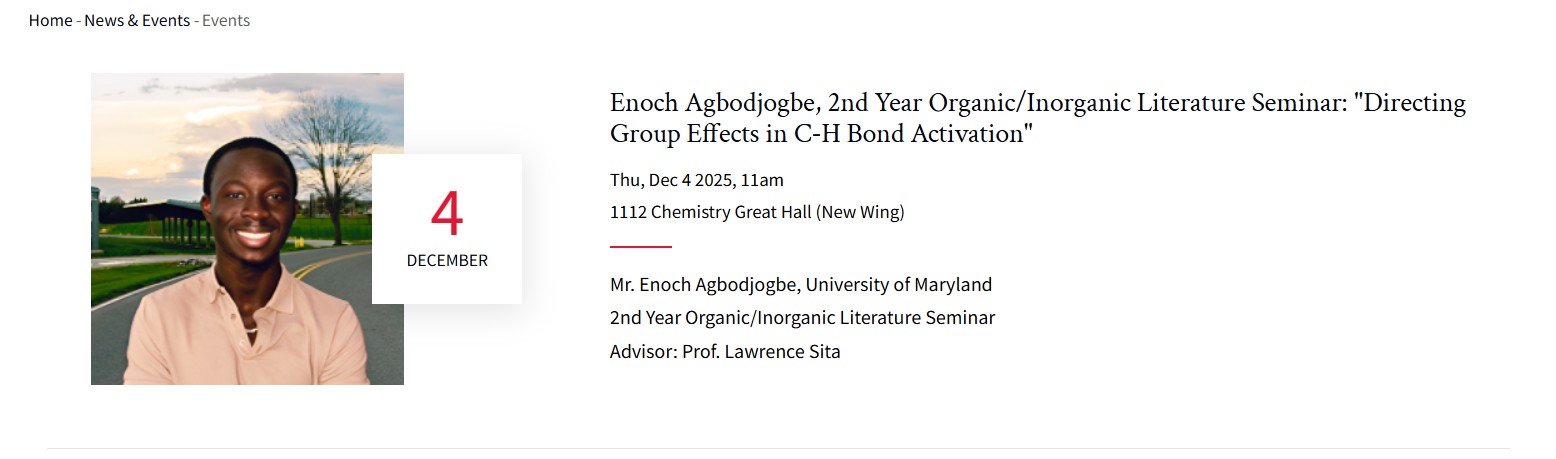
Name of Presenter/Organizer: Enoch Agbodjogbe, 2nd year Grad student under Professor Lawrence Sita and the Sita Laboratory team. Title of Presentation/Talk/Event: "Directing Group Effects in C-H Bond Activation" Date and Location of Presentation/Talk/Event: 11am on December 4th, 2025 in the large conference room (1112) in the Chemistry building's New Wing.
Before the event began, a few people slowly trickled in, before about a dozen students who seemed to be members of the presenter's Seminar-dedicated class. To begin the speech, a peer introduced Enoch with his credentials (where he went for Undergrad, the research experience he had there, and what he'd be presenting about today). Then Enoch jumped into his slides and introduced the topic. I followed the discussion of what C-H bonds were and their importance for the first slide quite well, but it quickly became entirely new material for me, which was both fun and scary. Regardless, I found it very engaging to try and follow along and pick up on the logic and terminology that was going on. He introduced the history of the process and also its significance to developing many organic compounds for drugs. One part I found interesting was the discussion on how certain processes within Mannich reactions are characterized by many issues when it comes to practicality;the economic, environmental, and chemical stability+safety challenges involved. Sometimes in classes we deal with absolutes, but this included the narrative of how in the real world, there are factors beyond just doing the chemistry on paper that impact human decisions. I also found the sections on Optimization really interesting, in which the scientists from each particular paper had been testing with dozens of different conditions and reagents to achieve the greatest yield. This demonstration of real scientific development is contrasted with being told what to do and needing to follow direct instructions throughout much of schooling. He went through and explained what each of the three sources had investigated and what the results for, in both the laboratory results with yields from materials, but then what a proposed mechanism would be for how the chemical reactions occurred. I enjoyed seeing various things that I had heard of or learned about the basics of from Organic Chemistry, which was expanded upon and compounded with other techniques in what all of these scientists were doing in the lab.
Unlike something like a TED-Talk, this presentation was not trying to persuade or argue, but really just introduce some of the work being done in many areas of the subfield of creating chemical compounds through targeting C-H bonds in different ways, to a broader audience using newly published literature. One part that one might critique with this sort of talk is driving home a major point across all three papers that the speaker detailed. There was not much discussion of comparing each topic, and even though I am very much a novice when it comes to the graduate-level specificities within chemistry, I felt like each of the three chosen papers had different processes entirely and so I missed what the connection between them was and if there was meant to be an overall statement. Even something about comparing the conclusions of each study and maybe finding the "best" (which could certainly be defined in several ways) would have been an interesting addition. But I am not aware of any major shortcomings or contradictions in the presentation. The one audience question that was asked was about what the outcomes from one of the papers had found regarding using the opposite configuration of an Alkene for a certain additional step (which the speaker hadn't covered it seemed) but it was addressed. Overall, I was extremely impressed with how the speaker flowed through so many slides and managed to be engaging and expedient with covering so much material. There was not much further elaboration on many concepts that I hadn't heard of, which is to be expected given that it was from a Graduate-level speaker for a Graduate-level intended audience, but I did notice how he broke down certain rationales for some of the reaction mechanisms which showed he had done his research and was knowledgeable about the subject. I am inspired by what I witnessed, both in terms of enjoying the process of being in the audience and by the thought of someday being able to participate in such research where I could present. I took notes on a lot of different terms and concepts that I hadn't encountered before which I'm hoping will allow me to further my knowledge. As a first foray into a University Colloquium, I found it to be a highly rewarding excursion.