


American Natural History Museum:
November 22nd, NYC, New York:
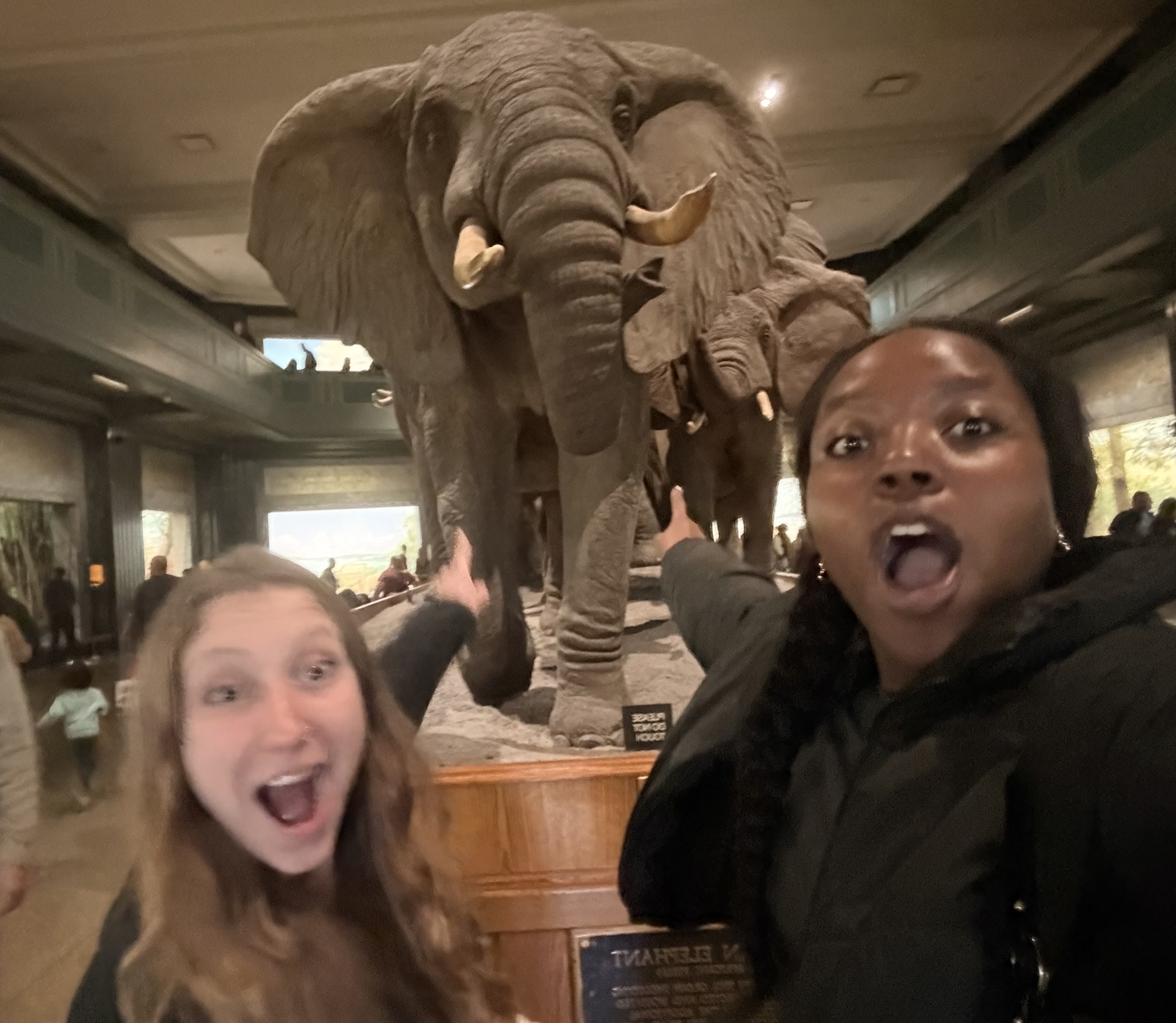
After shuffling out of the bus, bleary eyed, and sleepy, we stood in front of the grandiose entrance of the notable American Natural History Museum. We were led upstairs to the fourth floor and lined up for the museum's newly opened exhibit: Impact: The End of the Age of Dinosaurs. Right at the entrance of the exhibit, there was a large Triceratops biting a large tree branch. There were also many other animals and organisms around the entrance, immersing visitors into what life was like pre-asteroid impact. After walking farther in the exhibit, there is a short documentary playing in a theater. This documentary demonstrates the devastation that occurred when the asteroid hit the Earth, and the steps that led to the mass extinction. Once leaving the theater, there is an infographic with sounds and images demonstrating the blanket of soot blocking the sunlight and the catastrophic impact that resulted. The entire exhibit is set up very intentionally, as the visitors go on a journey chronologically from life on Earth pre-impact, to post-impact. This makes the exhibit and information easily digestible and interpretable to a casual visitor. One doesn't need any background knowledge on the Dinosaurs or the extinction to understand this exhibit. Finally, this exhibit makes this ancient extinction event relevant to people today as it relates to present-day anthropogenic climate change, causing another mass extinction. It presents a call to action to get people to be aware of our changing climate and the detrimental effects.
Furthermore, after leaving the impact exhibit we had the choice to explore a separate exhibit all by ourselves or find another guided tour. My group decided to leave it to our own devices and explore a new exhibit. We went downstairs to a random floor, and upon looking for the space-focused exhibit, we stumbled upon the quaint Pacific Peoples. Upon walking in, we were greeted by the illustrious Easter Island head. Through the exhibit, I learned these are called Moai Heads, and were carved from volcanic tuff rock. I was also intrigued by the fact that there are eight hundred seventy-seven Moai currently on Easter Island. Among the Moai, there are also other incredible artifacts such as an intricately designed Maori Chief’s Pataka. Patakas are storage houses used for storing food and cultural treasures. Etched along the gable roof of the structure are carved whales. Whales are symbols of abundance to the Maori, and they could feed a community for months. Lastly, on display was a Maori Weapons Case. This case consisted of many items, such as a Patu. This translates to “strike, hit, or subdue”. Patus were used for close combat. Additionally, Patus typically would be stored in the aforementioned Maori chief’s pataka. These Patu were usually made from wood, stone, or jade. Throughout the exhibit, the walls are painted a blue reminiscent of the Oceans around Polynesia, and native Polynesian music is softly wafting throughout the air, engulfing one into Polynesian culture and making visitors feel as though they are on an island. Despite the beautiful exhibit, I wish some of the synopses of the artifacts were longer. For example, I was left wondering about theories as to why the Moai were placed where they are, or why the Maori created them. This could’ve been placed as a short paragraph on the wall next to the Moai.
After leaving the islands of Polynesia, I meandered through the museum before landing at the Fossils hall. This hall was meticulously designed. At the beginning of the exhibit, visitors are led into a theater where they learn about the basics of tracing ancestry for humans as well as Vertebrates by using a Cladogram. At the end of the documentary, the cladogram warps, and we see that each branch of the cladogram is represented by a different hall of the exhibit. Furthermore, every circle on the ground is the introduction of a new feature of evolution, like hips and jawbones. This is a very novel organizing principle, and exceptionally captures the interest of the general public. Guiding the tour, we had Dr. Merck and Dr. Holtz translating the information littered throughout the hall. The tour entailed many interesting facts about the Paleozoic period, as well as clearing any misconceptions we may have held about the evolution of vertebrates. For example, many people, including myself, have heard that sharks are a primitive species and have not evolved much throughout their ancestry. This is not true as they have changed a lot from the Palaeozoic period. I also learned that humans share a common ancestor with the lobe-finned fish; we know this because the fish has a three-jointed limb, similar to humans. However, the exhibit was very outdated as it included many erroneous aspects like the position of turtles on the family cladogram, originally we believed they were similar to extinct reptiles but now we think they are closer to crocodiles and birds. Likewise, the Tyrannosaurus Rex is more closely related to birds than other reptiles. A way the new information could be conveyed is by placing QR codes near the exhibits that tell people new information or research has been discovered. This could be a logistical nightmare, however, when it comes to maintaining the website and putting QR codes throughout the museum.
After the fossils exhibit, we went downstairs to the Planetarium to see the show: Encounters in the Milky Way. The theme of the show was celestial objects in our galaxy. The show displayed a multitude of information about our galaxy, including how wide it is, where we live in it, and the scale of the galaxy. Many of the images projected looked like they were based on measurements in observations, as they accurately displayed the scale of the planetary orbits as well as the inclination of the moon’s orbit. The fact that the sun used to be in a stellar nursery with other stars, and the fact that we lie in a nebula cloud, was new information to me.
Lastly, the AMNH seeks to accommodate a variety of visitors from various backgrounds, ages, and learning abilities in many different ways, such as a place for audio tours, translation devices for the planetarium, and interactive trivia-esque games to placate children waiting in lines for the next show. The entire visit to the AMNH was very immersive, and I learned many different things.