


Field Trip Report: Smithsonian National Zoological Park
Gabriel Cruz
Event Name: Smithsonian National Zoo Excursion
Event Time and Place: National Zoological Garden, Washington, DC, May 3, 2026
The Smithsonian National Zoological Park (NZP) serves as the public face for the larger Smithsonian's National Zoo and Conservation Biology Institute (NZCBI); its focus is on public engagement/education and inspiration while also working in clinical/behavioral research and management of endangered species. At NZP, collections of animals are kept in thematic buildings or regions. There are eight main animal care units; my peers and I visited three: the Small Mammal House, the Reptile Discovery Center, and the Amazonia. Witnessing how they intertwined animal care and conservation with education was quite intriguing to witness, a truly entertaining and educational experience. In this report, I will describe the type of animals in each house, the methods of education employed, and the animals' mental/emotional welfare.
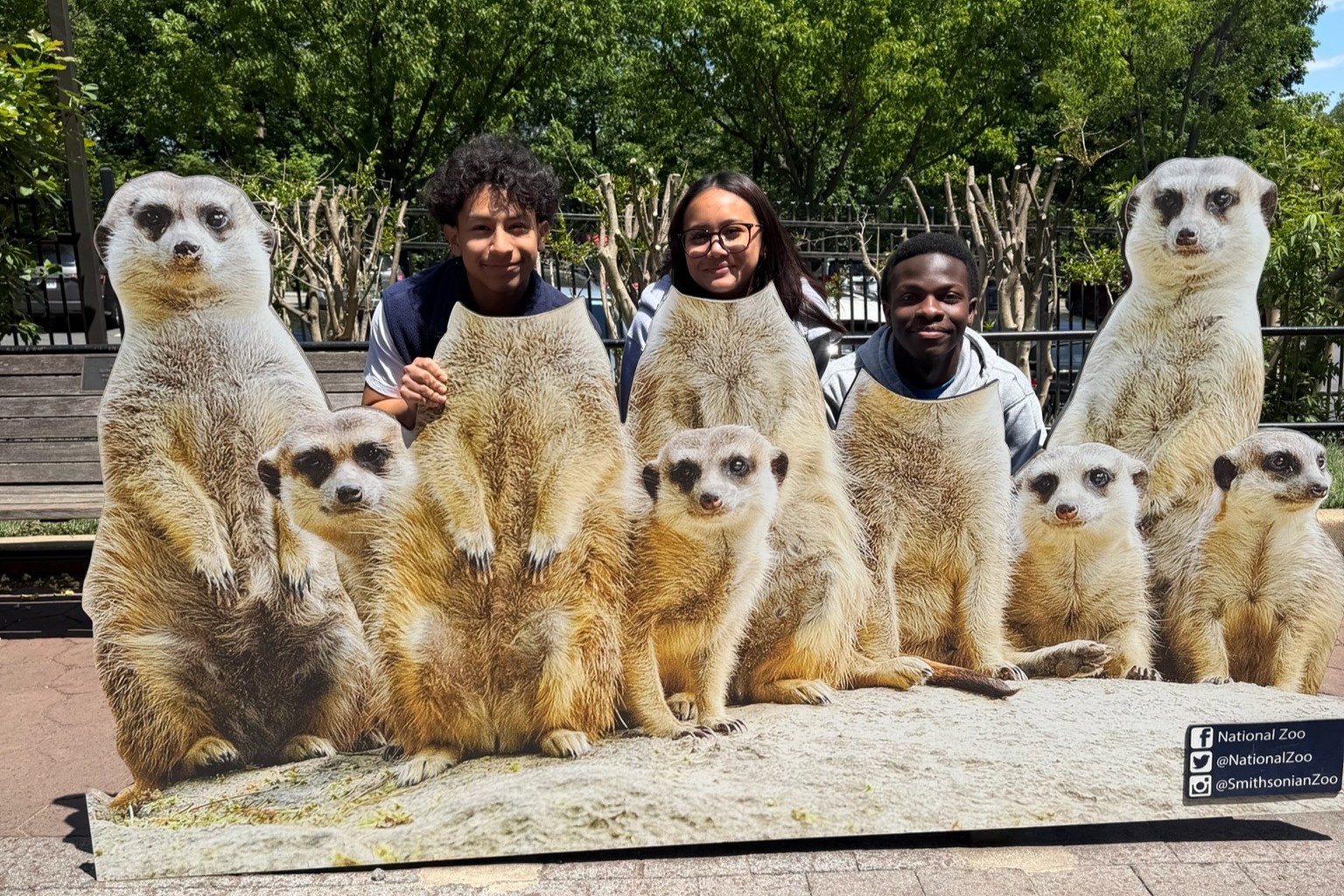
Gabriel and friends are taking a group picture with NZP's kids' meerkat cutout
Amazonia
The first building I visited was the Amazonia, in which my awesome SGC professors gave us a tour of the exhibits; my professors outlined the relationships and cool facts about the different species we would see. Nonetheless, to say the least, this building's structure/layout was by far the most distinguishable out of the ones I visited this day. Many of the exhibits I'll talk about later will be small enclosures where animals are kept isolated. But not this one. At the Amazonia, especially the second floor with birds, it was almost as if you were walking alongside the animals in their own environment; it almost felt as if I were walking in a rainforest.
- In the Amazonia, there would be a load of species: stingrays, tortoises, toads, loads of birds, eels, and a variety of fish. Each of these exhibits would be labeled with a sign or plaque with the animal's scientific and common name, their usual habitat, and also their roles in their habitats.
- There are a few different displays that go beyond just text on panels: there's replica fossils, sculptures of animals (like their freshwater dolphin), and even a fake electric eel that vibrates when you touch both sides, emphasizing how eels are "living batteries."
- I'd say the educational level of some of the areas are definitely targeted towards everyone, especially younger kids; the electric eel, as you'll see below, was a "shocking" and fun surprise for all.
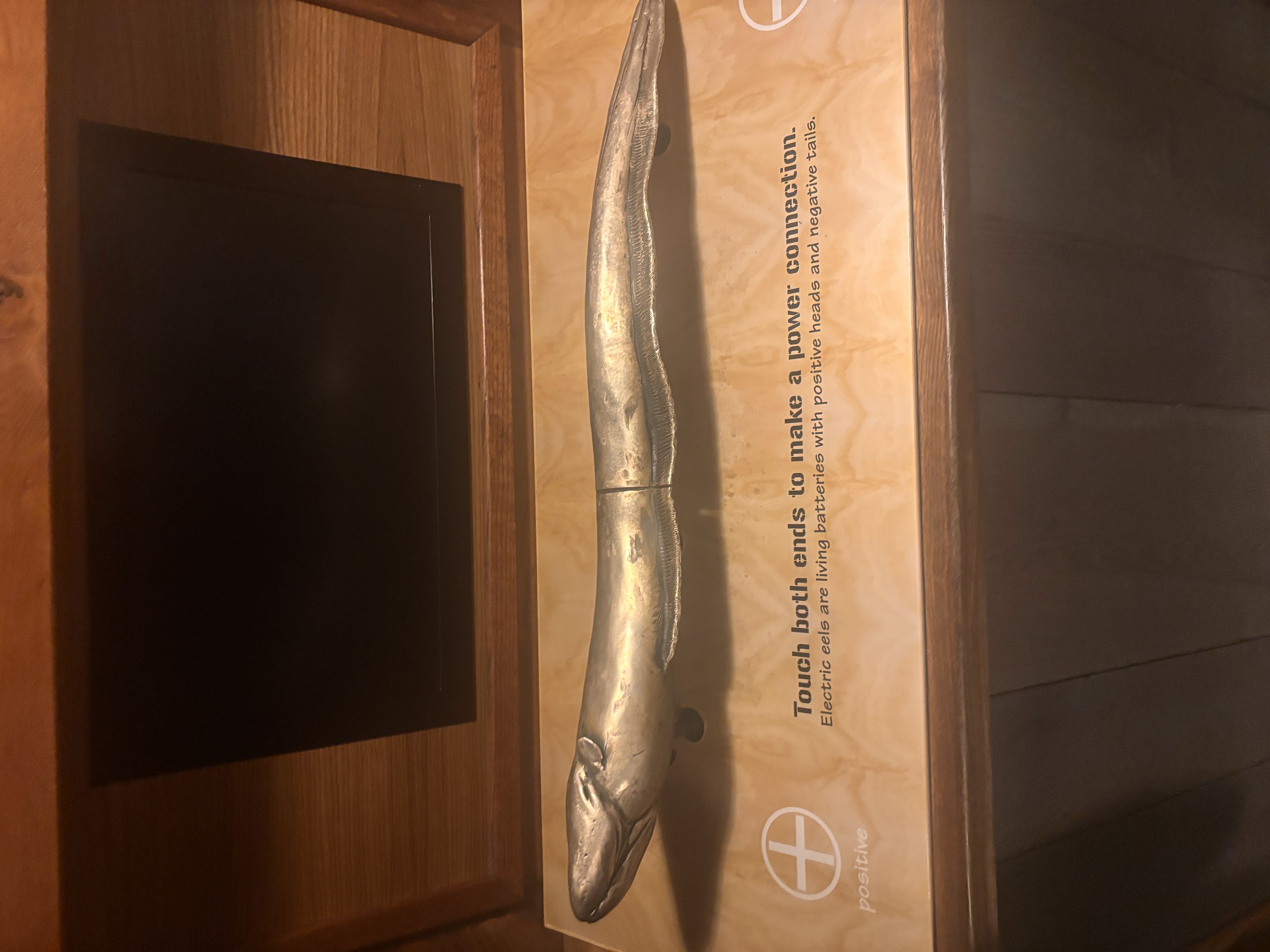
Picture of their interactive replica eel
Small Mammal House
The second house that we went to was the Small Mammal House. Here, most of the animals were enclosed in a room with large glass panels for visitors to see. They'd have a mini replica of their environment, maybe a few trees and rocks, but usually pretty small. They'd have small beds, which I found intriguing because those would very much not be found in the wild. Additionally, one of the fennec foxes I saw was pacing back and forth in their cage, almost as if it were anxious.
- Nonetheless, there were also a variety of species here: foxes, little monkeys, meerkats, and funny-looking moles. Again, their signs would display species name (common/scientific), their habitat, diet, and usually a fun fact about them.
- There weren't too many extraordinary displays in this museum, but there was a wall full of quiz-like Q&A panels. Additionally, there were little skeletons on display to educate on anatomy.
- In this house, I saw lots of younger audiences so I'd say this house would be doing a good job in targeting that audience. Of course, this implies that it was still easily digestible for those who are older.
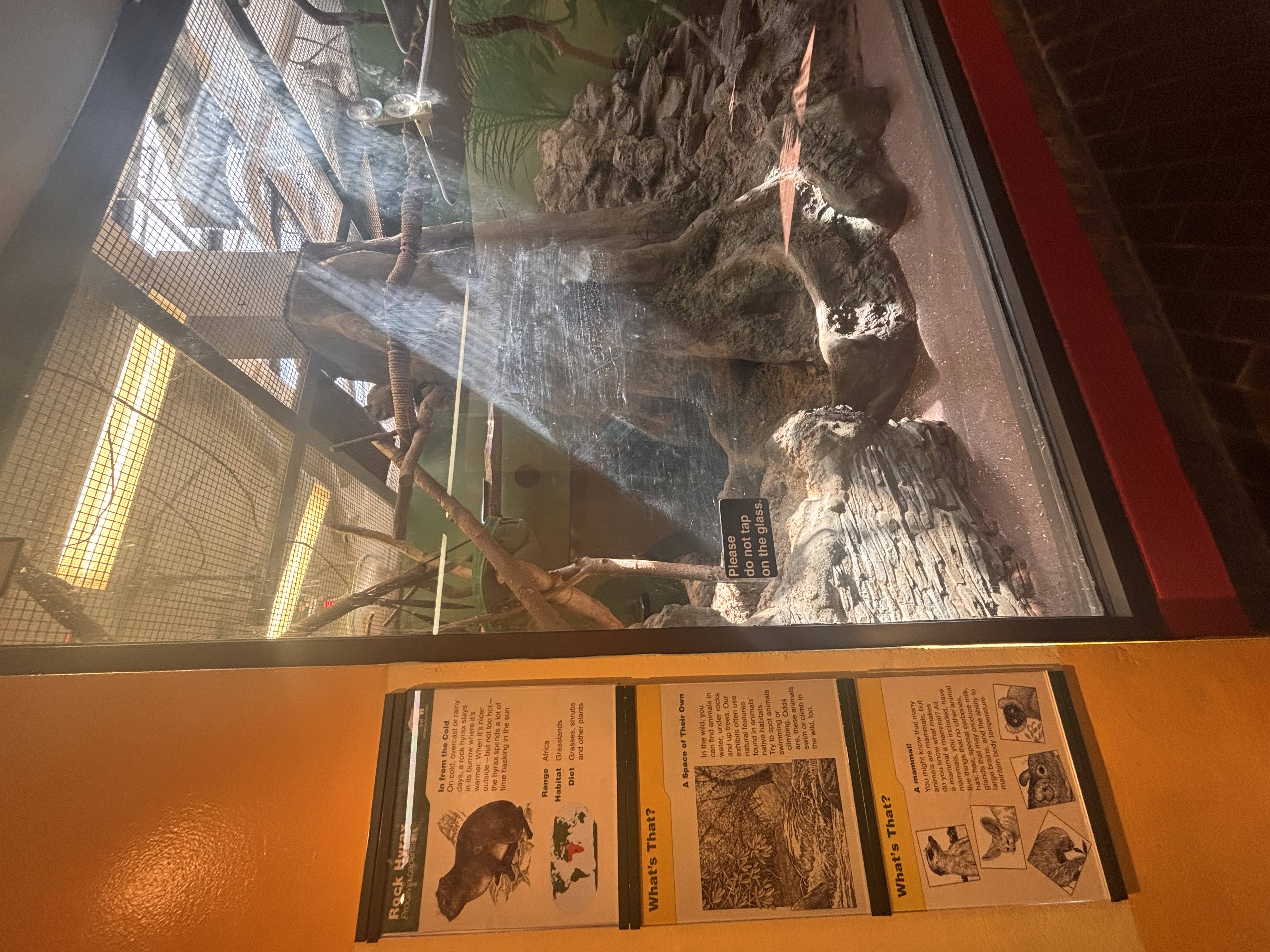
Rock Hyrax Exhibit! You can see them climbing their "trees"
Reptile Discovery Center
Last but not least is the Reptile Discovery Center! I really enjoyed this exhibit (mostly because I found the animals really cool). Nonetheless, these enclosures were a lot more traditional, like the Small Mammal House; there were a lot more interactive displays to educate about these creatures' anatomy.
- The species they had here consisted of turtles, tortoises, frogs, toads, lizards, geckos, snakes, etc. Once again, their signs would include their names, range, habitat, and additionally, any adaptations that they've had. Their signs might also include whether their species is endangered (e.g., frogs).
- Like I stated earlier, there were a lot more interactive displays in this house: skeletons, flippable signs, and even this big display that would show the anatomy of a human compared to a lizard on a large scale (we're more alike than one would think!).
- All of that said, they also had 1:1 replicas of different bones so visitors could get a very full understanding of the scale of their anatomy.
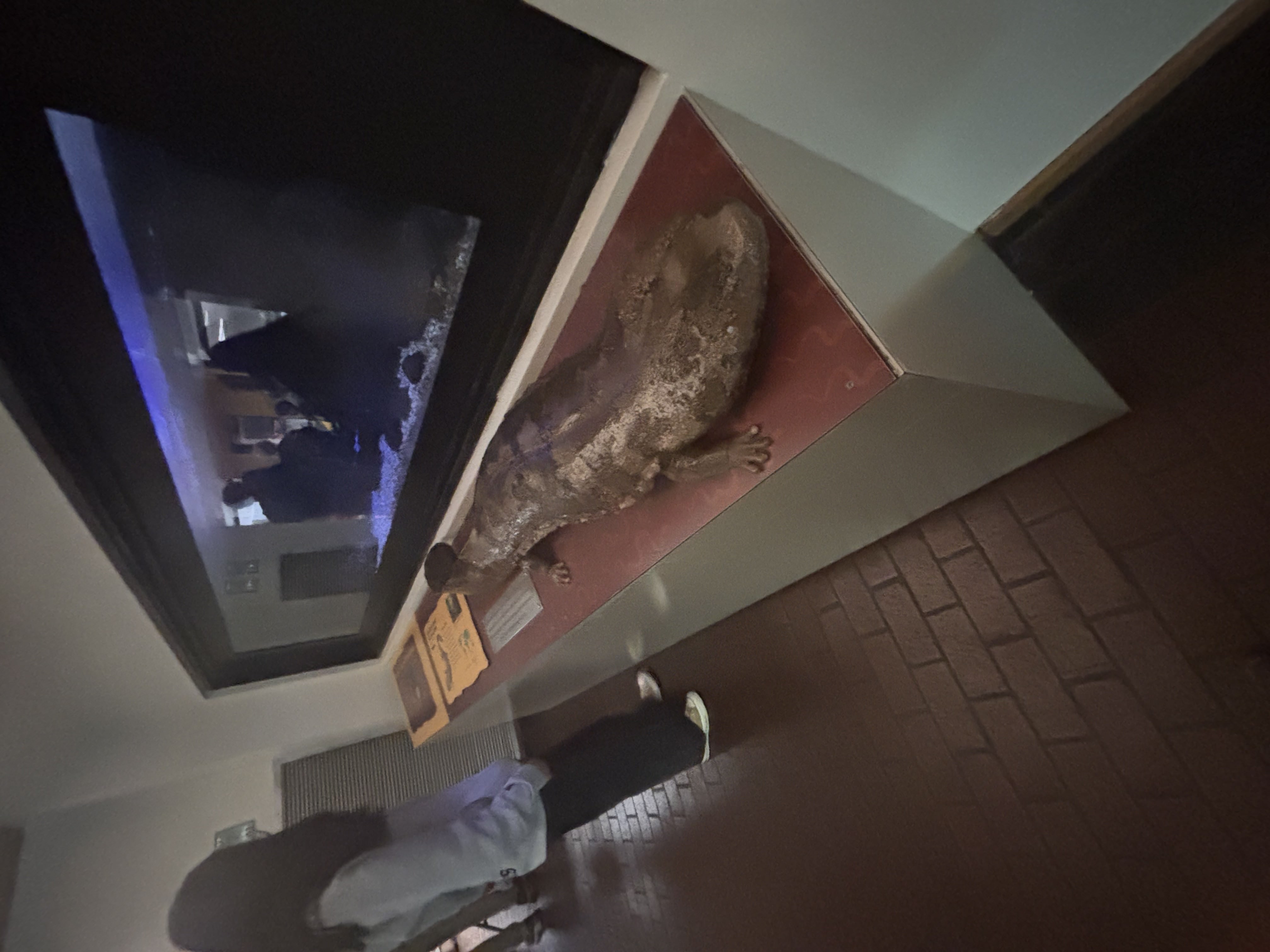
Very big (Giant Japanese) salamander model that puts scale into perspective for viewers
Public Education
Zoos were made for more than just entertainment. As we've seen through this report, signs and interactive displays teach us about each animal's role in their environment and how they behave. However, they also tell us about their conservation and help direct attention to those who need it, e.g., all the animals that might have an "endangered" sticker; the frog enclosures would be a prime example of this.
- I've also described a plethora of animal replicas, skeletons, and models of anatomy. These all create a benchmark for visitors, the public, educating them on how each of these little creatures we would never think about works. These displays provide a more effective education than any single plaque could.
- On the other hand, the Amazonia house really helped capture what animals truly need: space and a more full environment.
- Enclosures like this one help visualize the needs of animals. It shows how reliant these creatures are on their environment, and how we shouldn't get in the way of it.
Animal Welfare
One thing I noticed during the zoo trip was how many exhibits were designed to improve the animals' welfare and make captivity more comfortable. Instead of keeping animals in simple cages just for visitors to see, many habitats included features that allowed the animals to behave more naturally and have some privacy. In the Small Mammal House, a sign explained that animals may not always be visible because they are given places to rest or hide away from visitors. This showed that the exhibits were designed with the animals' comfort in mind, not just entertainment for people.
I also noticed several examples of enrichment added to make the environments more interesting. The fennec fox had a soft resting area, while other small mammals had logs, rocks, bedding, and burrow-like shelters for hiding and exploring. The red ruffed lemurs and golden lion tamarins had elevated branches that allowed them to climb and move vertically, similar to how they would in the wild.
In the Reptile Discovery Center, the black tree monitor had climbing surfaces, and aquatic species like the matamata were kept in habitats with water, rocks, and submerged areas that looked more natural. These features help animals stay active, reduce stress, and express natural behaviors even while living in captivity.
Nonetheless, it would be difficult to not note that a lot of these enclosures were a bit small. But it's good to see that they're making the most of their somewhat outdated building structure.