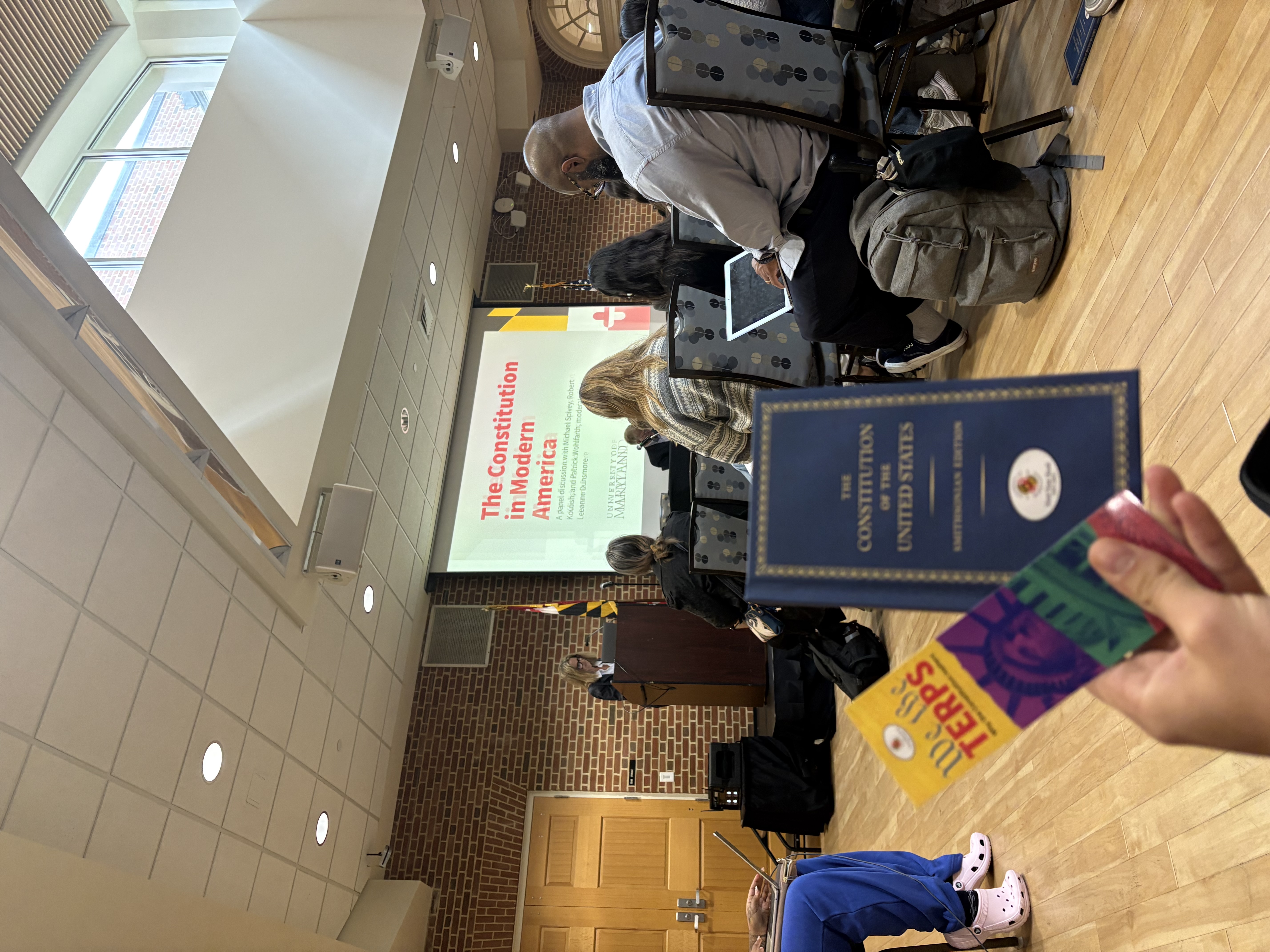


Excursion Report: The Constitution in Modern America (panel discussion)
Date and Location: 1pm - Wednesday, September 17th, 2025 - Stamp Student Union, University of Maryland.
Presenter/Organizer: We The Terps - UMD First Year Book Program
Panelists - Michael Spivey (Senior Lecturer, Government and Politics) and Robert Koulish (Director, MLAW Programs; Director, Justice and Legal Thought, College Park Scholars), and Patrick Wohlfarth, (Professor, Government and Politics), moderated by Laura Anderson Wright (Senior Associate General Counsel, University of Maryland)The panel centered on how the U.S. Constitution both shapes, and is reshaped by, contemporary political and legal debates in the United States. The discussion focused on three major topics: gerrymandering and redistricting, voter identification and registration laws, and the evolving role of Supreme Court precedent in constitutional interpretation. The panel examined how these issues reflect broader tensions in a politically divided America, particularly as demographic changes, technological advancements, and heightened polarization influence both legal battles and public expectations of fairness. On gerrymandering, the speakers explained how modern mapping tools allow state legislatures to draw increasingly precise districts, raising questions about equal representation and the meaning of “one person, one vote.” Voter ID and registration debates were presented in terms of constitutional guarantees of equal access versus the state’s interest in election integrity. Finally, the conversation then shifted toward the Supreme Court’s everchanging constitutional interpretations and how decisions often respond to, and in turn shape, public attitudes. Throughout the event, the panelists remained relatively neutral, emphasizing that these controversies ultimately illustrate a central theme: the Constitution is both a guiding document and a living reference point that evolves alongside a changing nation.
I found the panel’s main points convincing, largely because the speakers approached highly polarized topics with a balanced and historically grounded perspective. Their central claim, that the Constitution is not only shaping political debates but is also being shaped by them, aligns with both constitutional theory and observable political reality. In the case of gerrymandering, for example, the panelists’ explanation that modern technology magnifies partisan incentives is well supported by recent court cases and academic research. The Constitution provides principles of representation, but it does not specify the technical details of district design, creating a vector in which political actors continuously reinterpret constitutional values through their actions. This reinforced the panel’s broader theme that constitutional meaning is rarely static.
The discussion of voter identification and registration laws was similarly persuasive because the panelists framed the issue in terms of constitutional balancing rather than partisan slogans. They presented the legitimate constitutional interests on both sides: the state’s responsibility to maintain secure elections and the citizen’s right to accessible voting. Their emphasis on how courts navigate this tension through precedents, each influenced by the political moment in which it was decided, highlighted how the Constitution becomes a dynamic tool for resolving modern conflicts. This approach avoided oversimplification and recognized the real complexities underlying these debates.
Their points about Supreme Court precedent were also compelling. The panel emphasized that while the Court is meant to be insulated from political winds, it nevertheless responds to shifts in societal values and political climates. Historically, landmark decisions such as those related to civil rights, reproductive rights, and federal power have reflected both legal reasoning and changing national contexts. The panel did not claim this was good or bad; instead, they argued that this interaction is inherent to a constitutional system designed to endure across generations. This perspective resonated with me because it acknowledges the Court’s influence without attributing partisan motives where nuance is needed.
Overall, the panel strengthened my view that the Constitution remains crucial not because it provides easy answers, but because it establishes a framework within which political disagreements can be debated, constrained, and sometimes resolved. I appreciated that the speakers avoided suggesting that constitutional interpretation should be dictated by any single ideology. Instead, they argued that constitutional stability and adaptability must coexist. This is ultimately why the document has lasted, as it sets foundational principles while allowing room for reinterpretation as the nation evolves.
I did not observe any major logical fallacies in the panel’s arguments. Their reasoning was careful, historically informed, and clearly intended to foster understanding rather than political persuasion. By presenting the Constitution as both resilient and responsive, the panel offered a nuanced and intellectually honest perspective, and one that underscores why the Constitution remains essential regardless of political affiliation.