


National Air & Space Museum
650 Jefferson Dr SW, Washington, DC on February 22 from 11 AM to 3:30 PM
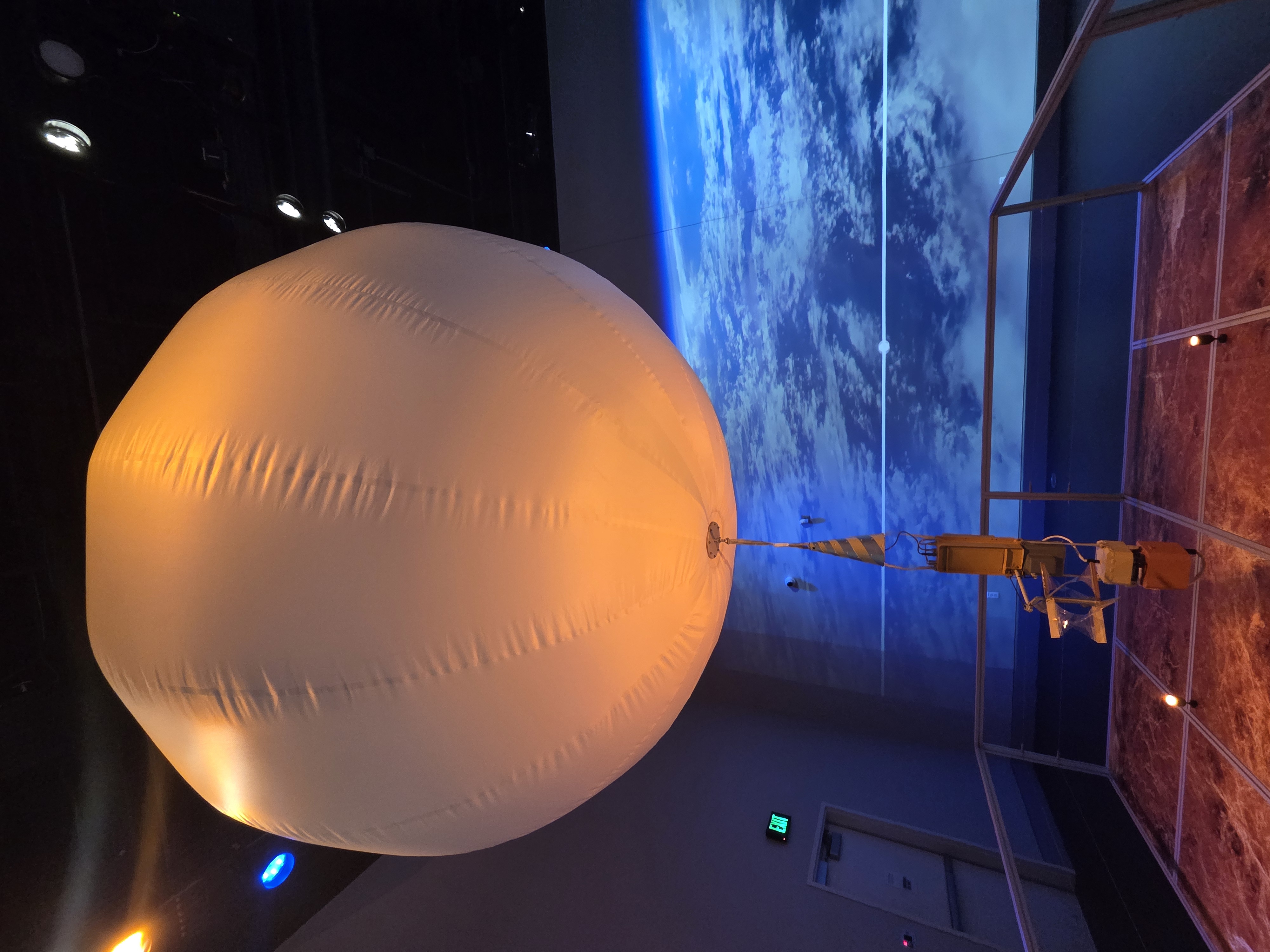
Vega space balloon model
Veering away from the Earth’s environment, the Futures in Space exhibit focused on space exploration and visions about the otherworldly. Science fiction, art, and moral quandaries were brought into discussion in this room. Popular science fiction works were on display, such as a model of R2-D2. This was used to bring into question whether robots could be friends to astronauts, as well as provide supplemental help on their journey, on the subsequent placards. There was a wall of different artworks on display, mostly paintings and some that were sculpted outward from the canvas. One painting that stood out to me was a beautiful, glistening painting of the galaxy in hues of blue, pink, purple, and white, glittered with stars. A repetitive theme throughout the exhibit was to put into perspective other people’s thoughts about space exploration and why they think it is important. I feel that the painting showed how the artist sees such beauty in outer space. There was also a model of a Mars habitat, built into the side of the wall, that you could go into to view a short movie about the future of space exploration. This room certainly had a lot of interactive elements, making me think that it was more catered towards younger audiences. There was a screen that showed three people saying a few sentences about why they think space exploration is important, and one of those people was a middle school kid. Many screens were in that room; there was a wall of various trinkets and multiple screens for people to scroll through the different items to read about what it represents in relation to wanting to go to space. These interactive elements were certainly effective for me because they allowed me to peruse the room at my own pace and learn more about the things that interested me the most, such as a sari in the display of items.
The Exploring the Planets exhibit explored astronomy and honed in on our solar system, focusing on the planets and some technology that was used to view space, as well as technology used to convey messages about space. For example, there was an artifact of the original telegram that was written by Jim Elliot to suggest Uranus has rings. Scribbled on it was a message to urge Dr. Brian Marsden to inform the South African Observatory. There were many display cases like the one containing the telegram, such as a case that contained ways of exploring other planets with telescopes, comparators, and antennas. Another focal point was teaching people the scaling of the planets and the distance between them. On the floor and the ceiling, different examples of the planets speckled the room. The floor allowed you to walk around the solar system; there was even a strip for the asteroid belt. In addition, the room had mock surfaces of planets/moons that encouraged people to touch them. This was to extend the information about the different textures of the planets. With the greater amounts of interactive surfaces, I believe this exhibit was greatly catered to younger audiences, but the depth of the information on placards around the room made it suitable for any audience. There were many other interactive elements to the room, such as a movie in the middle of the room, a movie on the side of the room, and many screens. I would have loved to see a demonstration without the use of screens, such as the displays from Aerospace and Our Changing Environment, as I feel like it would have allowed me to connect with the information better.
The Destination Moon exhibit focused on astronomy and engineering for space exploration missions. However, there were also parts of the extensive room that showed parts of science fiction and mythology to hone in on the importance of space exploration. There were many display cases in this area, such as a case with a large model of the lunar roving vehicle from Apollo 15, 16, and 17. They also highlighted the 1967 Apollo 1 tragedy, where Gus Grissom, Ed White, and Roger B. Chaffee died by asphyxiation from a fire in the electrical circuit. This disaster led to the innovation of design to prioritize the safety of the astronauts in ways such as creating an easier opening hatch. They used placards, a short movie on a small screen, and different designs/models to demonstrate the process of improvement. The upper floor of the exhibit seemed to focus more on the daily lives of astronauts. There was a display of different packages of space food accompanied by the typical menu for missions Apollo 11 to 16. There were dehydrated meals, such as an unfortunate block of tuna salad, as well as drinks. This exhibit seemed to me to be the most well-rounded, as many times I saw adults and kids alike fixated on the same display, in awe. There were interactive elements, such as touchable hand casts for gloves, but not as many as the other exhibits. It would likely be more engaging to implement more hands-on activities, such as a screen allowing someone to simulate what it would be like to eat on board, or something of the sort. I also feel like this exhibit didn’t touch much on recent astronomical concepts, but instead focused on chronological missions in the past.