


American Museum of Natural History
200 Central Park West, New York City on November 22 from 10 AM to 4 PM
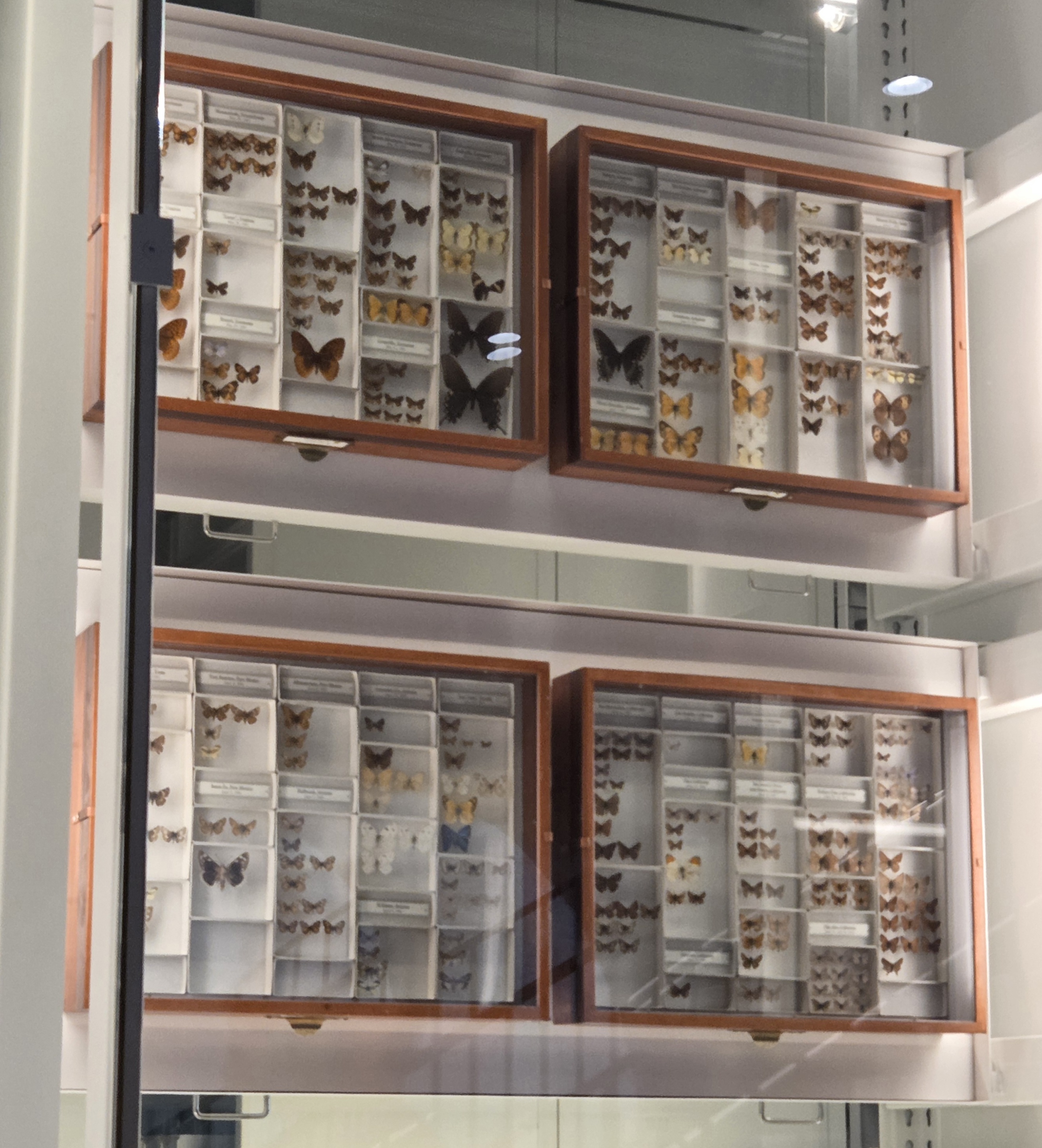
Butterfly collection from Collection's Core
The fossil halls are organized as a cladogram, which shows the evolution and branching of species. This helps categorize species under groups, which helps the museum organize the exhibits as such. For example, Marginocephalians encompass a range of species, such as the Triceratops and the Stegoceras, which are similar due to their common ancestor (they have a bony area at the back of the skull). One of the first displays that Dr. Holtz brought our group to was a cladogram of dinosaurs behind a clear glass screen. It was interesting to learn about the variety between different dinosaurs, as I hadn't had a lot of knowledge about dinosaurs in general. I learned that velociraptors likely had feathers. It makes sense, considering that birds are descended from dinosaurs, but I somehow visualized all dinosaurs having scaly skin similar to crocodiles. I also learned that some dinosaurs, like Pachycephalosaurus, may have used head-butting as a way to assert dominance. This was theorized because of how much space there was for their skull cap in comparison to the small silver that would have been their brain. The museum has some inaccuracies due to newfound knowledge that either disproves previous theories or suggests a more logical explanation. The Allosaurus and the Tyrannosaurus Rex were previously believed to be closely related, so their displays are next to each other. In addition, Velociraptors are depicted as larger than they actually are thought to be. Although regular renovations would lead to information being more up to date, it would be very time-consuming and costly to have exhibits moved. In addition, the museum would have to be closed for long durations of time, decreasing the revenue it would be able to make. However, these updates could be shown through updates in the signs.
Within the Collections Core, there was an area dedicated to fish. There is a technique of clearing and staining, which would make fish flesh transparent. Fish were preserved whole (without being cut open), so the external structure of a fish was maintained while still being able to see the anatomy. This technique is still used, but CT scanning is also used now to view internal anatomy. For amphibians such as toads, after euthanization, the full body is preserved by being kept in jars of ethanol, which prevents decomposition. Vladimir Nabokov, author of Lolita, collected species of butterflies across the United States and organized them by species. This collection was useful in order to demonstrate variance both within species and with other species. In addition, considering the effects of climate change, many butterfly species from his collection can't be easily caught and analyzed currently. His preservation of these butterflies is important to be able to compare populations of the present to the past (1940s). However, the ethicality of preservation is debated in collecting specimens. Although we won't ever have a definite answer, I'd like you to ponder: is it worth it to prematurely end an animal's life and keep it for science? In addition, Nabokov wasn't an entomologist; he just had an interest in lepidopterology. Should it be encouraged for people to collect specimens as a hobby? How does this impact a population on a larger scale?
For a self-guided tour, I went to the Gardner D. Stout Hall of Asian Peoples. This hall was organized by region and the ancient civilization that inhabited that area in a map-like way of a trade route (from north to south, or vice versa). From ancient China, there was a gift to the Emperor Ch'ien Lung in the 18th century. It is an ornate, circular disc of white jade with inscriptions and carvings of 12 different animals, which could correlate to the Chinese zodiac since many of the animals overlap. From ancient India, there was a mural that had many layers of color and depictions of individuals, some recognizable as Hindu deities. Each layer represented a different meaning; for example, the circle of blue in the middle with stripes of various colors signifies caste and karma. From ancient China again, there was a case with samples from the apothecary's pharmacopeia, such as salted scorpions, which were used to reduce fever and pain in teething children. I wish there were more explanation about the cultural significance of the artifacts or how they were created. Some items were thoroughly explained, while others simply had a description of what they were. Although it would be difficult to fully encapsulate the meaning in a way that would fit the allotted spaces, perhaps it would be helpful to have a sign to direct you to how you can learn more about them. In addition, I hoped that there would be an explanation as to how the museum obtained some artifacts, similar to how some exhibits in the Fossil Halls were labeled as donated or funded by an individual or group. As a side note, the depiction of ancient Asian people as semi-realistic but slightly off figures behind a glass screen was unsettling for me and felt somehow out of place. It was also frightening to see that human remains were only recently removed from display. However, it was still informative to be able to get glimpses of different cultures through the artifacts and learn about history.
The Space Show from this year was Encounters in the Milky Way at the Hayden Planetarium. This presented information about the occurrences that led to our solar system's existence, highlighting our galaxy and the formation of our Sun. The images of the stars in the sky seemed to be real images resulting from the Gaia Space Telescope discussed in the show. However, the imagery of the planets and the visualization of our solar system's creation, if we could have seen it from an otherworldly perspective, seems to be designed through computer modeling mixed with special effects. The existence of an Oort cloud that extends around our solar system was information that I didn't know. Other solar systems have this cloud too, and these clouds are in motion, sometimes even colliding with each other. In addition, the Milky Way and a smaller galaxy named the Sagittarius Dwarf Galaxy continuously collided, creating energy that likely prompted the formation of our Sun, as well as many other stars. The depth of space visualized in this fashion exceeded my expectations, and even through the detailed imagery, it is very difficult to conceptualize.
I thought the museum was generally accommodating for a wide range of visitors. Between exhibits, ramps were used to allow for accessibility rather than flights of stairs. When there were stairs, alternate pathways were provided, such as elevators. For people hard of hearing, the planetarium and other videos often had subtitles to correspond with the audio. Lastly, I observed that there were plenty of scattered seating areas, such as benches, which benefit people with difficulty standing or walking for long durations. I would recommend that people visit the American Museum of Natural History in New York!