Jun Ye, Scaling up quantum systems for clock and fundamental physics
December 8th, 11AM ATL2400 UMD Campus
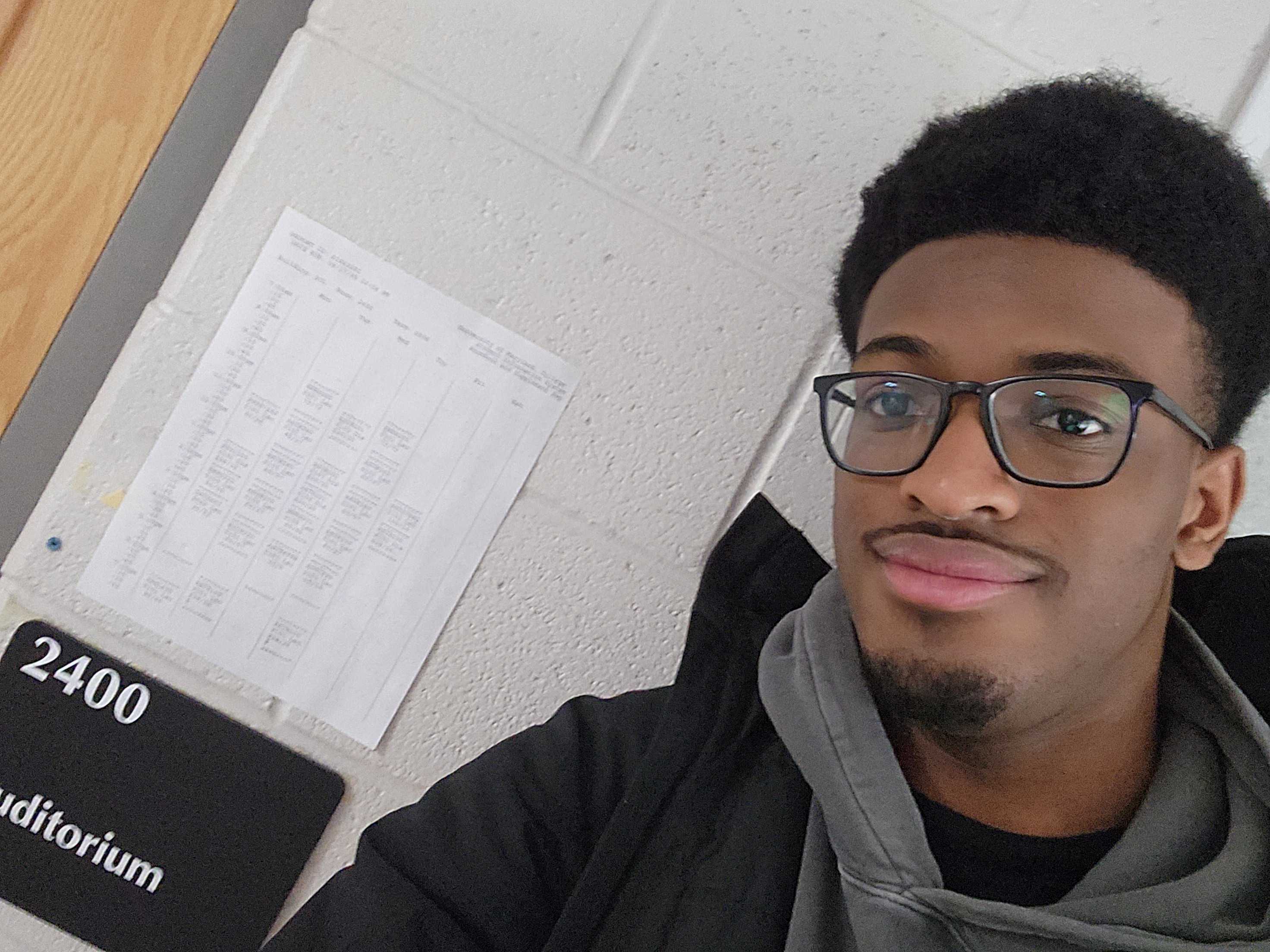
me outside of the room after the seminar, didnt get a chance to take a picture inside
Currently quantum technologies only exist at incredibly small scales. Part of this is that quantum technologies are inherently unstable due to the Heisenberg Uncertainty Principle. Minimizing this randomness is one of the biggest challenges when it comes to scaling quantum technologies upward. In the seminar I attended Jun Ye speaks about the development of nuclear clocks which would be even more accurate than the atomic clocks that exists currently.
Current atomic clocks work by measuring electron energy shifts in the atom, Nuclear clocks aim to measure these energy shifts within the nucleus. This would result in more accurate results than the current atomic clocks of today. The current advancements being made towards nuclear clocks is within the lasers that measure the change in energy levels. NIST has developed the at the time most stable laser in the world which uses a silicon cavity to channel the light. This is important because the main way that the inherently unstable nature of quantum mechanics is to take more measurements to get a good answer. These lasers allow more measurements to be made, and Ye believes that eventually nuclear clocks will beat out their atomic counterparts.
The seminar was very convincing to me though a lot of it came down to trusting that the speakers knew what they were talking about. I do not understand all of the complexities of quantum mechanics but I am aware of the very basics. Jun Ye was introduced as being a very accomplished physicist including receiving a medal of honor from the Niels Bohr Institute. He was also clearly respected by many of the physicists in attendance, some of which I know are experts in their field. This led me to be more trustworthy of him as a presenter as I could not easily discern that from the information alone. I do think the presentation itself did a pretty good job on convincing me of the progress being made in the field. The presentation did a good job of explaining how the technology worked and what their goals are currently, though it did become too heavy on certain examples that were not entirely relevant to the presentation. One thing I thought was uniquely good about the presentation is whenever another set of researchers or physicists were brought up, pictures of them were shown on the board. It is oddly common how many presenters give names assuming you are already aware of them. The presentation did lack many actual pictures of the devices they were talking about like the atomic/nuclear clocks and the lasers used in them, opting instead for diagrams that explained how they work. While diagrams are incredibly useful for understanding the inner-workings of something they should also be paired with pictures so that the audience can get a better sense of what is actually happening in reality. Towards the end Ye spoke a decent amount about the future and how many technologies that would further this field, like lasers fast and stable enough to measure parts of the nucleus, simply don't exist currently. I think stuff like that is incredibly interesting to talk about as it makes me wonder how far away we are from these new technologies and encourages people to look into science for themselves. The presentation did mostly neglect what the actual use cases for nuclear clocks are but I both think that research doesn't need to have a practical application, but also it isn't hard to envision why more accurate measurements of time would be useful as it would be useful for measuring things that happen on the quantum level. Overall the presentation was very interesting and as I am a freshman physics student attending seminars like these gives me a lot of perspective on what I could do in the future and quantum information research is looking very tempting.