


Event name: Principles and Challenges of Controlled Fusion
Event Overview
In this talk, Rajesh Maingi, head of tokamak experimental science at PPPL, presented the fundamentals of fusion. First, he defined fusion as the process of combining small nuclei into larger ones, releasing vast energy. Reactors use Deuterium-Tritium (D-T) fusion rather than the proton-proton chain used on the Sun, because it can be achieved at lower temperatures. A D-T reaction yields 14.7 MeV of kinetic energy, posing major material challenges.
Dr. Maingi discussed that plasmas can be confined in several ways. Across a magnetic field, ions and electrons will move around the field in opposite directions. Gravity on earth is not strong enough to confine these particles, so alternatively, we can do so using intense electromagnetic forces. You can also use lasers to compress a fuel pellet by increasing the density and temperature to induce controlled implosion, generating an immense amount of energy. In controlled fusion, there are three main ways to heat gas up to such high temperatures. The first is resistive heating, which is done by inducing a high current through the plasma. The next approach is wave heating, most effectively performed by radio waves. Lastly, we can heat a plasma with energetic neutral beams. An accelerator portion produces charged particles, which are converted back to neutrals to penetrate magnetic fields and transfer energy to the plasma.
Although not perfect, the circular tokamak allows for better confinement by preventing particles from leaking out. Maingi concluded by highlighting International collaboration on ITER, the largest magnetic confinement project, which aims to demonstrate sustained fusion power at an unprecedented scale.
Analysis of Main Arguments
Overall, I found the main points in Dr. Maingi's presentation to be convincing because they aligned with my prior knowledge of fusion concepts and current challenges in the field. In high school, I conducted a research project on fusion, which focused on using liquid lithium in tokamak reactor walls, especially the diverter region. This talk was a great refresher on the basic concepts of fusion. This included the basic reaction itself, the conversion of mass into energy, plus the processes of forming, confining, and heating the plasma. In the early stages of my research, I learned about these same concepts and approaches to controlled fusion on Earth that were discussed in Dr. Maingi's presentation. Moreover, his emphasis on materials challenges for fusion reactors was especially familiar to me, because I have studied issues such as reactor wall erosion, and other unwanted interactions between the plasma and inner walls. In fusion reactors, the plasma-facing components are prone to erosion, particle migration, thermal wear, and radiation damage due to prolonged exposure to plasma. These issues are precisely due to the heat and radiation within the fusion plasma that Maingi discussed in the Zoom talk.
In addition to supporting my previous understanding of fusion, Dr. Maingi expanded on certain nuances in fusion energy research, especially in the question-and-answer portion of his talk. For example, someone in the audience was curious how artificial intelligence will be implemented in fusion technology. Dr. Maingi explained that today, ML models are increasingly used to analyze plasma diagnostics and predict future experiments by interpolating and extrapolating from data sets. AI can also aid in control systems by warning when the reactor is approaching danger points and prevent disastrous damage. This particular discussion highlighted an exciting frontier in fusion research that I have not deeply explored yet.
What I found most compelling was the depth of engagement in the Q&A. I asked about the advantage magnetic confinement fusion (MCF) has over inertial confinement fusion (ICF) moving forward. Dr. Maingi explained that although ICF can currently achieve a net energy gain of 8:1 over MCF's 1:1, he explained that MCF's power output and efficiency will inherently increase as you increase the reactor size on a scale similar to what ITER will be. Furthermore, MCF reactors such as tokamaks are more suitable for sustained commercial operations. ICF reactors cannot perform the amount of repetitions necessary to power the energy grid due to the damage that one session causes to the reactor.
As I participated in Rajesh Maingi's presentation, I did not observe any logical fallacies or failures of critical thinking. All information was presented with scientific reasoning, and he also addressed uncertainties and areas for improvement in fusion. These points strengthened his credibility as a presenter. Based on my research experience, I agreed with his optimism about the future scalability of MCF, though I am aware that many argue that the commercial viability of fusion energy is still decades away. Ultimately, this presentation strengthened my confidence in magnetic confinement's feasibility while also talking through the enormous engineering and physics challenges that remain.
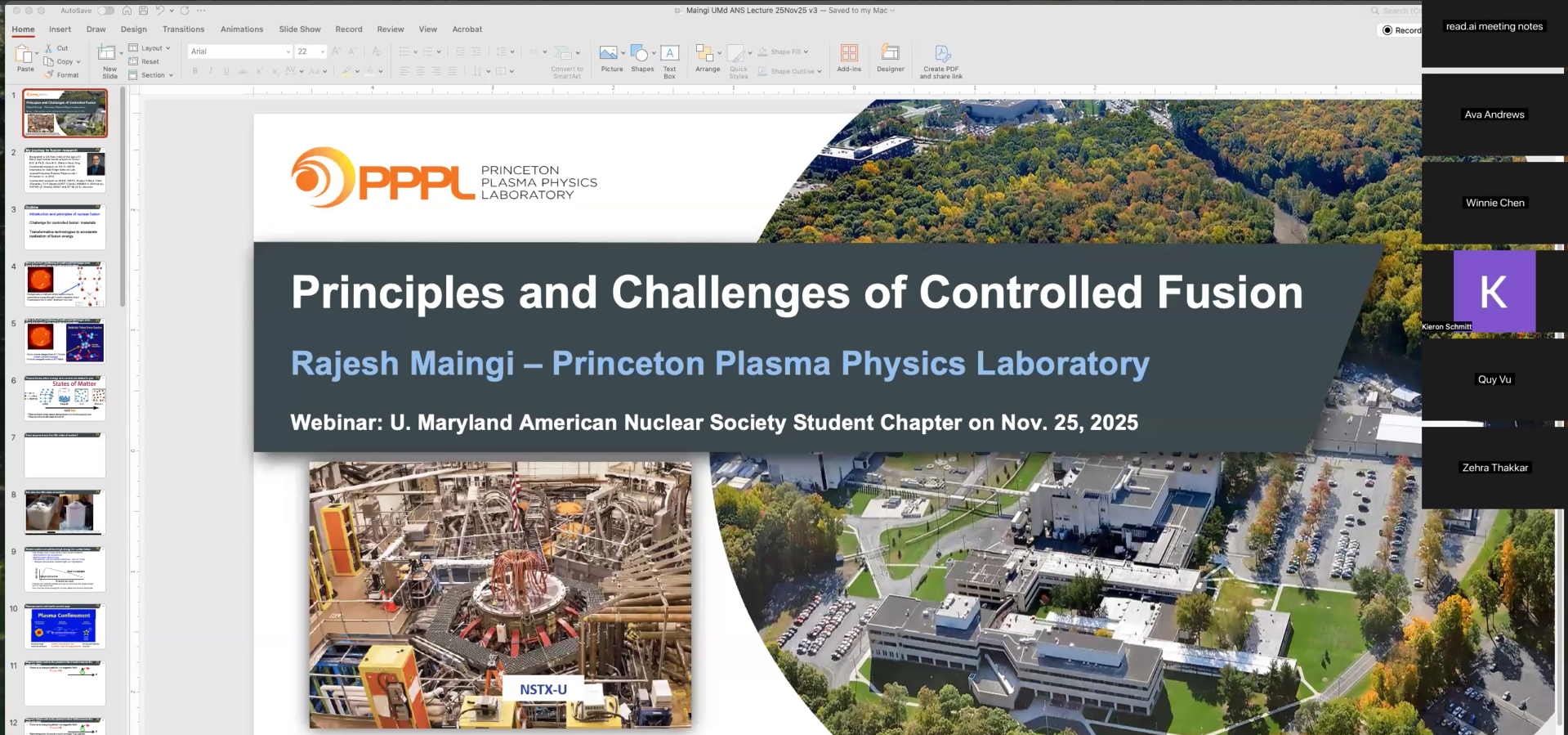
Title Slide of the Webinar