Novel Module 10: Open Choice

Assignment:  Choose one American novel published between 1914 and present that you would most like to read next in the contexts of  this course.  I am aware that you will not have time to read the novel this semester but ideally it would be your first summer reading book.  To meet this this requirement, after you have carefully selected your book according to your educational goals and personal interests.  E-mail back one paragraph to me the following information: novel title; author; date of publication; general subject of the book; the setting (time and place); narrative point of view; and most important, your reasons for selecting it--how it fits in with this course and your interests.  Your selection does not need to be unique: many students may select the same novel.  Be brief (the email will be posted on a page much like this one with everyone's choice); write well but relatively informally (your audience is the rest of the class).  This assignment is required but ungraded.  You may submit your selection at any time, but the final due date is Tuesday, May 13th.  Hand-in via email: cbarks-at-fitzgeraldsociety.org

Your Choices

Aziz Ahmad:  For my open choice I have selected Interpreter of Maladies by Jhumpa Lahri (1999).  One thing I have noticed in our read of modern American lit is that all books fundamentally describe a migration of the mind - a search for identity.  And for the most part this requires some inner definition (which involves primarily young males without family).  I'm inspired by these works, but find myself nodding more with works like Caramello, in which the family is important.  I think the migration for identity is uniquely different for some minorities.  So - for my open choice I have chosen a female first generation American (of Indian origin).  The book is actually a collection of short stories, all linked to the issue of minority vs. majority perception.  The stories take place mostly in the New England area.  So far it's great. Other recommendations: Joseph Heller's Something Happened (about the middle aged successful post war family man, and how life is unfulfilling.  Great work.  Nothing like Catch-22).  Also try Milan Kundrea's The Unbearable Lightness of Being.  

Ula Lukszo:
  As my next American novel, I would like to read Michael Cunningham’s 1998 novel The Hours . I really love contemporary American novels and I recently saw the film based on the novel, so I was intrigued. As a creative writer myself, I was especially intrigued by the large-scale challenges Cunningham sets for himself in this novel: recreating Virginia Woolf’s life, creating a modern-day version of Woolf’s masterpiece Mrs. Dalloway, as well as incorporating three different time periods, places and plot lines into one. The movie of course has many advantages, such as visual montages from all three plot lines, to aid it in the interlacing of the three different central female characters. I would like to see how Cunningham manages to do all of this in only 240 pages. Also, I found the film riveting and moving. We’ve talked in class about finding a book like Fight Club that could speak to women in the same way that that Fight Club does to men. For me, the film was as powerful as perhaps Fight Club was for my male friends.  I felt that I could relate to what the characters were going through as women, as writers, as human beings and I’m interested to see how it translated from the text to the screen.
 

Kelly Baker:   I want to read The Amazing Adventures of Kavalier and Clay by Michael Chabon, published in 2001.  It takes place in Brooklyn, NY between 1939-1954.  Written in third person, it touches upon the glory years of American comic books.  Specifically, it tells of the adventures of the cousins Sammy Klayman and Josef Kavalier.  I chose this book because I have heard nothing but wonderful things about it.  I have been told that the plot is unpredictable and the writing is so carefully crafted that you can't help but stop and examine each sentence.  I think this will an interesting read because it was written so recently and is so highly praised.

Anne Koroknay:   Alvarez, Julia How the García Girls Lost Their Accents . New York: Penguin Books, 1991.
After reading Caramelo and House on Mango Street by Sandra Cisneros, I became interested in reading more novels by Hispanic-American authors.  In an interview of Cisneros, she claims that she finds inspiration from her peers- one of whom is Julia Alvarez, a fellow contemporary, Latina author.  I have always been interested in multiculturalism and works of literature by minority authors.  Therefore, I wish to read (possibly this summer) Julia Alvarez’s novel How the García Girls Lost Their Accents.  It is the story of four Dominican girls who immigrate to New York City in 1960 and how they grow up amidst a world very different from the little island nation they left behind.  Alvarez’s novel is a collection of vignettes—each told by one of the García sisters, but Yolanda is the primary narrator—which begin in their adult lives and skip back into time as they assimilate to life in America and their early childhood lives in the Dominican Republic.  In a review from the School Library Journal, the novel is characterized as “interconnected vignettes of family life, resilience, and love are skillfully intertwined and offer young adults a perspective on immigration and families as well as a look at America through Hispanic eyes” (Amazon.com).  I look forward to reading this novel and learning more about the immigrant experience in America.

CHOOSING FAULKNER  

Robin Shutinya :I have selected As I Lay Dying by William Faulkner. As an English major with a concentration in American Literature, I'm practically ashamed to admit I have never read a work by William Faulkner before. I have heard countless teachers remark on the influence and importance of Faulkner in relation to the American novel and "House of Fiction", and think the open choice novel selection is the perfect opportunity for me to finally experience his writing. Amazon.com comments on Faulkner's "distinctive narrative structures-the uses of multiple points of view and the inner psychological voices of the characters," as well as basically describing the plot: "the members of the Bundren family must take the body of Addie, matriarch of the famil, to the town where Addie wanted to be buried. " I look forward to reading As I Lay Dying, and comparing Faulkner's work to the work of his peers like Hemingway and Fitzgerald, both of which we have read in class this year.

Bonny Busch:At the risk of sounding completely unoriginal, I also plan on reading Absalom, Absalom! by William Faulkner (1936).  The book opens in 1833 in Mississipi, and is a story about the "founding, flourishing, and decay of the plantation of Sutpen's Hundred, and of the family that demonic Thomas Sutpen brought into the world a generation before the Civil War" (Amazon.com).  I have never read Faulkner, and I knew all semester that I wanted to read something by him.  There is so much of the American literary canon that I have not yet been exposed to, and Faulkner is an author that I feel, as an English major, I need to be familiar with.  The title of this book intigues me, and a book review on Amazon.com says that Absalom, Absalom! is William Faulkner's major work--his most important and ambitious contribution to American literature."  Sparknotes.com adds that it is "perhaps Faulkner's most focused attempt to expose the moral crises which led to the destruction of the South."  I am looking forward to discovering Faulkner for the first time this summer.

Mike Rosolio: drum roll please...The next American novel I plan to read is Absalom, Absalom! by William Faulkner (1936).  It tells the story of a family's slow collapse which mirrors the descent of the once proud South following the Civil War. Absalom, Absalom! explores every aspect of American life during the 19th century, including racism, patriotism, gender relations and class struggle.  The story is told through different points of view and explores the full boundaries of the human mind, exposing similarities between people that might otherwise be overlooked.  The book is an experiment in form and, in the words of a professor I once had, reading a page of Absalom, Absalom! is like eating a gallon of ice cream.  I look forward to the challenge and experience of reading this novel.

Meg Hunter:  I plan to read William Faulkner's Absalom, Absalom! (1936) as well.  The novel is about an old legend about Thomas Sutpen , who tries to make something great in Jefferson, Miss, but ends up destroying it with his sons.  The narrator , Quentin Compson , is obsessed with the story and the Old South.
In high school, I loved reading As I Lay Dying and had to research it, Yoknapatawpha County , and Southern Grotesque literature.  Somewhere in my research I came across this story: two literary scholars/critics were talking, and one mentioned to the other that he had never read "Absalom.."  The other critic, who had, was jealous because he would never get the chance to experience the pleasure of reading it for the first time, like this other critic would. The fact that someone would be jealous that anohter person (like me) had the opportunity to read the book for the first time always stuck in my head, and I figure I deserve a little literary treat.

Alec Boyajy:  I will be reading William Faulkner's Absalom, Absalom (1936) . I've read and enjoyed The Sound and the Fury and As I Lay Dying, so my keen logical sense and uncanny ability to detect patterns both tell me that Absalom, Absalom is a pretty safe bet. The novel tells the story of the Sutpen family as they arrive, conquer, and then destroy themselves in Mississippi in the 19th century. I like this type of universal, human nature theme, and am confident that I will really enjoy the book. If any other students are considering reading Faulkner, let me say that based on my rather limited experience, he is a pretty tough read. However, if you force yourself to stick with it and read it slowly (taking notes might help), you will definitely be rewarded when you get through it.
 
Kelli Herod: I’ve managed to go through my entire academic career without reading any Faulkner, but I’ve always remained curious about what’s in store for readers of his fiction. I chose Faulkner’s The Sound and the Fury for my open choice novel because it’s a book that I’ve always heard mentioned among the greatest literature of the twentieth century, but have not yet had the chance to read.  After reading a bit about him, I’ve learned that Faulkner is known for his “highly experimental style” which has helped to label him as “one of the greatest novelists of the twentieth century” (SparkNotes.com). He is also known for his use of stream of consciousness, a narrative technique that I would like to learn more about. In The Sound and the Fury, the decline of a once-successful family is detailed through the thoughts, opinions, and tales of the family members. It is often seen as a challenging book to some of its readers because of the switching that occurs between past and present events. However, this is challenge I am willing to undertake in order to further understand the outstanding reputation that both the book and the author have received. I am also eager to see for myself what it is that Faulkner specifically contributes to American literature.

  **************************************************  


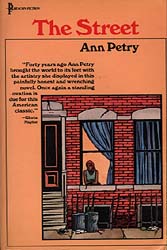
      The women work because the white folks give them jobs -washing dishes and clothes and floors and windows. The women work because for years now the white folks haven't liked to give black men jobs that paid enough for them to support their families. And finally it gets to be too late for some of them. Even wars don't change it. The men get out of the habit of working and the houses are old and gloomy and the walls press in. And the men go off, move on, slip away, find new women. Find younger women.   --from The Street

Eric Hirsch:   The Street, by Ann Petry, published in 1946 , is set in the North during the 1940’s.  It tells the story of a single black mother’s struggle to survive the racism in the United States.  Lutie Johnson, the protagonist is very smart and capable but still attributes the hardships she endures to the whites oppression of the blacks.  For a year during High School, I became intrigued by the phenomenon of slavery and racism.  I read countless books on the topic, but never got a chance to read The Street.  After reading Invisible Man, my interest was peaked once again.  The narrator in Invisible Man seems to be similar to that in The Street. They are both marginalized members of society, but come from a different perspective.  While the first book I read this summer will be Black Like Me, I look forward to reading this novel to gain an even broader sense of the post slavery struggle of blacks in America.

 
      "As a writer, Petry revealed her knowledge of how the interconnections of race, gender, and class can shape tragic experiences for both blacks and whites, and showed her desire to represent blacks in all of their humanity and complexity. Critics have attempted however, to enclose her in the narrow space of the naturalistic tradition. She has overcome this through her writing, exposing the limits of naturalism by creating a narrative space to fit her unique perspective of telling not only one story of black oppression, but telling many stories of black survival."  --from Voices from the Gaps  

Kristen Teraila: I have chosen Tender Is the Night by F. Scott Fitzgerald .  Ever since reading The Great Gatsby several years ago, I wanted to pick up another Fitzgerald novel and this one was recommended to me by a teacher.  It has been sitting on my bookshelf in the “to-read” pile but I have yet to get around to it.  I was glad for this opportunity because it will make me finally read it. This novel fits in with our class themes in that it is a story about Americans who don’t believe in the American dream anymore and move off to Europe.  It fits into my personal goal of learning more about Fitzgerald.  Amazon says:   Set on the French Riviera in the late 1920s, Tender Is the Night is the tragic romance of the young actress Rosemary Hoyt and the stylish American couple Dick and Nicole Diver. A brilliant young psychiatrist at the time of his marriage, Dick is both husband and doctor to Nicole, whose wealth goads him into a lifestyle not his own, and whose growing strength highlights Dick's harrowing demise. A profound study of the romantic concept of character -- lyrical, expansive, and hauntingly evocative . . . Of all his novels, Tender Is the Night is the one closest to Fitzgerald's heart.


CHOOSING Vonnegut and Heller

Influential Novels emerging from World War   II

Andrew Gretes:  I'm going to read Kurt Vonnegut's Slaughterhouse Five (1969) for my open choice novel.  Basically the novel is the story of Billy Pilgrim who is Kurt Vonnegut and is trapped inside the fire bombing of Dreden during WWII.  I want to read this novel because it has been recommended to me on many occasions from my Mom and from friends who rave over Vonnegut's maddening writing.  Since I did my final paper on writing styles and tools of Ellison and Palahniuk, I figure analyzing the style of Vonnegut will be interesting in comparing him to two authors I have done a fair amount of research on.

Romney:  For my open choice novel I am reading Kurt Vonnegut’s Slaughterhouse Five (1969). After doing research for my term paper, I came to realize that this books embodies the traits common in American existentialist literature perhaps moreso than any other novel.  I had never read it, so I figured now was as good a time as any.  I think I am also going to attempt to finish _Infinite Jest_ by David Foster Wallace.  I've started it so many times but I can never seem to get past the 500-700 page mark so I am officially making it my goal to finish that book soon.

Mark Baxter:
For my open choice novel I have chosen Joseph Heller's Catch-22 . It is a novel that has always intrigued me, yet I have never been able to read the complete version in a literature class. This has surprised me, given the acclaim that it receives for its take on the horrors and insanity of war. The story takes place through the eyes of a bombardier, Yossarian, who offers commentary on the continuing war and his inability to become distanced from it. The comment I hear most about it is the humor that is used to parody the situation and show the insanity of the events surrounding Yossarian. Amazon describes it as a period piece, and I feel that it would have definitely fit into our reading of Hemingway. I think it would have been interesting to compare the two novels, to examine the similarties and differences on how they viewed two different wars. This is a novel  that is still widely read today and is considered a classic of American literature.

Brian Robb recommends (and so do I) Joseph Heller's Catch-22   (novel 1961; film 1970): "A protest novel underscored with dark humor, Catch-22 satirizes the horrors of war and the power of modern society, especially bureaucratic institutions, to destroy the human spirit.WW II."  To read an interesting interview with Joseph Heller & Kurt Vonnegut, click on Joe and Kurt .  Heller's novel, like Vonnegut's Slaughterhouse-Five , has been highly influential  in the American novel's postmodernist (roughly post 1960) period.

*************************************************************************************************************

Tricia Willard:  The novel I have chosen is Ishmael by Daniel Quinn.  My friend heavily recommended it to me a few months ago, so I started checking it out on Amazon.com.  I was surpised to learn it was about a gorilla who somehow learned how to communicate and philosphize about humanity, which would normally turn my interests away from reading the novel.  Also, the first review from the Literary Journal didn't have all that many good things to say about it either.  However, the customer ratings were very high!  It just makes me wonder how can this book--about a talking gorilla--be so good.  To those customers, the novel was profound and mind-altering and it changed their perception of their universe, basically.  Very intriguing.  I'm not quite sure that it will do the same for me, but maybe I'll be surprised; I'm up for the challenge.
*************************************************************************************************************
 
CHOOSING Egger and Wallace

Aalap Dave:  I plan on reading You Shall Know Our Velocity by Dave Eggers .  I think Eggers is one of the most fresh and intriguing writers of our time.  This is Eggers first novel--he became well known for his memoir Heartbreaking Work of Staggering Genius.  I read Eggers' memoir last summer, and it single-handedly shifted my reading focus to contempory American authors.  Heartbreaking Work of Staggering Genius was an astonishing debut and I think the reason I loved it so much was because I'm not sure anyone has told such a horrific story (both of his parents died from cancer about a month apart from each other and he was forced to take custody of his little brother) with such an unassuming air.  Eggers uses his sense of humor and his uncanny writing style to present the audience with a piece of literature that is truly staggering.  Eggers created one of the best non-fiction novels I have ever read, so I am interested to see what he can bring to the realm of fiction with his newest novel.  I bought a copy and I already know that it is going to be a great novel.  What I like so much about his new novel is that the story begins right on the cover.  The opening paragraph is printed right on the cover and there are no pages inside with the title and the publisher's information.  I do not think that You Shall Know Our Velocity is going to be better than Heartbreaking Work of Staggering Genius but I do think it will serve as a great fictional companion to his previous nonfiction work.

Mike Rosolio suggests:
Infinite Jest by David Foster Wallace. Reviews say: "Infinite Jest bends every rule of fiction, features a huge cast and multilevel narrative, and questions essential elements of American culture--our entertainments, our addictions, our relationships, our pleasures, our abilities to define ourselves"; "So brilliant you need sunglasses to read it, but it has a heart as well as a brain. Infinite Jest is both a vast, comic epic and a profound study of the post-modern condition."

Dr. Barks : I plan to read two novels next: Dave Egger’s A Heartbreaking Work of Staggering Genius ( 2000) and David Foster Wallace’s Infinite Jest: A Novel (1996).  I am interested in reading innovative contemporary fiction and interested also in reading current novels that my students are enthusiastic about. A Heartbreaking Work appears be a non-fiction novel—in this case, a memoir and metafiction novel—based on Egger’s experience at the age of twenty-two when his parents died of cancer within a few months of each other and he become his kid-brother’s guardian. It’s also about being a young man in America during the 1990s, and shines a satiric, ironic light on many aspects of our culture.  Similarly, Amazon states that Infinite Jest is “[e]qual parts philosophical quest and screwball comedy . . . it bends every rule of fiction, features a huge cast and multilevel narrative, and questions essential elements of American culture--our entertainments, our addictions, our relationships, our pleasures, our abilities to define ourselves”; therefore, this novel certainly fits in with our course themes.  Furthermore, Eggers and Wallace are noted to be the literary descendants of John Barth, the well-known novelist and creative writing teacher at Johns Hopkins U, who has been one the leading postmodernist writers and thinkers of the last decades.  These novels have been highly recommended to me this semester by members of this class, and I think that reading them together will strengthen my knowledge of contemporary fiction, which is a goal I’ve set.

Previously Posted Suggestions

Karen Perolman
suggests Douglas Coupland 's Shampoo Planet (1992)--"Laughing at disaster, Coupland's post-post-baby-boomers rationalize the culture of constant change, self-reinvention, and immediate gratification ." --Kirkus Reviews

Emily Adamo is interested in the new genre of the Graphic Novel and suggests Dan Clowes   Ghost World . Reviews say: "Ghost World avoids all the clichés of the gen-X genre, presenting a melancholy, affecting portrait of two teen-age girls, best friends whose intertwined lives afford them a certain sanity, while the threat of separation brings home the tenuousnes of their shared reality."

Other Suggestions

 back to top
 syllabus
 home